
In Prince Edward Island, the answer to “how much and how often” depends more on soil type and the cool Maritime climate than on a fixed calendar. Most vegetable and flower gardens need roughly an inch of water a week, delivered in one or two deep soakings rather than daily sprinkling, adjusted for soil texture and whatever the sky already provided. Local watering restrictions, when they exist, come from your municipality or water utility, not the province as a whole.
How much, how often

The single biggest mistake in a PEI garden is watering a little bit every day. Shallow, frequent watering trains roots to stay near the surface, where they dry out fast and cook in the first real heat spell. A deep, infrequent soaking pushes roots downward, into soil that stays cool and moist longer, so the plant can tolerate a dry stretch without wilting the moment the sun comes out.
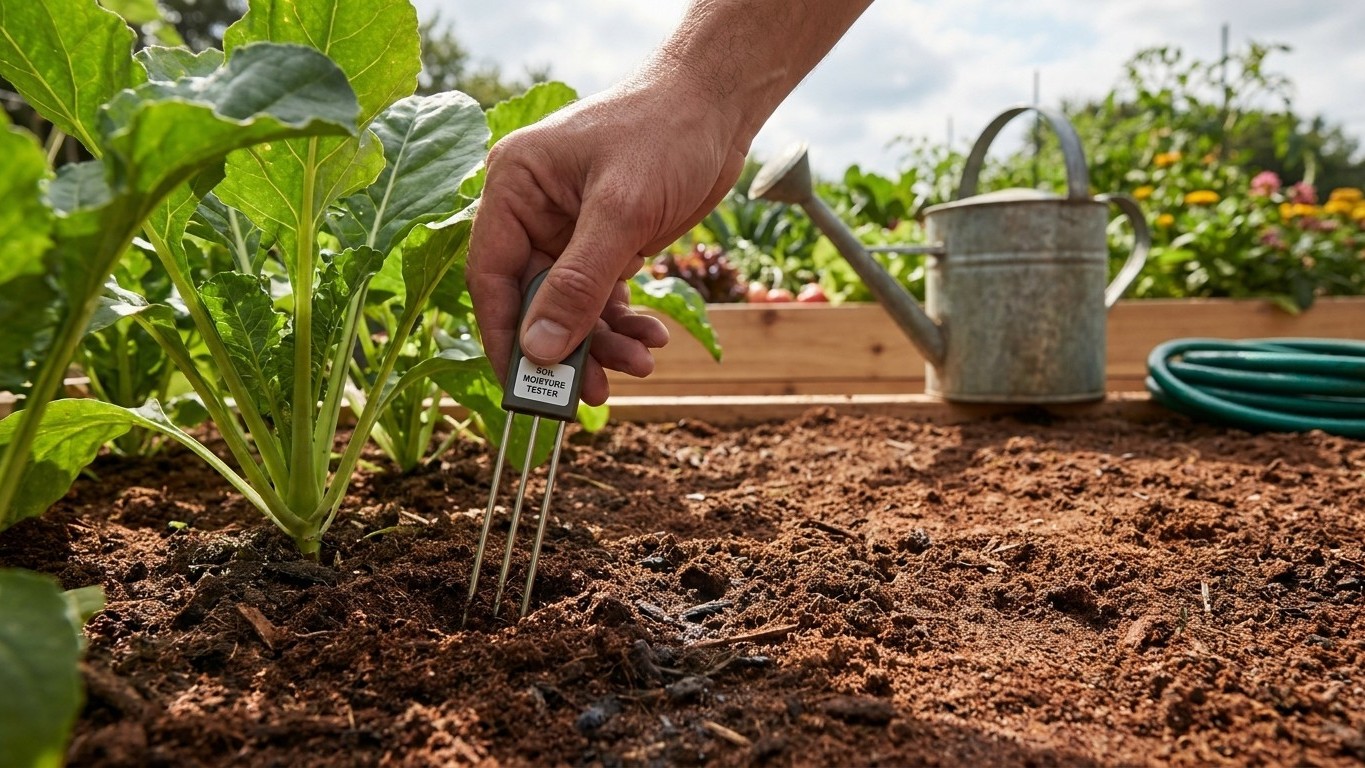
The trick is knowing when the soil is actually dry at root depth, not just dry on top. Push a finger or a trowel two inches into the ground near the plant’s base. If it’s still cool and damp, wait. If it’s dry and crumbly at that depth, it’s time to water. This simple check beats any watering schedule printed on a seed packet, because it responds to what’s actually happening in your yard that week, not to an average.
Match the method to PEI’s ground and climate
Soil texture changes everything here. The reddish sandy loam common across much of the Island drains quickly and holds relatively little water, so beds in this kind of soil often need shorter, more frequent soakings than a clay-heavy plot would. Where soil runs heavier and holds water for a week or more, the opposite problem shows up: watering before the ground has actually dried invites root rot, and working or soaking heavy, wet soil compacts it, squeezing out the air roots need. Test before you water, every time, rather than watering on autopilot.
Prince Edward Island’s cool summers also change the math. The Charlottetown reference station averages 0.0 days a year above 90°F, which means the intense evaporative demand that drives daily watering in hotter climates almost never shows up here. Gardens on the Island generally need less frequent watering than the same bed would in a hot-summer state, provided the soil has had a chance to soak in whatever rain does fall. Deep soaking a couple of times a week, checked against the finger test, covers most PEI gardens through a normal summer.
Here’s a dependable sequence to follow:
- Check soil moisture two inches down with a finger or trowel before deciding to water at all.
- Water early in the morning, so foliage dries quickly and less water is lost to midday evaporation.
- Aim the hose or watering can at the base of the plant, keeping water off the leaves to limit fungal disease.
- Apply enough to soak the top six to eight inches of soil, roughly an inch of water in one session for most vegetable beds.
- Skip the next scheduled watering if the soil is still damp at root depth, and re-check in two or three days instead.
Restrictions and rules
Watering restrictions are common across Canadian municipalities during dry spells, and they change from year to year and even week to week depending on reservoir and well conditions. Prince Edward Island has no single province-wide watering ban that applies to every garden, but individual municipalities and water utilities can and do put limits in place, particularly on hoses, sprinklers, and lawn irrigation during hot, dry summers.
The only way to know what applies to your address this season is to check with your local water utility or municipal office before you set up a timer or an automatic sprinkler system. Rules can specify which days of the week outdoor watering is allowed, restrict watering to early morning or evening hours, or ban sprinkler use entirely while allowing hand-watering with a can or hose nozzle.
Because Prince Edward Island’s summers are cool and its recorded days above 90°F sit at essentially zero, the pressure that drives the strictest restrictions in hotter regions, mass lawn irrigation during heat waves, is less common here. That doesn’t mean restrictions never apply. Dry stretches still happen, and local supply conditions, not just temperature, drive many municipal decisions. For agricultural and horticultural guidance specific to the province, the Prince Edward Island agriculture department is the right starting point, and it’s worth a check before a dry summer sets in, not after restrictions are already posted.
Using less
Cutting water use in a PEI garden doesn’t mean watering less carefully. It means making every gallon count, which matters even in a cool, generally moist province, because dry weeks still happen and every plant recovers faster when the soil around it is already holding moisture.
- Mulch, two to three inches deep: a layer of straw, shredded leaves, or bark around the base of plants slows evaporation dramatically and keeps the soil at root depth cooler and damper for days longer between waterings.
- Drip irrigation or soaker hoses: delivering water directly to the root zone instead of spraying it into the air cuts losses to evaporation and wind drift, and it keeps foliage dry, which lowers disease pressure in the Island’s humid summers.
- Group plants by water need: putting thirsty vegetables like lettuce and squash in one bed and drought-tolerant perennials in another means you’re never over-watering the tough plants just to keep the thirsty ones alive.
- Add organic matter to the soil: compost worked into sandy loam holds water like a sponge, stretching the interval between soakings in exactly the soil type most common across the Island.
- Collect rain in a barrel where local rules allow it: an inch of rain falling on a thousand square feet of roof sheds roughly 600 gallons, so even a single average rainfall event can fill a barrel or two. Given PEI’s generally distributed summer rainfall, a barrel is likely to refill more reliably here than in a province with a sharply dry summer season, though it can still run empty during an extended dry spell and shouldn’t be treated as a sole water source for a whole garden.
Common questions
When should I start watering my garden in spring?
The average last spring frost at the Charlottetown reference station is May 16, but that’s a midpoint, not a guarantee, since frost arrives later than that in half of all years on record. Wait until frost risk has clearly passed in your specific area, especially if you garden inland or at higher elevation, before relying on a regular watering schedule for tender plants.
How long does the outdoor watering season last on PEI?
Using the average frost dates as a rough guide, the frost-free window runs from around May 16 to October 17, a season of roughly five months. Some years run longer, some shorter, so treat these as planning dates rather than fixed markers, and keep an eye on the forecast at both ends of the season.
Do I need to water differently because PEI summers are cool?
Yes. With an average of 0.0 days a year above 90°F, evaporative demand is much lower here than in hot-summer regions, so gardens generally need less frequent watering. Still check soil moisture at root depth before watering rather than assuming the cool air means the soil is automatically moist.
Who do I contact about local watering restrictions?
Contact your municipality or local water utility directly, since rules vary by community and by season rather than applying uniformly across the province. The Prince Edward Island agriculture department is a useful starting point for broader gardening and water guidance specific to the Island.