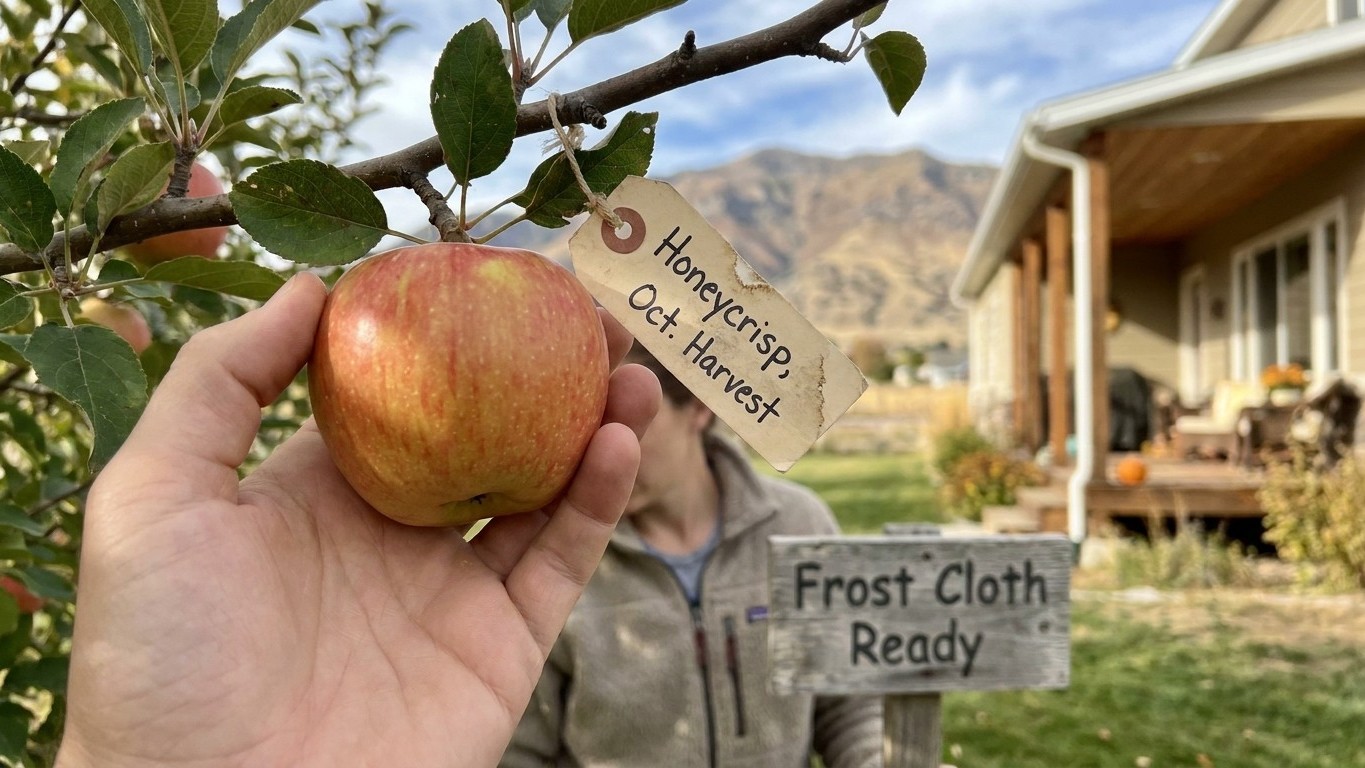

Utah’s elevation is the only forecast that matters here — not the county, not the zone map average, just the number of feet under your own feet. A mountain valley near Sanpete or Cache County and a warm bench near St. George are running two different apple climates, and the tree that thrives in one will sulk or die in the other. So before you buy anything, find your actual elevation and check it against the hardiness zone it lands in — that’s what tells you whether you’re shopping cold-hardy stock or the warm-winter end of the list.
Can you grow apples in Utah
Utah covers a huge range of growing conditions for a single state, from mountain valleys above 6,000 feet to low desert benches near St. George. The USDA Plant Hardiness Zone Map spans zone 4a to zone 9a across that range, which means Utah isn’t one apple climate, it’s several stacked on top of each other by elevation. At the Salt Lake City reference station, NOAA’s 1991-2020 climate normals put the average minimum of the coldest month at 21.6°F, a figure that describes the valley floor near the airport, not the benches above it or the high desert further south. That number is the one that rules out anything but a genuinely cold-hardy apple, and the apple qualifies almost everywhere in the state.
High valleys versus low benches
Where the climate gets hard for apples is the higher mountain valleys of central and northern Utah, places like the upper benches of Sanpete and Cache counties, where winter lows run colder than the Salt Lake City station ever records and the frost-free season is shorter. That’s the ground where a grower needs a variety bred for USDA zone 4, and where a late spring frost does more damage to a season’s crop than the winter cold ever does. Growers wrestling with that same cold, short, frost-pinched calculus will recognize the terrain described in Growing Apples in Wyoming, where the higher elevations force nearly identical variety and timing decisions.
Lower down, along the Wasatch Front benches and especially in the Dixie region around St. George, the growing season runs longer and the winter minimum is milder than the Salt Lake City figure suggests. That’s where zone 8 and zone 9 varieties come into play, and where a grower can lean toward the warmer end of the apple’s range without much worry about winter kill.
The practical takeaway: don’t ask whether apples grow in Utah, ask where in Utah you are. Match your own elevation and nearest weather station to the USDA zone map before committing to a tree, and treat the Salt Lake City figures in this article as a valley-floor starting point, not a promise for the whole state. For a closer look at which cultivars fit each of these zones, see The Best Apple Varieties for Utah, and for how these zones translate into month-by-month tasks, see The Utah Apple Calendar, Stage by Stage.
Which varieties suit this climate

Start with hardiness, then check winter chill. Both filters matter and they test different things: hardiness tells you whether the tree survives the winter, chill tells you whether it flowers cleanly the following spring. A tree bred for a mild-winter chill requirement, planted somewhere with a long, cold Utah winter, can still survive fine and simply bloom thin and ragged because it never got the kind of chill signal it was bred to expect, or it can break dormancy unevenly and bloom over several scattered weeks instead of one clean window.
For hardiness, several widely sold apples publish a USDA zone range that covers most of Utah’s populated elevations: ‘Honeycrisp’ (zones 3-8), ‘Liberty’ (4-8), ‘Haralson’ (3-7), ‘Zestar!’ (3-7), ‘Enterprise’ (4-9), and ‘GoldRush’ (5-8). At the warmer end, where the Dixie region’s mild winters push toward zone 8 and 9, ‘Gala’ (5-9) and ‘Fuji’ (6-9) come into range too, though either would struggle through a colder mountain valley’s winter.
Chill hours: the filter most guides skip
Winter chill runs in the opposite direction from hardiness concern here. Utah’s higher valleys deliver plenty of cold hours, often far more than a low-chill apple ever needs, which is why a variety bred for the Deep South or coastal California, one asking for only 300 to 400 hours below 45°F, tends to bloom thin here or skip a strong bloom altogether. Most cultivars sold through mainstream nurseries for northern and intermountain climates ask for 700 to 1,000 hours of chill, and that range suits the bulk of Utah’s elevation far better than a low-chill selection bred for Georgia or Florida ever would.
| Variety | Published hardiness zones | Typical chill need | Bloom timing |
|---|---|---|---|
| ‘Honeycrisp’ | 3-8 | 800-1,000 hrs | Mid-season |
| ‘Liberty’ | 4-8 | 800-900 hrs | Mid-season |
| ‘Zestar!’ | 3-7 | 800-900 hrs | Early to mid |
| ‘Enterprise’ | 4-9 | 800-900 hrs | Late |
| ‘GoldRush’ | 5-8 | 800-1,000 hrs | Late |
These are catalog figures published by the nurseries that sell the trees, and they shift by a week or two with the season and by up to a full USDA zone between different growers’ listings, so use the table as a shortlist rather than a guarantee. No statewide source in Utah publishes a single official variety recommendation, so the closer check is the county-level guidance from USU Extension covered in the last section below.
Planting a pair that works here
Apples need cross-pollination from a genetically different apple blooming at roughly the same time, and a single tree in a Utah yard, however healthy, will set little or no fruit without a partner nearby or a good pollinator already growing next door. Among the varieties that suit this climate, the realistic pairings are the ones with overlapping bloom windows: ‘Honeycrisp’ with ‘Liberty’, or ‘Zestar!’ with ‘Honeycrisp’, both cross well in mid-season and both carry fertile pollen. ‘Enterprise’ and ‘GoldRush’ bloom later and pair well with each other for a grower in a colder valley who wants the whole cycle pushed back from the risk of frost.
Avoid the sterile-pollen trap
The one variety mistake worth flagging: some popular apples produce sterile pollen and can’t pollinate anything, even though they happily accept pollen from a neighbor. ‘Gravenstein’, ‘Jonagold’, and ‘Winesap’ fall into that group. Plant one of those and you still need two other, fertile varieties nearby, not just one partner, or the triploid tree becomes the one that needs help rather than the one that provides it.
Nursery tags and catalog listings usually group varieties into early, mid, and late bloom, and pairing two trees from the same bloom group is the simplest way to guarantee overlap without tracking exact calendar dates, since bloom timing shifts with the spring anyway. A crabapple with a long, generous bloom window also works as a pollen source and takes up far less space than a second full-size tree, which matters on a smaller lot. Plant either pairing within about 50 feet of each other for reliable bee traffic, since bees do the actual work and a fence line or windbreak between the two trees cuts down on visits more than distance alone does.
The frost that costs a crop here

At the Salt Lake City reference station, NOAA’s NCEI 1991-2020 climate normals put the last spring freeze (32°F) somewhere between April 12 and April 29, using the 30 to 70 percent probability band. Higher valleys and mountain benches run colder and later than that window, and the warmer benches and the Dixie region run earlier and milder, so treat this range as a valley-floor figure and check it against your own elevation rather than assuming it applies statewide.
Why a late frost is worse than a cold winter
The thing that catches new growers out: a frost that arrives after the buds have opened to the pink stage doesn’t kill the tree, it kills the flowers. The tree leafs out fine, looks healthy all summer, and simply carries no fruit that year, because an open blossom or a young pistil is far more frost-tender than the dormant wood around it. A hard freeze in January that a zone 5 apple shrugs off can cost far less than one light frost in late April that catches the bloom wide open.
There’s not much a grower can do once a freeze is forecast except reduce its severity at the margins: running overhead sprinklers before dawn to coat the buds in ice, which releases a small amount of latent heat and helps hold the tissue near 32°F rather than letting it fall further, covering a young or small tree with frost cloth overnight, or siting the tree on a slope rather than a low spot where cold air pools. None of those fully protect a full bloom against a hard freeze.
The more reliable protection is timing the bloom itself later than the frost window, which is where variety choice does real work. A late-blooming cultivar such as ‘Enterprise’ or ‘GoldRush’ pushes bloom past the riskiest weeks and gives the flowers a better chance of opening once the local late-frost risk has largely passed, though a colder valley elsewhere in the state will push its own frost date later still than the Salt Lake City reference figures. Growers weighing that same bet on a late bloomer against a narrow frost window can see how it plays out in a different climate at Growing Apples in Nova Scotia, where a maritime spring delays frost risk in its own way.
The apple year in Utah
Go by the tree’s stage, not the calendar, and anchor each stage against the frost window for your own area rather than a fixed month. Near Salt Lake City, NOAA’s 1991-2020 normals put the last spring frost between April 12 and April 29 and the first fall frost between October 18 and October 29, and a colder mountain valley or a warmer southern bench will shift both dates in opposite directions from that range.
Stage by stage
- Dormancy (winter into early spring): prune while the tree is fully leafless and check for winter damage or vole gnawing at the base.
- Green tip (buds swell and show the first sliver of leaf): finish any dormant oil or copper application before this stage, since coverage matters more before green tissue is exposed.
- Pink (buds show color but haven’t opened): the most frost-vulnerable stage right up through full bloom, and the one to watch closely against your local spring frost window.
- Bloom (flowers fully open): hold off on any spray that could harm pollinating bees, and understand this is the stage a late freeze does its worst damage.
- Petal fall (petals drop, tiny fruitlets visible): the first realistic point to judge whether a frost cost you the crop.
- Fruit set (fruitlets swelling, natural June drop underway): thin crowded clusters down to one fruit each to size up what’s left.
- Harvest (late summer into fall depending on variety, well before the first fall freeze): pick by taste and by how easily the fruit separates from the spur, not by a date on the calendar.
Because both frost windows are ranges rather than single days, each stage above can shift by a week or two in an early or late spring, and a stretch of unusually warm weather in March can push green tip forward even while the frost risk behind it hasn’t actually receded. The gap between the two Salt Lake City windows, roughly late April to late October, defines the growing season that most valley-floor varieties named above are bred to fit inside, which is one more reason to know your own local frost dates before planting a variety bred for a longer season than your elevation actually offers.
Local help
For a shortlist of apple varieties tested for specific Utah counties, and for spray timing keyed to local pest pressure, Utah State University Extension publishes county-level fruit tree guidance that goes well beyond the general figures in this article. USU Extension is also the right office to call about a specific disease outbreak, a soil test, or confirming your own zone and frost dates against the weather station nearest you, since the Salt Lake City figures used here won’t match every county exactly.
Common questions
Can I grow apples above 7,000 feet in Utah?
Likely yes, but you’re working in a colder USDA zone than the Salt Lake City figures describe, with a shorter frost-free window on both ends of the season. Pick a variety rated to zone 4, favor a late bloomer to dodge a late spring freeze, and confirm local frost dates with USU Extension’s county office rather than the statewide figures in this article.
Do I need two apple trees, or will one alone ever produce fruit?
Almost always you need two compatible, cross-pollinating trees, unless a neighbor within bee range already has a fertile variety blooming at the same time as yours. Don’t count on that neighbor’s tree staying put or blooming reliably every year, so planting your own second tree is the safer bet.
My apple tree bloomed heavily but set almost no fruit, what went wrong?
The usual culprits are a late frost that hit the open flowers, cold or rainy weather during bloom that kept bees from flying, or a pollination partner that turned out to be a sterile-pollen variety like ‘Jonagold’ or ‘Gravenstein’. Check your bloom-week weather first, then check whether your second tree is actually a fertile pollen source.
Are apples worth growing in the St. George or Dixie area given how mild the winters are?
Yes, but lean toward varieties suited to the warmer end of the state’s zone range, like ‘Gala’ or ‘Fuji’, rather than a cultivar bred for a long, cold northern winter. Even there, most mainstream nursery apples still expect several hundred hours of winter chill, so an extremely mild winter can occasionally shortchange bloom quality even in the warmest Utah valleys.
Do apple trees in Utah need irrigation, or can they survive on rainfall alone?
Nearly everywhere in Utah, a young or bearing apple tree needs supplemental irrigation through the growing season, since the state’s arid climate rarely delivers enough rainfall on its own. Exact watering schedules depend on your soil type and local conditions, so USU Extension’s county office is the better source for a specific irrigation plan than any general rule.