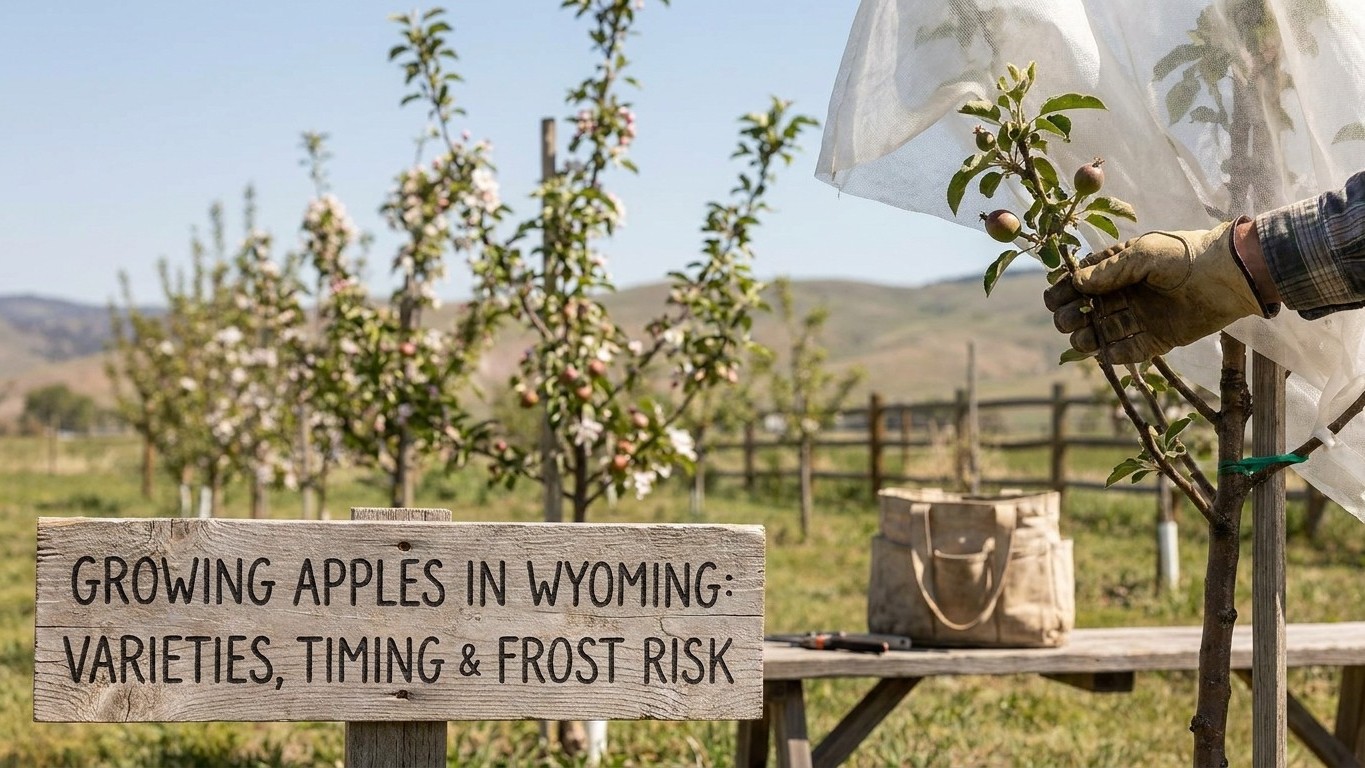

Wyoming apple trees only earn their keep if you pick the hardiest variety on the market and give it the warmest patch you own. Most of the state sits in zone 3a to 6a, cold enough that a mismatched tree dies back before it ever fruits, and elevation swings the frost-free window from around 130 days near 6,000 feet to frost-any-month in the high valleys. Start by checking that your variety’s hardiness rating covers zone 4 or colder, then scout your property for the south-facing, wind-sheltered slope where cold air won’t pool.
Can you grow apples in Wyoming
Yes. The USDA Plant Hardiness Zone Map (2023 edition, based on 1991-2020 normals) places Wyoming across zones 3a to 6a, a wide enough range that most of the state can support a cold-hardy apple tree if the variety is matched to the coldest end of that scale. Cheyenne, the reference station used for these figures, records a coldest-month minimum of 17.3°F under NOAA’s 1991-2020 climate normals. That is a mean daily low, not a record cold snap, and it is the number that rules out marginal varieties before you even think about frost dates.
Wyoming’s climate is not uniform, and treating the whole state as one growing zone is the biggest mistake a new orchardist makes here. Elevation drives almost everything: at around 6,000 feet, the frost-free window narrows to roughly 130 days, and in the mountain valleys above that, a frost is possible in any month of the year. Lower valleys and river bottoms, where cold air drains away and elevation drops below that mark, give an apple tree a noticeably longer and gentler season. If you garden near Cheyenne itself, use the 17.3°F figure and the 3a-6a zone range as your starting point. If you’re at a different elevation or in a different part of the state, treat those numbers as a baseline, check your own site’s exposure, and consult a Wyoming apple Calendar to time your key tasks accordingly.
Compare that to a place like Nunavut, where the growing season is too short and too cold for tree fruit of any kind, and apples simply aren’t a workable crop there. Wyoming looks generous by comparison. The zone range here at least includes a workable band for the right rootstock and variety, which is more than colder territories can say.
The practical takeaway is that site selection does more work than variety selection in Wyoming. A south-facing slope with good drainage and some windbreak, sited below the coldest air pooling in a valley bottom, will outperform a textbook-perfect variety planted in a frost pocket. Look for the warmest, most sheltered spot on your property before you order a tree, then consult The Best Apple Varieties for Wyoming to narrow down your choice.
Which varieties suit this climate

Once the zone and elevation check is done, the next filter is winter chill, and it measures something different from hardiness. Hardiness tells you whether the tree survives a Wyoming winter. Chill hours tell you whether it flowers properly the following spring, and Wyoming sits firmly at the high-chill end of the scale. A variety bred for the Deep South or coastal California, where winters barely dip below freezing, will bloom thin and ragged here even if it happens to survive, because it never accumulates the cold hours it needs to break dormancy cleanly. Everything planted in Wyoming should be a full-chill northern variety, never a low-chill selection bred for a mild climate.
Real varieties with published hardiness ratings that cover zone 3 to 4 include ‘Honeycrisp’ (roughly zone 3-8), ‘Haralson’ (zone 3-7), ‘Wealthy’ (zone 3-7), ‘Norland’ (zone 2-7), ‘State Fair’ (zone 3-8), and ‘Zestar!’ (zone 3-7). All six were bred at northern research stations, mostly in Minnesota, specifically to combine cold survival with a chill requirement suited to a short, cold season rather than a long, mild one. ‘Dolgo’, a crabapple rather than a full-size eating apple, is rated to zone 2 and is worth knowing about mainly as a pollen source, which comes up in the next section.
Ripening season varies across this list, and that matters more in Wyoming than in a longer-season state. ‘Norland’ and ‘State Fair’ both ripen in mid to late summer, well ahead of ‘Haralson’ and ‘Honeycrisp’, which hold on the tree into early fall. Cheyenne’s first fall freeze, per NOAA’s 1991-2020 normals, falls between September 24 and October 5, so a late-ripening variety needs to finish before that window arrives, or the grower is racing frost to pick.
Treat the varieties above as catalogue-documented cold-hardy choices rather than a locally endorsed recommendation, and confirm bloom timing and rootstock choice with your county office before ordering.
Planting a pair that works here
Apples do not reliably self-pollinate, and a cold climate’s compressed spring makes matching bloom times trickier than it is in a longer, milder season. You need two trees flowering at the same time, and at least one of them has to carry fertile pollen. Among the cold-hardy varieties that suit this climate, ‘Honeycrisp’ and ‘Haralson’ bloom close enough together to work as a pair, and ‘Wealthy’ and ‘Norland’ are another workable combination. ‘Zestar!’ and ‘State Fair’ overlap as well, since both were selected at the same northern breeding program with a similar spring bloom window.
A crabapple like ‘Dolgo’ earns its space even in a small yard, because crabapples tend to bloom over a longer stretch than full-size apples and carry fertile pollen reliably. That makes a crabapple a forgiving backup pollinator when a cold, stretched-out spring pushes your two main trees’ bloom windows a few days apart, which happens more often here than in a milder climate.
The one trap to watch for is a triploid variety, a category that includes well-known names like ‘Jonagold’ and ‘Gravenstein’. These produce sterile pollen and cannot pollinate any other tree, which means a triploid needs two other, unrelated trees nearby, not one. If you want one of these varieties anyway, plan for three trees from the start rather than discovering after a bloomless spring that a two-tree orchard was never going to set fruit.
Space the pair within easy bee-flight distance of each other, since insects do the actual pollen transfer and a short flight matters more when the bloom window itself is short. In a cold spring that opens late and closes fast, every extra day the bees have to fly between trees is a day pollination might not happen at all.
The frost that costs a crop here

The frost date that matters most for an apple crop is not written on a calendar, it is written on the tree. NOAA’s 1991-2020 climate normals put Cheyenne’s last spring freeze, in the 30 to 70 percent probability band, at May 7 to May 18. That is a range, not a single date, and it shifts earlier or later depending on the exact spring and how far you are from Cheyenne itself. Other parts of Wyoming, especially at higher elevation, see frost risk stretch later into the spring and, in the mountains, in any month at all.
The detail that catches new growers off guard is what a late frost actually kills. Once the flower buds show pink and open, a freeze does not damage the tree itself, the wood survives just fine. It kills the open flowers and the tender fruit that would have set from them. A tree can leaf out looking perfectly healthy in May and still produce zero apples that year, because the crop was lost at bloom while the tree itself never noticed.
There is not much a home grower can do to warm an entire orchard, but a few tricks help on a small planting. Covering young trees or wrapping the lower canopy on a night when frost is forecast during bloom can save a few degrees, enough to matter at the margin. Watering the soil before a clear, calm night also helps, since moist soil holds and releases more heat overnight than dry soil does. Neither trick works miracles against a hard freeze, but both can be the difference in a marginal one.
The more reliable fix is choosing a late-blooming variety in the first place. A variety that flowers later in the spring simply avoids more of Cheyenne’s May frost window by the time its buds are vulnerable, which matters more here than almost anywhere with a longer, gentler spring. Compare that to a state where the last frost window closes earlier and bloom timing carries less risk: Illinois growers work with a different frost calendar entirely, one with a wider margin for error at bloom.
The apple year in Wyoming
Every stage of an apple tree’s year should be read off the tree itself, not off a date on the wall, because Cheyenne’s frost window moves year to year within its own range and a calendar date can be days off from what the buds are actually doing.
Dormancy through green tip
The tree sits dormant through winter and into early spring, and this is the safest window for pruning, since cuts made while the tree is fully asleep heal cleanest and won’t push new growth into a stretch of cold. Green tip, when the first bit of leaf shows at the bud, often arrives while there is still real frost risk on the table given Cheyenne’s last-freeze window of May 7 to May 18 (NOAA NCEI 1991-2020 normals), so this is not the moment to relax.
Pink through bloom
Pink bud is the single most frost-vulnerable stage of the year, because the flower is nearly open and has almost no cold tolerance left. Bloom itself is the highest-risk week of the whole season in a climate where the last frost date runs this late. This is exactly the window discussed above, and it is worth checking a forecast daily once buds show pink rather than assuming the average date will hold.
Petal fall through fruit set
Once petals drop and small fruit begins to swell, frost risk drops sharply, since a young fruitlet tolerates cold better than an open flower did. This is the point to thin excess fruit, spacing developing apples along the branch so the tree isn’t carrying more than it can size up well by harvest.
Harvest
Harvest timing depends on the variety’s own ripening season, discussed above, but every variety needs to come off the tree before Cheyenne’s first fall freeze, which NOAA’s 1991-2020 normals put at September 24 to October 5. A late-ripening variety like ‘Haralson’ is cutting it close in a year when frost arrives at the early end of that window, so pick a day or two early rather than gambling on a few extra days of ripening.
Local help
The University of Wyoming Extension is the right first call for anything specific to your county, from a locally tested variety list to current spray timing for pests and disease. Reach the University of Wyoming Extension office before you plant, especially if your site sits well above or below Cheyenne’s elevation, since its local staff can adjust the general guidance in this article to your actual conditions.
Common questions
Can I grow apples at high elevation, like 8,000 feet, in Wyoming?
You can try, but expect a much shorter frost-free season than the roughly 130 days seen at 6,000 feet, and frost is possible in any month at that elevation. Stick to the hardiest, earliest-ripening varieties and pick a sheltered microsite if you’re above 7,000 feet.
Do I need to spray my apple trees in Wyoming?
It depends on what pests and diseases are active in your specific county, which varies enough that a blanket answer isn’t useful. Contact the University of Wyoming Extension for a current local spray schedule rather than guessing from a national chart.
What rootstock should I use in a climate this cold?
Look for rootstocks with a strong cold-hardiness reputation, such as ‘Antonovka’ seedling rootstock or ‘Budagovsky 9’ (Bud.9), both widely used in northern climates for exactly this reason. A dwarfing rootstock bred for milder regions can suffer root damage here that the same variety on hardier rootstock would shrug off.
How many years before a newly planted apple tree bears fruit?
Most cold-hardy varieties on standard or semi-dwarf rootstock start bearing within about three to five years of planting. A hard site, a stressed transplant, or a couple of frost-lost bloom years can push that further out.
Why did my apple tree bloom fine but set no fruit?
The two most common causes are a frost that hit the open flowers even though the tree looked undamaged, and a missing or poorly timed pollinator variety. Check your bloom dates against your pollinator pair before assuming the tree itself is the problem.