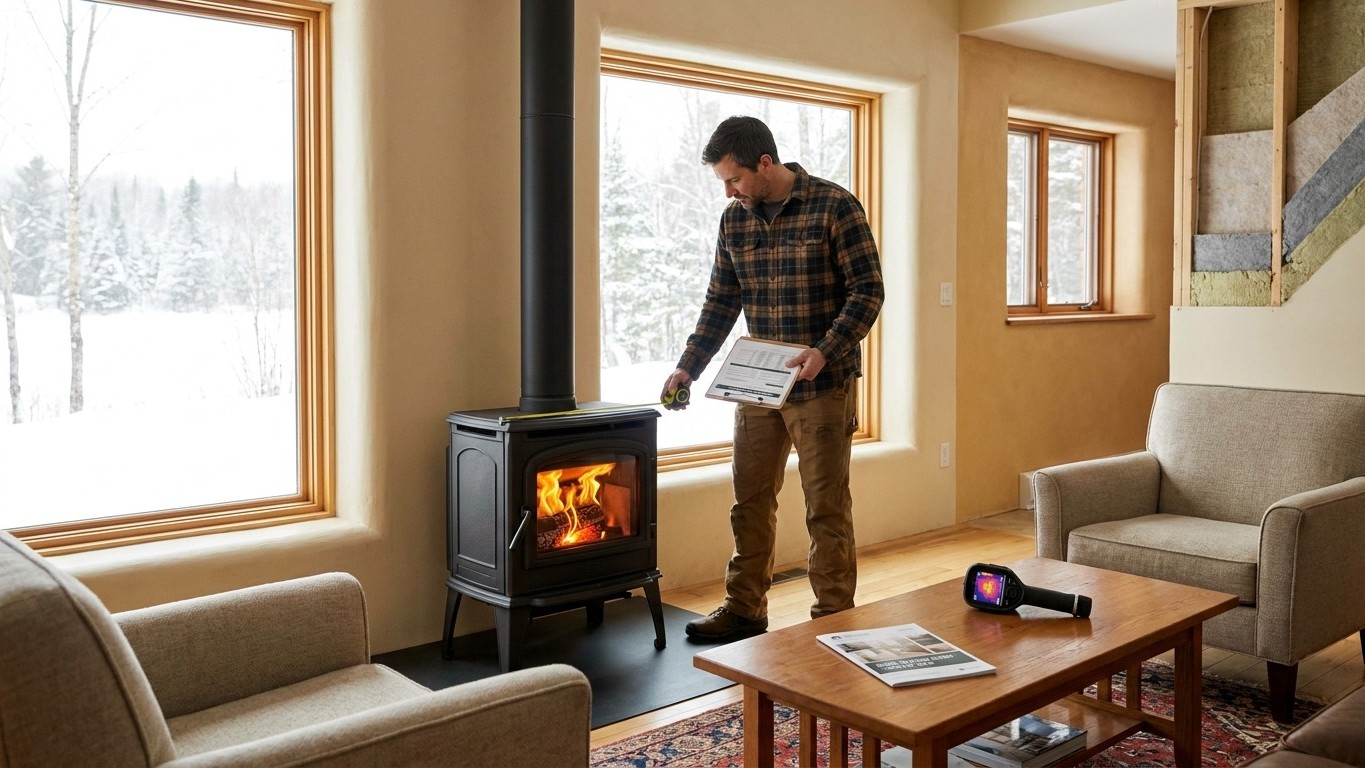

The right size for a wood stove has almost nothing to do with your square footage and everything to do with two numbers: how well your walls hold heat, and how cold it actually gets on your worst night. Get those two things wrong, and you’ll end up with a stove that either can’t keep up in January or one you’re constantly choking down to keep from cooking yourself out of the living room.
Wood stove sizing

Most people start sizing a wood stove by measuring the room. That’s the wrong starting point. University and state extension programs that cover residential wood heat, including services like University of Missouri Extension and Oregon State University Extension, size stoves around heat load instead: how much heat a house loses per hour at design temperature, which depends on insulation levels, window quality, ceiling height, air sealing, and the local climate’s coldest stretch, not the number of square feet under roof.
Two identical 1,800-square-foot houses in the same town can need very different stoves. One with blown-in attic insulation, sealed rim joists, and double-pane windows might coast through winter on a mid-size stove running a moderate burn. The other, drafty, with single-pane windows and a crawlspace that breathes cold air all night, could need a bigger firebox just to hold the same room temperature, and even then it may struggle on the coldest nights of the year.
Why bigger isn’t safer
This is the part that trips people up: an oversized stove is a worse problem than an undersized one. It sounds backwards. Everyone assumes more heating capacity is a safety margin. In practice, a stove that’s too big for the space gets damped down to keep the room from turning into a sauna, and a damped-down fire burns cool and incomplete. Instead of clean combustion, you get smoldering wood, more smoke, and creosote building up along the chimney liner. That’s a mechanism, not a guess: less air to the fire means lower flue temperatures, and lower flue temperatures let the wood smoke’s tars condense on the way up instead of exiting as vapor.
An undersized stove has a more obvious failure mode. It runs hot and clean because you’re pushing it, but it can’t produce enough total heat on the coldest nights. That’s an uncomfortable problem. A chronically oversized, chronically damped stove is a chimney fire risk. Between the two, extension guidance on wood heat consistently leans toward sizing down and running the stove closer to its rated capacity rather than sizing up “just in case.”
Open fireplace versus closed stove
The heating math changes completely depending on what you’re replacing or comparing. An open fireplace sends most of its heat straight up the flue along with the smoke, and it can actually pull more warm household air out through that opening than the fire puts back into the room. A closed stove or insert flips that ratio: the firebox is sealed, the air feeding the fire is controlled, and the heat radiates into the room instead of escaping. That’s why the same cord of wood heats a house far more effectively once it’s burned in a closed appliance instead of an open hearth. If you’re sizing a replacement for an existing fireplace, don’t use the fireplace’s apparent heat output as your baseline. It was never an efficient heater to begin with.
How to do it
- Walk the house and note its insulation gaps. Check the attic depth, feel for drafts around window frames and outlets, and note whether the crawlspace or basement rim joists are sealed. This tells you whether your home leaks heat fast or slow, which matters more than its floor plan.
- Find your area’s coldest typical night, not the average winter temperature. Local weather records or your state climatologist’s office can give you the design temperature for your region. Sizing around an average mild day is how houses end up cold every January.
- Measure the space the stove needs to heat, room by room, not the whole house. Open floor plans heat one stove’s worth of area well. Houses with closed-off bedrooms down a hallway won’t get evenly heated by one stove no matter how big it is.
- Rule out the oversizing trap before you shop. If a stove’s rated heating capacity looks like it comfortably exceeds your space with room to spare, that’s not a safety cushion, it’s a future creosote problem. Aim for a stove sized to run at or near its rated output on most winter days, not one that spends the season damped down.
- Check the chimney or flue situation before committing to a size. A stove has to match the flue it’s venting into. An oversized stove paired with an undersized flue, or vice versa, causes draft problems no amount of adjusting the air control will fix.
- Ask about the appliance’s actual square-footage rating, then discount it for your insulation level. Manufacturers rate stoves for well-insulated, modern construction. An older or leakier house needs to size toward the lower end of that range, not the upper end.
- Call your local extension office or state energy program before buying. Many state extension services publish region-specific wood heat sizing worksheets that factor in your climate zone, which is worth five minutes on the phone before a purchase you’ll live with for a decade or more.
What goes wrong
The room next to the stove roasts while the back bedrooms stay cold
This is the classic sign of a stove sized to the whole house instead of to the space it can actually heat through open air, not walls. Closed doors and hallways stop heat from traveling the way it does in an open floor plan. If this has already happened, the fix usually isn’t a bigger stove, it’s a small fan or duct booster moving warm air toward the cold rooms, or accepting that a second, smaller heat source covers the far end of the house.
The glass and flue are coated in dark, tarry buildup after only a few weeks of burning
That’s creosote, and it almost always means the fire has been running too cool for too long, often because the stove is bigger than the room needs and keeps getting damped down. Once you see it, stop running the stove damped low as the default setting. Burn hotter, shorter fires more often instead of one big smoldering load, get the chimney inspected and cleaned before the buildup thickens further, and consider whether the stove was oversized for the space from the start.
The stove can’t hold the house above 65 degrees on the coldest nights
This points to an undersized stove for your actual heat loss, not necessarily bad luck with the weather. If it’s already happened this winter, check first whether air sealing and insulation gaps are making the problem worse than the stove itself deserves. If the house is reasonably tight and the stove still can’t keep up, that’s a sizing mismatch worth correcting before next season rather than compensating for indefinitely with space heaters.
Smoke backs into the room when the door opens
This is usually a draft problem tied to a flue and stove size that don’t match, or a chimney that’s too short or too cold to establish good draft. Once it’s happening, don’t just open windows and tolerate it. Have the flue and chimney height checked against the stove’s specifications; a mismatch here won’t resolve itself by adjusting how the wood is loaded.