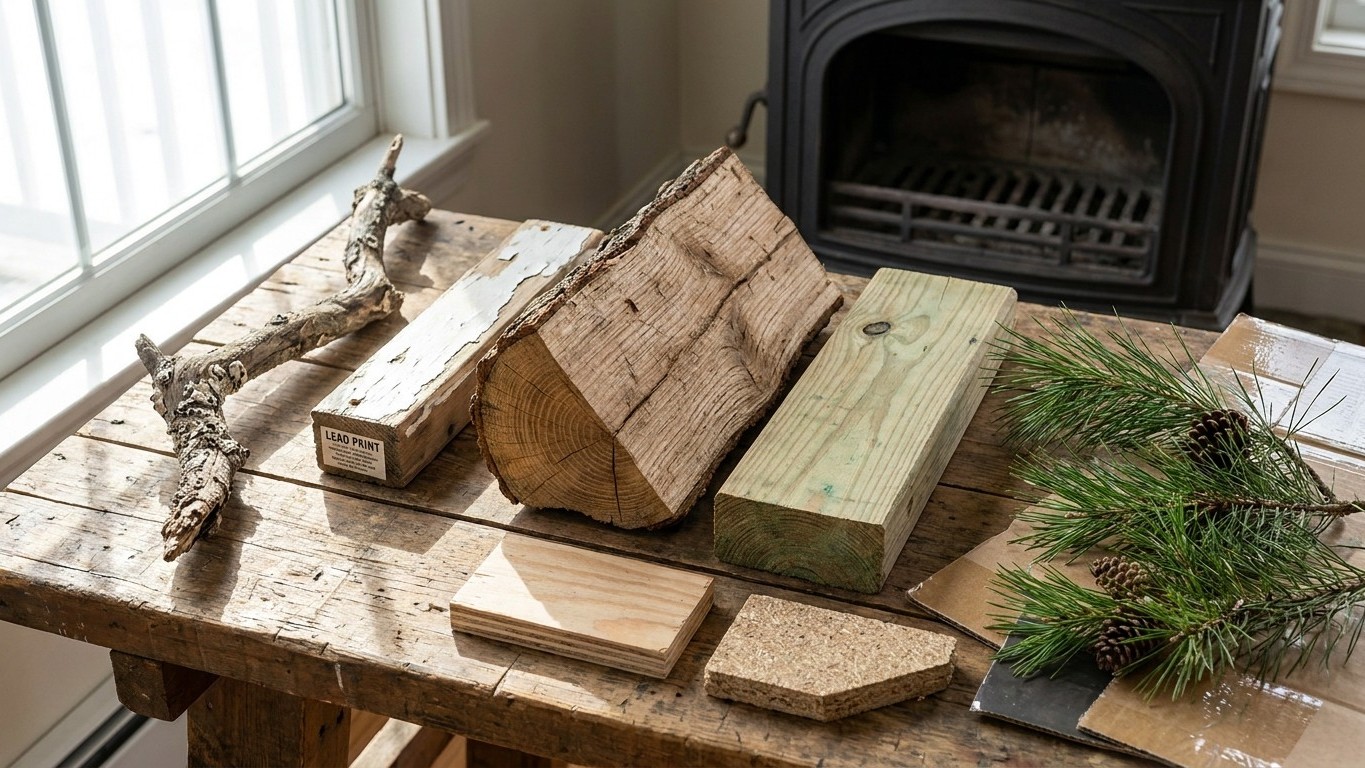

Burn wood that’s dry, split, and unpainted, and skip everything else. That short list rules out more than people expect: treated lumber, driftwood, green Christmas trees, glossy paper, and any piece of wood you can’t identify. Each one causes a different kind of damage, from house fires to a stove interior nobody wants to touch again.
What not to burn

The short answer is simple. Never burn treated, painted, or manufactured wood. Never burn driftwood. Never burn a green, resinous conifer like an unseasoned Christmas tree. Never burn glossy paper or cardboard. And never burn anything you can’t positively identify. None of these are matters of taste or efficiency. They’re mechanical and chemical facts about what happens inside a firebox that isn’t built to handle them.
Treated, painted and manufactured wood
Pressure-treated lumber, the green-tinted boards used for decks and fence posts, carries preservative salts driven into the wood under pressure. Burning it releases those compounds into your firebox and up your flue, and a stove is not designed to contain them. Painted wood carries its own risk, especially in older houses where lead-based paint is still buried under newer coats. Plywood, chipboard, and MDF aren’t solid wood at all. They’re wood fibers held together with resins and adhesives, and those bonding agents are exactly the kind of thing a wood stove was never engineered to process. Cooperative Extension programs across the country, the same university-affiliated services that advise homeowners on gardening and land management, list all three categories among the materials to keep out of any woodstove or fireplace.
Driftwood, green conifers and coated paper
Driftwood looks like free fuel sitting on a beach or riverbank, but it has spent months or years absorbing salt from the water. That salt is corrosive to both the stove and the flue, working on the metal in ways ordinary firewood never does. A green, resinous conifer, the classic example being a Christmas tree still full of sap, burns hotter and faster than seasoned wood and throws off flare-ups while coating the chimney with the same resins that made the tree smell good in your living room. Glossy paper and cardboard belong in recycling, not kindling. The coatings and inks that give them their shine and color aren’t fuel. They’re additives that don’t combust cleanly, and they don’t add heat, just residue.
Anything you can’t identify
Scrap wood picked up from a job site, a curb, or an old renovation project is a gamble. If you don’t know what it was cut from, whether it was treated, painted, glued, or coated, you’re guessing with something that’s about to burn a few feet from where your family sleeps. Anything you cannot identify does not go in a fire you sleep near. That’s not caution for its own sake. It’s the same standard extension services apply when they tell homeowners to burn only wood they can trace back to a known, untreated tree.
| Material | Why it’s a problem |
|---|---|
| Treated/painted lumber | Preservative salts or old lead paint released into the firebox and flue |
| Plywood, chipboard, MDF | Resins and adhesives not meant for combustion |
| Driftwood | Salt absorption corrodes stove and flue metal |
| Green conifers | High resin content flares hot and coats the chimney |
| Glossy paper/cardboard | Coatings and inks don’t burn cleanly, add no heat |
How to do it
- Sort your existing wood pile this weekend. Pull out anything painted, stained, or oddly uniform in shape, the kind of leftover lumber that usually came from a construction or demolition project rather than a felled tree.
- Check for paint and coatings by scratching a small section. Bare wood underneath a scratch means it’s probably safe to season and burn. A painted or lacquered layer that flakes off means it goes in the trash pile, not the woodpile.
- Smell and weigh any driftwood before storing it. Salt-cured wood often feels heavier than its size suggests and can carry a faint briny smell even after drying. Set it aside for yard décor or a fire pit you don’t mind replacing, never for an indoor stove.
- Separate any conifer branches or trees by season, not by convenience. If a tree came down green this year, stack it apart from your seasoned hardwood and don’t touch it for burning until it has dried for the better part of a year.
- Set up two paper bins, not one. Plain newsprint and brown paper bags make decent kindling. Glossy inserts, magazine pages, and coated cardboard boxes go straight to recycling instead.
- Label anything you’re unsure about, or get rid of it. A scrap of wood with no clear origin isn’t worth the guesswork. If you can’t say where it came from, it doesn’t belong near your stove.
What goes wrong
-
The stove is coated in a black, sticky residue
That buildup is creosote, usually the result of burning green or resinous wood, and it collects fastest when a conifer or unseasoned log has been in the mix. Once you see it, stop burning that batch of wood immediately and have the chimney inspected and cleaned before lighting another fire. Continuing to burn on top of heavy creosote buildup is how a routine fire turns into a chimney fire.
-
My eyes and throat burn when I load the stove
That reaction points to something in the fuel that shouldn’t be there, most often treated or painted wood releasing compounds into the room and up the flue. Open windows, stop feeding the fire, and let it burn out on its own rather than trying to smother it, which can push more fumes back into the room. Afterward, trace exactly which piece of wood caused it and remove the rest of that batch from your supply.
-
The chimney flared or roared louder than usual
A sudden, loud draw or visible flare at the top of the chimney is often the sign of a resin-heavy green conifer catching fast and hot. If it happens, close the stove’s air intake to slow the burn, keep a fire extinguisher within reach, and call your local fire department if the roaring continues for more than a minute or two. Once it’s out, don’t burn from that same stack of green wood again until it has properly seasoned.
-
The stove pipe looks pitted or corroded
Corrosion on the metal, especially a pitted or flaking look near seams, usually traces back to driftwood or other salt-contaminated wood burned over time. There’s no fixing corroded metal once it’s set in; the practical step is replacing the affected section of pipe and reviewing your wood source so it doesn’t happen again. Keep any wood collected near saltwater out of the stack entirely going forward.