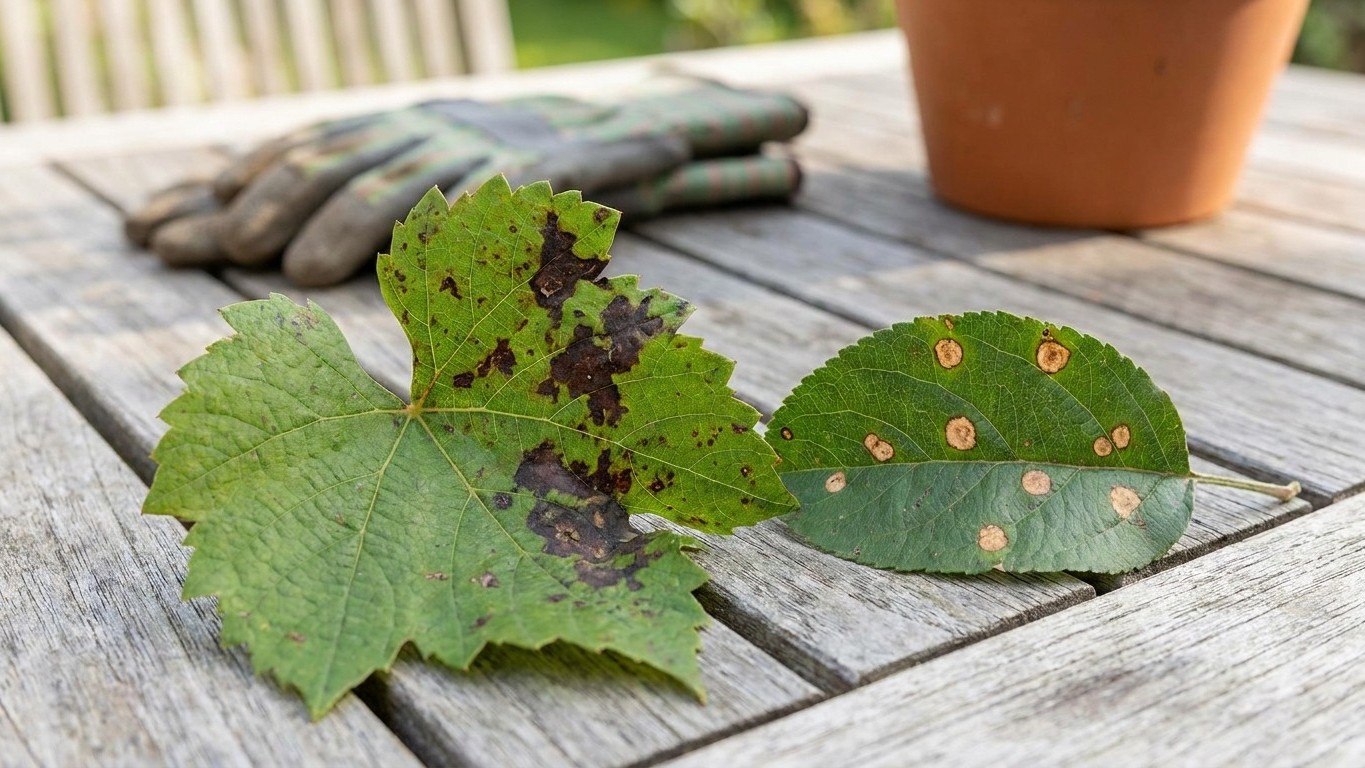

Black rot and frogeye leaf spot are two faces of the same fungus, Botryosphaeria obtusa, showing up on leaves as small tan-and-purple ringed spots and on fruit as a spreading rot with concentric brown-and-black bands. The fungus overwinters in cankers and dead wood on the tree, so before you treat anything, check the limbs for sunken, reddish-brown bark patches. That’s where next year’s infection is coming from.
What you are looking at

On the leaves first
The earliest sign most growers notice is on older leaves, usually well after bloom: small circular spots, tan to brown in the center, ringed with a darker purple-brown margin. Growers call it frogeye leaf spot because the pale center and dark rim really do look like an eye. Spots start scattered and small, often on the lower or interior leaves first, and multiply through the season if the weather stays wet.
On the fruit and bark
On fruit, the disease starts as a small brown fleck, usually at a lenticel, an old insect wound, or the calyx end. It expands into concentric rings of light brown and black, a target pattern that is the single most useful thing to look for. Left alone, the fruit shrivels down into a hard black wrinkled mummy that often stays clamped to the spur through winter instead of dropping.
On limbs, look for cankers: patches of reddish-brown bark that sit slightly sunken against the surrounding wood, frequently centered on a dead spur, an old pruning cut, or a wound left by a fire blight strike. The canker edges crack and lift with age, and the canker keeps widening year over year until it can girdle and kill the limb above it.
What it is not
Several other apple problems produce fruit rot or leaf spotting that gets mistaken for black rot, and mixing them up means pruning or spraying for the wrong thing.
| Disease | Fruit appearance | Leaf appearance | Distinguishing detail |
|---|---|---|---|
| Black rot | Flat, concentric brown-and-black rings, fruit mummifies and clings | Frogeye spots, tan center, purple-brown rim | Rot is flat and target-patterned, not sunken |
| Bitter rot | Sunken, cone- or V-shaped rot pushing into the flesh | Rarely leaf-spotting | Rot is cone-shaped and sunken, not flat rings |
| Sooty blotch and flyspeck | Dark smudges or tiny black dots on the skin surface only | None | Rubs off with a thumbnail, does not rot the flesh |
| Apple scab | Corky, cracked, olive-dark lesions | Velvety olive-green spots, no purple rim | Leaf spots are velvety, not ringed like a frogeye |
Bitter rot is the closest look-alike on fruit and the one growers confuse most often, because both produce brown rot in warm weather. The tell is the shape: bitter rot digs in as a cone, black rot spreads flat across the surface in rings. Sooty blotch and flyspeck, by contrast, never touch the flesh at all. If the discoloration wipes off the skin with a fingernail, it was never rot to begin with. For the full range of what else can turn up on an apple tree through the season, the Apple Diseases overview is worth checking before you commit to a diagnosis.
The conditions that bring it on
Where the fungus lives between infections
Black rot does not blow in from nowhere each spring. It survives the winter in exactly the tissue you’d expect: the cankers on limbs, the dead spurs and broken twigs still hanging in the canopy, and the mummified fruit that never fell. Every one of those is a spore factory waiting for rain.
What tips a year into a bad one
A wet spring is the main trigger. Rain splashes spores out of cankers and off mummies onto young leaves and developing fruit, and repeated wetting events through the season keep reinfecting new tissue. Warm, humid nights extend how long the fungus can establish once it lands, which is why a season that stays damp through summer tends to run worse than one with a few hard rains and long dry stretches between.
Wounds matter as much as weather. Winter-injured bark, hail damage, borer entry holes, and especially fire blight strikes all give the fungus a place to start a new canker that it would not otherwise get through intact bark. A tree that took a bad fire blight year is a tree primed for a bad black rot year right behind it. Dead wood anywhere near the orchard, including brush piles and neglected crabapples at the fence line, works the same way: it is a reservoir the wind and rain draw from every time it storms.
What to do now
Cut and remove, this week if you can
Once fruit shows the concentric rot pattern or a limb shows an active canker, no spray reverses that tissue. The useful work now is physical: pick off and destroy mummified fruit still hanging or lying under the tree, and prune out cankers, cutting several inches past the visible margin into clean wood. Do the cutting in dry weather so you aren’t spreading spores on wet tools and hands.
Do not compost what you remove. Bag it, burn it where local rules allow, or haul it off the property. A pile of infected prunings sitting behind the shed is functionally the same reservoir as the cankers you just cut out.
Check what you’re actually looking at before you spray anything
If the rot is at ground level on the trunk rather than up on limbs or fruit, you may be dealing with collar rot instead, which behaves and gets managed differently. And if a fungicide is warranted for the rest of the season, the active ingredients labeled for black rot and the timing to apply them vary by state, so that decision belongs with your own state extension service rather than a general guide. What you can control without a product label is sanitation, and this season’s sanitation work is what determines how bad next season starts.
Preventing it next season
Sanitation is most of the job
Every mummy left on the tree, every dead spur, every uncut canker is inoculum for next spring. Walking the orchard in late winter, before bud break, to strip off anything that didn’t fall on its own does more for next year’s crop than any single spray. Rake up dropped fruit too, since it keeps producing spores on the ground through the growing season.
Prune for air, and pick a rootstock you can actually reach
Wet leaves and fruit that stay wet longer after rain or dew give the fungus more time to infect, so an open canopy that dries out quickly is a real defense. This is easier on a smaller tree. A tree on M.9 rootstock tops out at 8 to 12 feet according to USU Extension, and one on M.26 or G.11 at 12 to 15 feet, both short enough to prune thoroughly by hand every year. A tree on seedling rootstock, by contrast, can reach 35 to 40 feet by the same USU figures, and a canopy that size is much harder to keep open and dry with a ladder and loppers. If you’re planting new trees with this disease in mind, rootstock choice is as much a sanitation decision as pruning is.
Common questions
Can I still eat apples that only have a small black rot spot?
Most growers cut the affected part away and eat the rest, but the rot usually extends further into the flesh than it looks from outside, and taste suffers even where the flesh looks sound. If you’re unsure how far a specific fruit is affected, it’s simplest to compost or discard it rather than guess.
Does black rot spread to my pear or peach tree too?
The fungus is primarily a problem on apple and crabapple. It is not the main disease growers watch for on pears or stone fruit, so a black rot canker on an apple limb is not a reason to inspect neighboring pear or peach trees for the same thing.
My tree lost a lot of leaves to frogeye spot. Is it going to die?
A single bad year of frogeye leaf spot rarely kills a tree outright. Repeated heavy defoliation over several seasons weakens it, reduces fruit size and next year’s bud set, and makes the tree more vulnerable to winter injury, which is exactly the kind of wound this fungus exploits to start new cankers.
There’s black fungus on a dead branch pile near my trees. Does that matter?
Yes. Dead wood, whether it’s a broken limb still in the canopy or a brush pile stacked nearby, is exactly the kind of material the fungus overwinters in. Clearing it out is as much a part of managing black rot as pruning the tree itself.