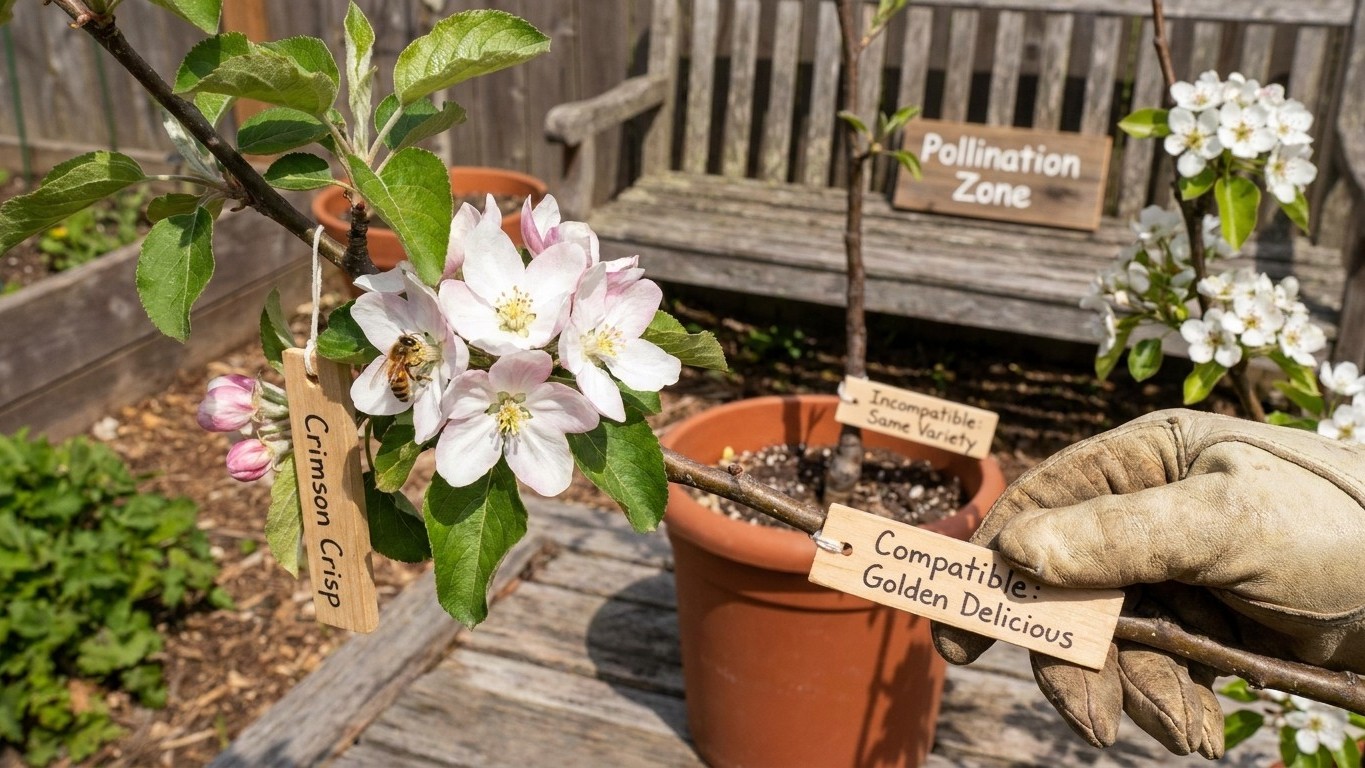

Crimson Crisp will set fruit only if another apple opens its flowers in that same Mid-season window nearby. Nobody has published its exact partner, but its bloom time is on record, and that’s the detail you can actually work with. So the move is simple: pick a Mid-blooming variety with known fertile pollen, plant it close to your Crimson Crisp, and watch both trees for a couple of springs to confirm their flowers really overlap before you count on a full harvest.
The short answer
USU Extension’s Apple Production for the Utah Home Garden guide does not publish a named list of compatible varieties for Crimson Crisp. That is worth saying plainly, because plenty of variety pages online will hand you a confident-sounding pairing that traces back to nothing more than a nursery catalog guess. What USU does document for Crimson Crisp is a Mid bloom season, hardiness in zones 4 through 7, a mid-September harvest, and susceptibility to fire blight. The bloom season is the one figure that actually matters for pollination, because it tells you which window to shop in.
Nearly all apple varieties crop better with a compatible partner nearby, and Crimson Crisp is no exception even though its specific partners are not published in this source. The practical rule most orchardists work from is two trees if the partner has fertile pollen, and three trees if either variety carries sterile pollen, because a sterile-pollen tree can receive fertilization but cannot return the favor. Since Crimson Crisp’s own pollen fertility is not stated in USU’s guide either, the cautious move for a small garden is to choose a partner with known, fertile pollen and a documented Mid bloom season, rather than gambling on an unknown pairing that might leave both trees sterile toward each other.
For a broader look at how apple pollination works before you shop for a partner, the general mechanics are laid out on our Apple Pollination page, and it is worth reading first if you have not already worked through a bloom-group match for another tree.
Why these varieties and not others

Two apple trees pollinate each other only if their flowers are open at the same time, and that is all a bloom group actually promises. Clemson Cooperative Extension describes bloom groups as a relative ranking, not a calendar date: an early-blooming variety in Vermont still opens before a mid-blooming one there, even though both bloom weeks later than the same two varieties would in Georgia. What stays constant from one climate to the next is the order, not the day. That is why a Mid bloom listing from USU Extension is useful for matching Crimson Crisp to a partner in Utah, but the exact date it flowers will shift with the season and with elevation.
What overlapping bloom does not tell you
Sharing a bloom group only clears the first hurdle. It says nothing about whether the candidate partner’s pollen is actually fertile, and some widely grown apples carry sterile pollen despite flowering at the right time, a trait called triploidy. It also says nothing about parentage. Two varieties can flower together and still fail to set fruit if one was bred directly from the other, because a seedling and its own parent share too much genetic material to cross-fertilize reliably. Neither of those exclusions is documented for Crimson Crisp in USU’s guide, so treat bloom-group membership as a starting filter, not a guarantee, and confirm fruit set in your own garden before assuming a pairing works.
If you have already worked through a bloom-group match for a different apple, the same logic applies whether you are pairing Crimson Crisp or something else entirely, such as the pairings discussed on our What Pollinates Dorsett Golden, and What Cannot page, where a documented partner list does exist.
What cannot pollinate it
This is the section most growers actually want, and the honest answer is that USU Extension’s guide does not name a specific variety that fails to pollinate Crimson Crisp. No sterile-pollen partner in its bloom group is listed, and no parent-offspring exclusion is given. What can be said, in general terms, is how those two failure modes work, so you can check any candidate partner yourself against its own catalog description.
Sterile pollen, in general
Some apple varieties are triploid, meaning they carry an extra set of chromosomes that makes their pollen largely infertile. Jonagold, Winesap and Rhode Island Greening are commonly cited examples of triploid apples in catalogs and extension references. A triploid variety can still receive pollen and set fruit normally, but it cannot fertilize a neighboring tree in return. Plant two triploids together with nothing else in bloom, and neither one gets fruit. None of this is stated about Crimson Crisp specifically in USU’s guide, so before assuming a partner works, check that partner’s own catalog listing for triploid status rather than guessing.
The other common failure is parentage. A cultivar bred by crossing two named varieties will not reliably pollinate the parent it came from, because the genetic overlap is too close. This matters for shoppers who assume any two named apples will do the job. Compatibility beyond bloom timing is simply not published for Crimson Crisp in the source used here, and the safest response to that gap is to plant a partner with a documented, unrelated parentage and confirmed fertile pollen rather than to guess.
How close the second tree has to be

Apple pollen moves on bees, not on wind, so distance is a practical question about foraging habits, not a technical one about drift. The closer the second tree sits to Crimson Crisp, the more reliably bees carry pollen between the two on a single visit. Same garden beats same street, and same street beats a pairing a quarter mile away with a fence line and a busy road between them.
The second tree does not have to be one you planted on purpose. Several things can do the job:
- A neighbor’s apple tree in bloom at the same time, if it sits within normal bee-foraging range
- An ornamental crabapple flowering on the same schedule, since many crabapples produce abundant, fertile pollen
- A branch of a compatible variety grafted onto the same trunk as your Crimson Crisp
What no partner can fix
None of those options help if the weather during bloom keeps bees grounded. Cold, wind and rain during the short bloom window all suppress bee activity, and a well-matched partner sitting ten feet away does no good if nothing is flying between the two trees that week. There is no substitute planting or spray that compensates for a bad bloom week. It is one of the reasons commercial growers plant partners as close as a shared row rather than trusting a pollinator a block over.
If there is no room for a second tree
A small garden does not rule out fruit, but each workaround trades some effort or reliability for the space it saves. The options fall into a few categories, and it helps to see them side by side before choosing one.
| Option | Space needed | Effort | What it does not solve |
|---|---|---|---|
| Multi-grafted tree (several varieties on one trunk) | One planting hole | Buy pre-grafted or graft yourself over a few seasons | Still needs bloom-timing overlap between the grafted varieties |
| Pollinator branch grafted into existing tree | None, uses the tree you have | One grafting session, plus a year or two to establish | Grafted branch can fail or be pruned off by mistake |
| Columnar variety alongside Crimson Crisp | A narrow strip, roughly a container’s width | Low, plant and grow as usual | Bloom timing and pollen fertility still have to be checked separately |
| Ornamental crabapple planted nearby | One planting hole | Low, most crabapples are easy to grow | Bloom overlap with Crimson Crisp is not guaranteed and should be watched for |
A multi-grafted tree solves the space problem most completely, since the compatible variety is already attached to the same root system, but it takes longer to establish a full canopy on each grafted branch. A pollinator branch grafted onto your existing Crimson Crisp is the cheapest fix if you already have a compatible scion to graft, though a single branch can be lost to storm damage or an over-enthusiastic pruning pass in a way that a whole second tree cannot. A columnar variety fits where nothing else will, but it still needs its own bloom-timing check, since columnar habit is a growth trait bred by selecting compact spur types and says nothing about pollen fertility or bloom group. A crabapple is often the fastest fix in practice, but confirm it is actually flowering alongside Crimson Crisp in your own garden rather than assuming from a catalog description of “spring bloom,” which covers several weeks in most references.
Anyone weighing the same trade-offs for a different variety, such as the options laid out on our What Pollinates Priscilla, and What Cannot page, will find the same short list of workarounds applies, since the space constraint is the same regardless of which apple sits in the ground already.
Common questions
Can I just plant two Crimson Crisp trees together?
Two trees of the same variety will not pollinate each other, because they share identical genetics and bloom at the same moment without any genetic difference to trigger fertilization. You need a genuinely different variety, not a second Crimson Crisp.
Does a crabapple count as a real pollinator?
Yes, as long as it flowers at the same time as Crimson Crisp and produces fertile pollen, which most ornamental crabapples do. Confirm the bloom overlap in your own garden for a season or two rather than assuming it from a nursery tag.
How do I know if Crimson Crisp itself has fertile pollen?
USU Extension’s guide does not state Crimson Crisp’s pollen fertility, so it is not settled here. Check the variety’s catalog listing from the nursery you are buying from, since triploid status is usually noted there.
What if my Crimson Crisp bloomed but set no fruit?
The most common causes are a partner that flowered outside the overlap window, poor bee activity during a cold or wet bloom week, or a partner with sterile pollen. Work through each one before assuming the tree itself is at fault.
Will bees fly far enough to pollinate from a neighbor’s yard?
Often yes, if the neighbor’s tree is within normal foraging range and blooms at the same time, but reliability drops the farther apart the two trees sit. A tree in your own garden is still the surer bet.