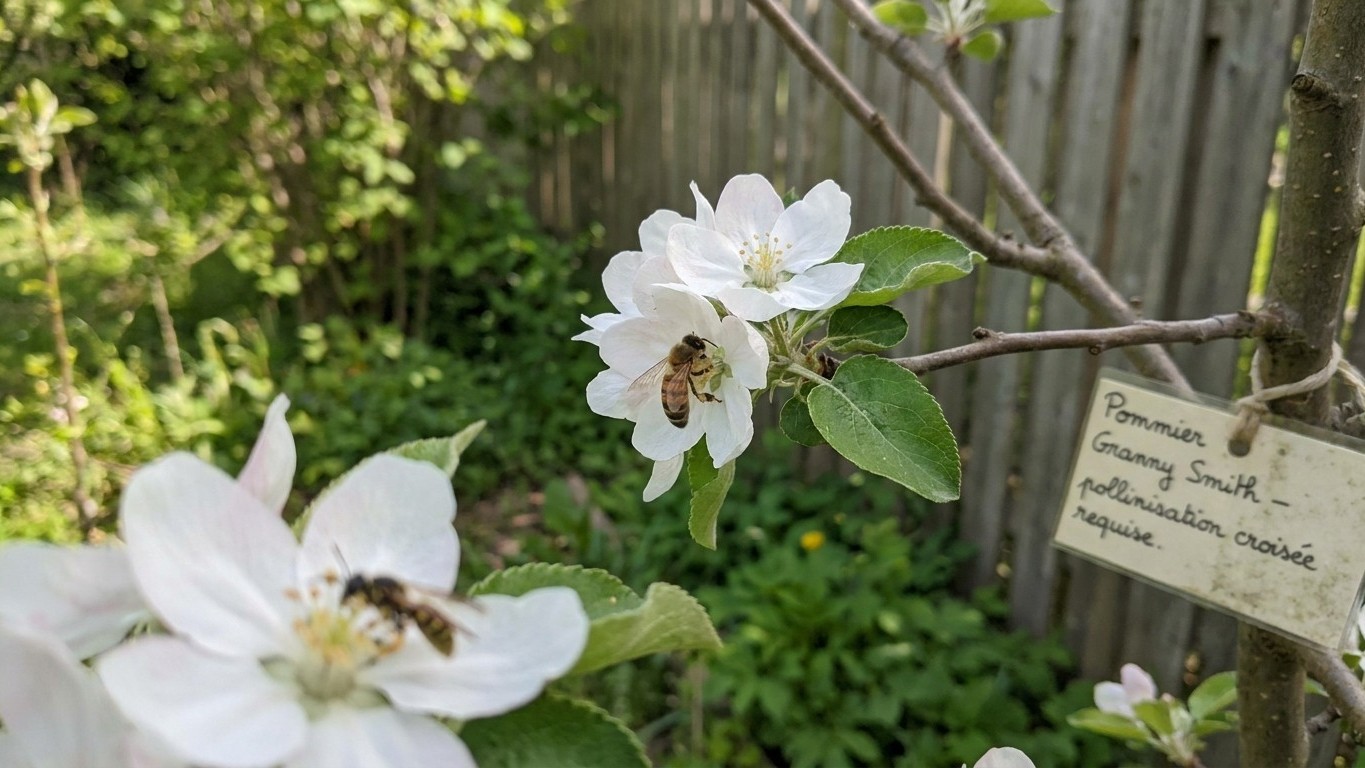

Granny Smith sets a full crop only with a second variety blooming at the same time nearby, and Fuji, Gala, Ginger Gold, Jerseymac, Mollie’s Delicious, Red Delicious and Yates all fit that window. Plant one of these somewhere in the same yard, not down the street, and check the rootstock it’s grafted to before you decide how much room it needs.
The short answer
If you’re planting a Granny Smith and want fruit on it, put one of these nearby: Fuji, Gala, Ginger Gold, Jerseymac, Mollie’s Delicious, Red Delicious or Yates. Any one of them blooms in the same window as Granny Smith and carries pollen that can fertilize its flowers. You don’t need all seven. One is enough, as long as it’s close enough for bees to visit both trees in the same trip.
Two trees is the number to plant, not three, because every variety on that list produces fertile pollen. A Granny Smith and a Gala, for instance, can pollinate each other. Bees move pollen both directions between two fertile varieties, so a simple pair does the job.
That changes if you already have, or were planning on, a variety with sterile pollen as the second tree. In that case you need three trees, because the sterile variety takes pollen but never gives any back, and something else has to cover for it. That situation comes up more often than gardeners expect, and it’s the whole subject of the next section.
- Fuji
- Gala
- Ginger Gold
- Jerseymac
- Mollie’s Delicious
- Red Delicious
- Yates
Any one of these paired with a Granny Smith, planted close together, is enough for both trees to crop. For a look at how Yates itself sorts its own partners, What Pollinates Yates, and What Cannot covers the same question from the other tree’s side.
Why these varieties and not others

Apples are grouped by bloom group, a system that ranks varieties by the relative order in which they flower each spring, not by a fixed calendar date. Clemson Cooperative Extension’s HGIC 1350 fact sheet, with figures corroborated by the University of Georgia’s C740, places Granny Smith in bloom group B, which corresponds to a mid-season bloom according to Utah State University Extension’s guidance on home orchard apples. The actual date that group B flowers shifts year to year and region to region. A cold spring in one state and a mild one in another will push the whole sequence earlier or later. What doesn’t shift is the order: group B always flowers around the same relative point in the sequence, after the earliest bloomers and before the latest ones.
That’s the entire mechanism behind a compatible pollinator. Two varieties need overlapping bloom windows so that bees carrying pollen from one tree’s open flowers can reach the other tree’s open flowers before either finishes blooming. Fuji, Gala, Ginger Gold, Jerseymac, Mollie’s Delicious, Red Delicious and Yates all overlap with Granny Smith’s window closely enough to make that transfer reliable.
What bloom group does not tell you
Sharing a bloom group is necessary but not sufficient. It says nothing about whether a variety’s pollen is actually fertile, and it says nothing about parentage. Two trees can flower on the same days and still fail to pollinate each other, either because one produces sterile pollen or because one is a direct parent or offspring of the other. Neither problem shows up by watching the blossoms. You’d only find out at harvest, with a tree full of flowers and no apples.
This is also why a general answer like “plant something in the same bloom group” isn’t good enough on its own. The named list above has been checked for fertility and compatibility with Granny Smith specifically. A same-group variety that isn’t on that list may or may not work, and nothing in the published bloom-group data will warn you either way.
What cannot pollinate it
Mutsu flowers at the same time as Granny Smith but its pollen is sterile, so it cannot fertilize Granny Smith’s blossoms even though the timing looks perfect. A garden with only a Granny Smith and a Mutsu in it will bloom heavily most springs and still set little to no fruit on either tree, because Mutsu can accept pollen but never gives any back.
This is the trap worth watching for. A nursery tag or a bloom chart will show Mutsu and Granny Smith overlapping and say nothing about pollen fertility, because that detail isn’t part of the bloom group system at all. It comes from separate breeding records, not from when the flowers open. If Mutsu is already growing nearby, or you’re tempted by it as a second variety, it needs a third tree in the mix: one of the fertile partners named above, close enough to serve both.
Parentage exclusions
The other kind of incompatibility comes from breeding lineage. A variety bred directly from another cannot be fertilized by that parent, no matter how well the bloom times line up, because the genetics are too close for fertilization to succeed. None is documented for Granny Smith beyond the Mutsu sterility issue, so treat any other variety not on the compatible list as unproven rather than assume it fails for parentage reasons. The honest position is that compatibility beyond the named list and the Mutsu exception isn’t published, and guessing at exclusions that aren’t documented does more harm than leaving the question open.
How close the second tree has to be

Pollen moves between apple trees on bees, not on wind, which makes distance a practical question rather than a technical one. The closer the two trees are, the more often the same bee visits both in a single foraging trip, and the better the fruit set on both. Same yard beats same street, and same street beats a pollinator a mile away that no bee working your garden ever reaches.
The second tree doesn’t have to be one you planted on purpose. A neighbor’s Gala or Red Delicious in bloom at the same time can do the job just as well as one in your own soil, as long as bees are working both properties. An ornamental crabapple flowering in the same window counts too. Crabapples aren’t grown for fruit but many varieties produce abundant, fertile pollen and bloom right alongside dessert apples, which makes them a common and effective pollinator even though nobody eats what they produce.
What stops the whole system
Weather during bloom matters more than which variety you chose. Cold, wet or windy conditions keep bees from flying, and a garden full of open blossoms on two perfectly matched varieties can still miss the pollination window if the bees never leave the hive. No amount of variety planning compensates for a stretch of bad weather at the exact days both trees are in flower. That risk is one more reason to plant a compatible partner as close as physically possible: it shortens the odds that even a short break in the weather still gives bees enough time to make the crossing. For a broader look at how this plays out across the whole crop rather than one variety, Apple Pollination covers the general mechanics in more depth.
If there is no room for a second tree
A small garden doesn’t rule out a second variety, it just changes what form it takes. A multi-grafted tree, carrying two or three varieties grafted onto separate branches of one trunk, solves the space problem outright: the tree pollinates itself because the branches are genetically different trees sharing one root system. It costs more up front and needs a little extra care in pruning to keep each variety’s branches balanced, but it needs no second planting hole.
Grafting a single pollinator branch onto an existing Granny Smith is a cheaper version of the same idea, using scion wood from any of the fertile partners named earlier. It takes a season or two to establish and produce flowers, and it demands basic grafting skill, but it turns one tree into its own pollination pair. Because Utah State University Extension rates Granny Smith as very susceptible to fire blight, keep any grafting wounds clean and watch the union for dieback, since fire blight spreads fastest through fresh cuts and soft new growth.
A columnar variety planted a few feet away is the least effort option for tight spaces, since columnar apples take up barely more room than a fence post, though they still need to be a variety that overlaps in bloom and carries fertile pollen. A flowering crabapple works too, planted purely for pollination rather than fruit, and takes up no more space than any other small ornamental tree. None of these options removes the need for overlapping bloom and fertile pollen. They only change where that second source of pollen physically sits.
Common questions
Can Granny Smith pollinate itself if I only plant one tree?
Not reliably. Nearly all apple varieties, Granny Smith included, crop far better with a compatible partner nearby than alone, and a single tree with no partner typically sets little or no fruit even with heavy bloom.
Does a crabapple count as a real pollinator or do I still need a named variety?
A flowering crabapple with overlapping bloom and fertile pollen works as a genuine pollinator, not a substitute that only half-counts. It won’t give you crabapple fruit worth eating, but the bees don’t care what the apples taste like.
I already have a Mutsu, do I need to remove it?
No. Keep the Mutsu and add a third tree from the compatible list, such as Gala or Red Delicious, planted close to both. Mutsu still benefits from receiving pollen even though it can’t supply any in return.
What if my two trees bloom at slightly different times some years?
Some years the overlap will be shorter than others, since bloom timing shifts with the weather even though the relative bloom-group order doesn’t. A few days of overlap is usually enough if bees are actively working both trees during that window.
Will a Honeycrisp pollinate my Granny Smith?
Honeycrisp isn’t on the list of varieties confirmed compatible with Granny Smith in the sources used here, so treat it as unproven rather than assume either way. See What Pollinates Honeycrisp, and What Cannot for what is documented about Honeycrisp’s own pollination needs.