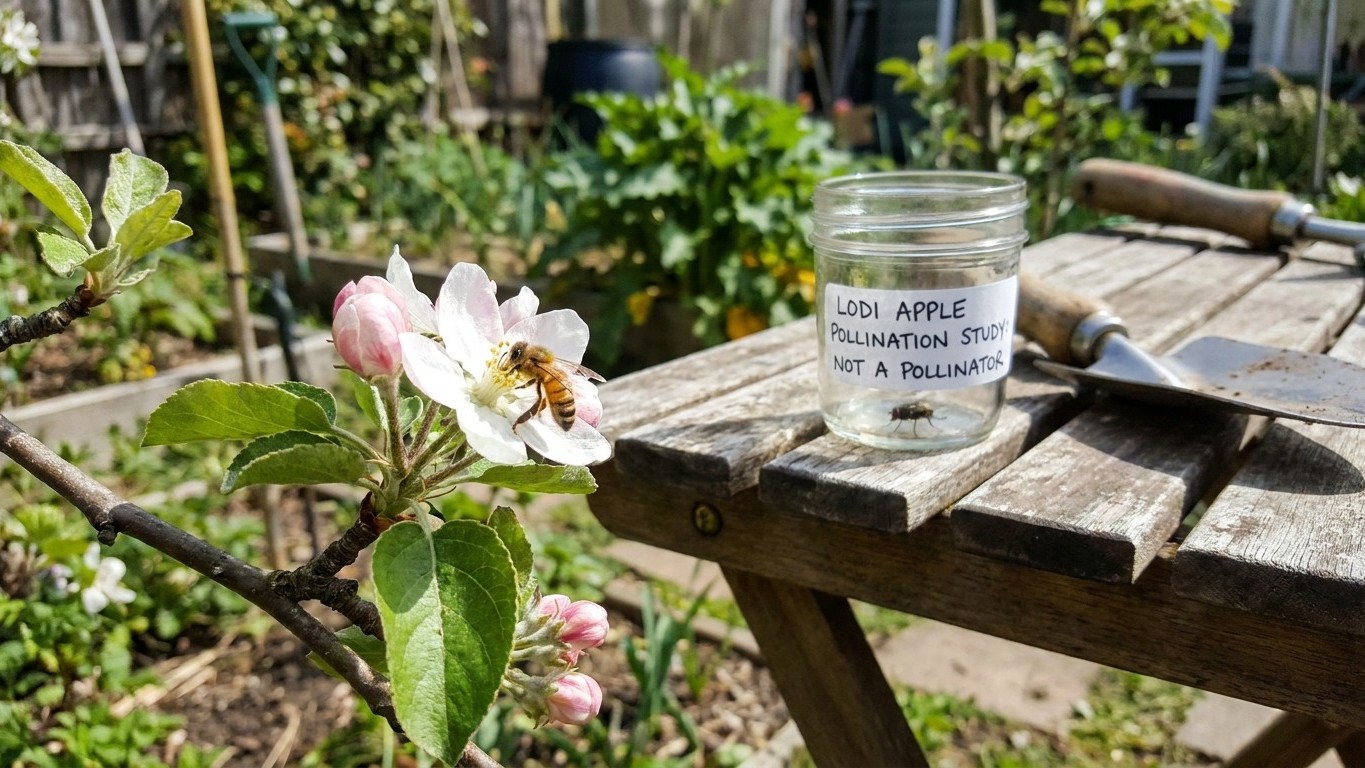

What USU Extension does document is that Lodi blooms Early and carries a Very Susceptible rating for fire blight, and that it needs a second apple tree nearby to crop well. The action to take: confirm a candidate partner’s bloom timing with a nursery tag or your local extension office before you plant, rather than assuming any early apple will do.
The short answer
USU Extension’s guide to apple production lists Lodi’s bloom season as Early and its hardiness range as zones (3)4-7, and stops there. That gap matters, because a grower who plants one Lodi tree and expects a full crop is relying on whatever happens to be blooming nearby, not on a documented match.
The number of trees needed still follows a fixed rule, even without a named partner. Most apple varieties carry fertile pollen, so two trees blooming together are usually enough as long as each can fertilize the other. A smaller number of varieties are pollen-sterile: they can accept pollen and set fruit, but they cannot hand any back. Plant two sterile varieties side by side, with nothing else in bloom nearby, and neither one sets fruit, because there is no fertile pollen anywhere in the garden.
The extension variety tables name only four pollen-sterile apple varieties—Jonagold, Mutsu, Stayman, and Winesap—and Lodi is not among them. Until it is confirmed, the safer plan for a small garden is to treat any second early-blooming apple as unverified and, where possible, keep a third tree or an outside pollen source in reach rather than betting the whole crop on one unconfirmed pair. For the general framework behind bloom groups and tree counts, the Apple Pollination guide covers the mechanics that apply to Lodi.
Why these varieties and not others

What a bloom group actually means
A pollination partner works only if two trees release and receive pollen inside the same few-day window. Clemson Cooperative Extension groups apple varieties by bloom time into a small number of relative categories, from earliest to latest, because the actual calendar date shifts with climate and season while the order between varieties does not. A variety’s bloom group tells you where it falls relative to other varieties, not what date it will flower in any one garden.
USU Extension places Lodi’s bloom season as Early. That narrows the search to other early-flowering apples rather than the full list sold at a nursery, but it does not, on its own, name a workable partner. Two varieties sharing a bloom group are not automatically compatible.
What overlap does not guarantee
Overlapping bloom guarantees timing and nothing else. It does not guarantee that either tree’s pollen is fertile, and it does not rule out a parent-and-offspring relationship between the two, which blocks fertilization regardless of when they flower. Because USU Extension rates Lodi as Very Susceptible to fire blight, the choice of partner carries a second consideration beyond timing: a partner that is itself highly susceptible doubles the risk of losing both trees to the same wet-spring outbreak, while a partner with better resistance at least keeps one tree standing if blight moves through the block.
A grower comparing Lodi against another early-season apple, such as the varieties discussed in What Pollinates McIntosh, and What Cannot, should treat bloom-group overlap as the first filter, not the final answer. Pollen fertility and parentage are the questions that decide the rest, and a nursery tag or extension office is usually the fastest way to answer them where the published record runs short, as it does here for Lodi.
What cannot pollinate it
Sterile pollen and parentage, in general
For some apple varieties, the record is specific enough to name an exclusion outright: a partner with sterile pollen sharing the same bloom group, or a direct parent that cannot fertilize its own seedling. Neither specific is settled for Lodi, so no exclusion can be named.
That gap cuts both ways. It does not mean every early-blooming apple is safe to plant next to Lodi, and it does not mean the opposite either. A tree with sterile pollen can overlap in bloom time with Lodi and still fail to set a single fruit, because sterile pollen works one way: the tree carrying it can receive pollen and set its own crop, but it cannot pass any back. Two such trees planted together, with nothing else blooming nearby, produce flowers and no apples.
Parentage works the same way in a different direction. A variety bred directly from another cannot fertilize the parent it came from, no matter how well their bloom windows line up. This kind of exclusion has to be established variety by variety, and it is documented for some well known apple pairings, including the one detailed in What Pollinates Acey Mac, and What Cannot. It is simply not published for Lodi here.
What to check before you guess
The practical response to an undocumented gap is to ask, not to guess. A local nursery selling Lodi as a named variety, or a state extension office, can usually confirm whether a specific candidate partner carries fertile pollen and whether any parentage link exists between it and Lodi. Until that is confirmed, treat a second early-blooming apple as an unverified candidate rather than a guaranteed match, and keep the fire blight rating in mind when narrowing the list, since a poor partner choice is not the only risk sitting in that part of the garden.
How close the second tree has to be

What can carry the pollen
Apple pollen moves on bees, not on wind, which makes distance a practical question rather than a technical one. The closer the second tree stands to Lodi, the more consistently bees carry pollen between the two, especially on a marginal spring day when they are not flying far. A partner in the same bed works better than one across the yard, and one across the yard works better than one three properties away.
- A neighbor’s apple tree blooming at the same time, even outside your own fence line
- An ornamental crabapple in bloom during the same window, which many bees visit interchangeably with apple flowers
- A pollinator branch grafted onto an existing tree, adding a second variety without a second trunk
Honeybees and orchard mason bees both tend to forage close to home when flowers are available nearby, so a partner tree at the far edge of a large property gets visited less reliably than one within the same block of trees. If the only available partner is on a neighboring property, the odds of adequate crossing depend on how many bees are working both gardens on the same afternoons, which is something no grower can control directly.
What stops it regardless of distance
None of these substitutes matter if the weather keeps bees grounded. Cold, wind, or wet conditions during the bloom window suppress bee activity, and no partner variety, however well matched, compensates for a week of bees staying in the hive. A grower who has done everything right on paper, an early-blooming partner within sight, healthy trees on both sides, can still lose the crop in a spring where bloom coincides with a cold snap.
If there is no room for a second tree
A small garden does not have to give up on fruit set, but each workaround trades one form of effort for another, and none of them replaces confirming that the partner it introduces actually overlaps with Lodi’s bloom.
| Option | What it takes | What it does not solve |
|---|---|---|
| Multi-grafted tree | One purchase, several varieties on one trunk, individual pruning per branch | Confirming any of the grafted varieties actually overlaps Lodi’s bloom |
| Grafted pollinator branch | A basic graft, compatible scion wood, one to two seasons before it blooms | Fruit this year, or next |
| Columnar variety | A narrow tree bought to fit a tight space | The need for a compatible partner blooming at the same time |
| Ornamental crabapple | Little space, mainly bee traffic during bloom | Producing apples worth eating from the crabapple itself |
A multi-grafted tree buys built-in bloom overlap without a second hole in the ground, but it costs more up front than a standard single-variety tree and needs yearly attention so one vigorous branch does not shade out the others. Grafting a pollinator branch onto an already-established tree, Lodi included, achieves something similar for less money, but it does not solve this year’s pollination gap while the graft establishes. A columnar Lodi still needs a partner in bloom at the same time, so buying one solves a space problem, not a pollination one. A crabapple checked for bloom timing against Lodi’s Early rating from USU Extension can carry pollen between the two without taking up an orchard’s worth of ground, which makes it the lowest-effort option on this list even though it never puts fruit in a basket itself.
Common questions
Can one Lodi tree fruit on its own without a second variety?
A little, sometimes, but not reliably. Nearly all apple varieties crop better with a compatible partner nearby, and a lone Lodi depends entirely on whatever bees happen to be carrying, whether that is a distant neighbor’s tree or an ornamental crabapple no one planted on purpose.
Extension variety tables name the pollen-sterile apple varieties—Jonagold, Mutsu, Stayman, and Winesap—and Lodi is not among them. Some apple varieties carry sterile pollen and can only receive it, never give it, and until Lodi’s pollen status is confirmed by a nursery or extension office, do not rely on it as the sole pollinator for a second variety.
Does Lodi’s fire blight rating have anything to do with pollination?
Indirectly, yes. Fire blight bacteria commonly enter a tree through open blossoms, so the same early bloom window that matters for pollination is also the window during which Lodi’s Very Susceptible rating from USU Extension matters most.
Where do I find an actual list of pollination partners for Lodi?
Start with the nursery that sold the tree, since many print a partner recommendation right on the tag, then follow up with a state extension office if the tag is silent.
Will a crabapple growing wild nearby pollinate my Lodi?
It can, if the crabapple is in bloom at the same time and bees are moving between the two trees. Wild crabapples vary widely in bloom timing, so it is worth watching your own tree for a season before counting on one you did not plant yourself.