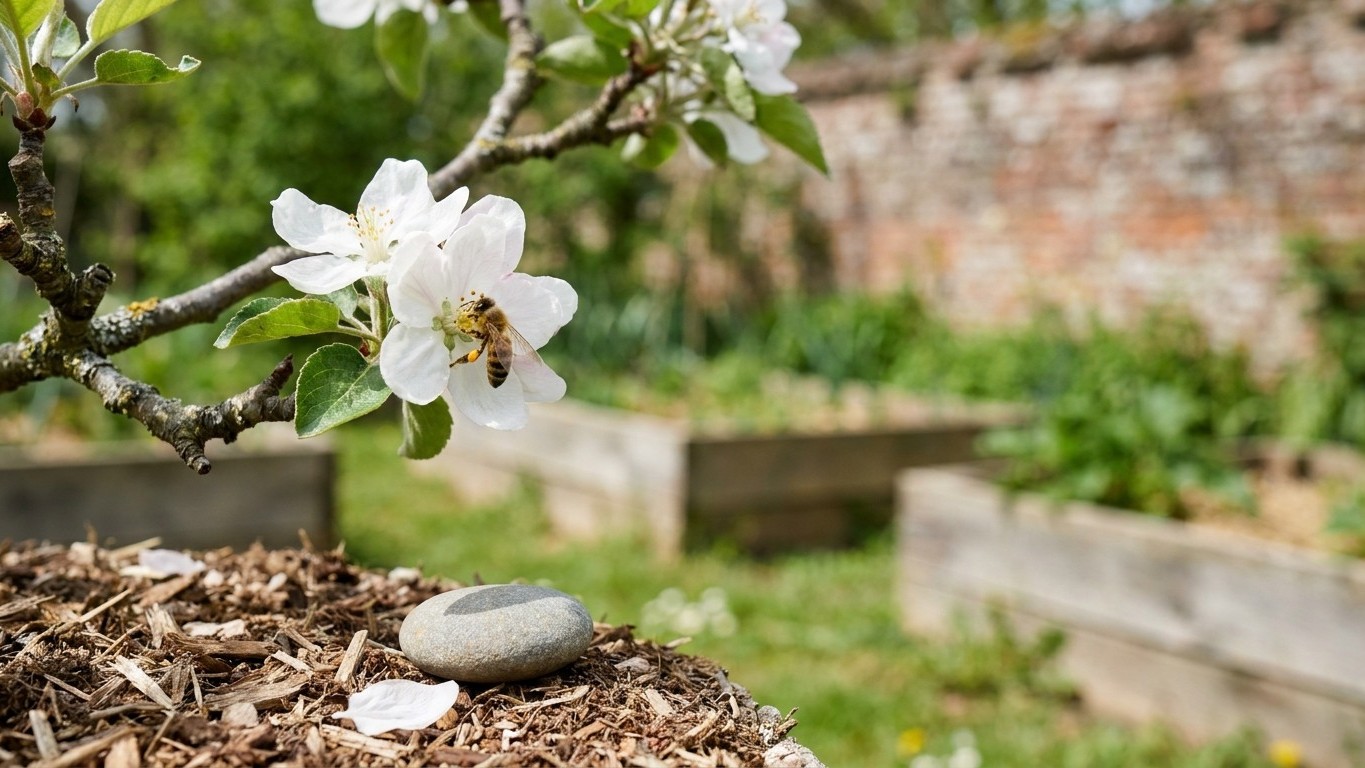

Mollie’s Delicious needs a neighbor whose pollen actually fertilizes its blossoms, and that rules out more trees than it includes. Bloom timing alone won’t do it — some apples flower right alongside Mollie’s Delicious yet carry pollen too weak or wrong to set fruit. What decides the outcome is genetic compatibility layered on top of overlapping bloom, which is why only a short list of varieties can stand beside this tree and actually get it fruiting.
The short answer
Mollie’s Delicious can be pollinated by Fuji, Gala, Ginger Gold, Granny Smith, Jerseymac, Red Delicious, and Yates, per Clemson HGIC 1350 and UGA Extension C740. Any one of those seven, planted close enough for bees to move between the two trees during bloom, will set a workable crop on both.
The seven compatible varieties
- Fuji
- Gala
- Ginger Gold
- Granny Smith
- Jerseymac
- Red Delicious
- Yates
Two trees are enough here, because every variety on that list carries fertile pollen. Plant Mollie’s Delicious beside any one of them and each tree feeds the other during bloom. That is not true of every apple pairing. Some varieties flower at the right time but produce pollen that cannot fertilize anything, and a garden built around one of those needs a third tree to do the actual pollinating work.
If there is already an apple tree of unknown variety in the yard, it is worth identifying it before assuming it will do the job. Apple pollination in general depends on two trees flowering inside the same window and bees moving freely between them, not on the two varieties being closely related or sold together as a labeled “pair.”
Why these varieties and not others

Every variety on that list shares one thing with Mollie’s Delicious: Clemson Cooperative Extension places it in bloom group B, the same relative flowering slot as Mollie’s Delicious. Extension services sort apple varieties into bloom groups to describe the order they open their flowers in a given season, not a fixed calendar date. Group B varieties flower a step behind the earliest varieties and a step ahead of the later ones, and that order holds from year to year and place to place. The actual date it lands on does not. A group B apple might open in early spring in one region and weeks later in a colder one. What stays constant is that a group B variety and another group B variety are close enough in timing, wherever the orchard sits, for their bloom windows to overlap.
That overlap is the entire reason the pairing works. Bees need both trees in flower at the same time to carry pollen from one to the other. A variety from a much earlier or later bloom group could finish flowering before a potential partner even opens, and no amount of bee activity closes that gap once it exists.
What bloom group does not tell you
Sharing a bloom group is necessary, but it is not the whole story. It says nothing about whether the pollen itself is fertile. Mollie’s Delicious’s own list proves the point: seven varieties overlap in bloom and also carry pollen that actually works. A variety could share the same window and still be useless as a partner if its pollen were sterile, which is exactly the situation with Mutsu, covered next.
Bloom group also says nothing about parentage. Two unrelated varieties can pollinate each other well, and two varieties bred one from the other can share a bloom window without being usable partners, since a seedling generally cannot be fertilized by the parent tree it came from. None of the seven varieties above are recorded as a parent or offspring of Mollie’s Delicious in the sources cited, so parentage is not the reason they work. Timing and fertile pollen are.
What cannot pollinate it
Mutsu flowers at the same time as Mollie’s Delicious, sitting in the bloom window described by Clemson Cooperative Extension and the University of Georgia Extension. On timing alone it looks like an obvious partner. It is not. Mutsu’s pollen is sterile, which means the tree can accept pollen from a compatible variety and set its own fruit, but it cannot supply pollen that fertilizes anything else. A garden planted with only Mollie’s Delicious and Mutsu, however close together the two trees stand, sets no fruit on either one.
This is the trap worth naming plainly. Matching bloom groups is not the same as matching compatibility. Two trees can flower in perfect unison and still leave an empty crop if one of them is sterile and no third, fertile variety is in range. If Mutsu is already growing in or near the garden, treat it as a tree that needs its own pollinator, not as one that supplies pollen to Mollie’s Delicious.
Beyond this list
Clemson and UGA’s compatibility notes cover the seven fertile partners and the one sterile exception named above. They do not publish a full account of how every other apple variety interacts with Mollie’s Delicious, and no parentage relationship between Mollie’s Delicious and another named variety appears in those sources. Rather than guess whether some other variety in a catalog will work, plant from the confirmed list of seven, or check with a local extension office before relying on an unlisted variety as the only pollinator.
The same trap shows up on other apples. Some varieties pair with a long list of partners and carry a specific sterile exception worth knowing before planting. Acey Mac’s pollination needs and Jonamac’s pollination needs follow the same logic: a shared bloom group plus fertile pollen, with their own list of exceptions.
How close the second tree has to be

Pollen moves on bees, not on wind, so distance matters in bee-flight terms rather than feet on a tape measure. The closer the two trees stand, the more reliably bees carry pollen between them during the short window both are in bloom. A partner in the same garden bed works better than one at the far end of a large property, and one on the same property works better than hoping a neighbor’s tree three streets over gets found by a passing bee.
What else can do the job
The compatible tree does not have to be one planted specifically for this purpose. A few things already count:
- A neighbor’s Gala, Fuji, or other compatible variety flowering nearby
- A grafted branch of a compatible variety added onto an existing tree
- An ornamental crabapple in bloom at the same time, since many crabapple cultivars produce fertile pollen apple varieties can use
Any of these can substitute for a dedicated second tree, as long as the bloom windows genuinely overlap and bees have a reasonable path between them.
What no partner tree fixes is weather. Cold, wind, or wet conditions during the bloom window keep bees from flying at all, and if bees are not moving, pollen is not moving either, no matter how well matched or how close the two varieties are. A perfectly timed, perfectly fertile pair still sets a thin crop in a spring where bloom coincides with a stretch of poor pollinating weather.
If there is no room for a second tree
A small yard does not rule out a compatible partner. It just changes which form that partner takes.
Weighing the options
- A multi-grafted tree carrying two or three compatible varieties on separate branches of one trunk, so the pollination job fits in the space of a single tree
- A pollinator branch grafted directly onto the existing Mollie’s Delicious tree, using scion wood from Fuji, Gala, or another variety on the confirmed list
- A columnar variety planted alongside, which takes up little more than a few feet of bed space
- An ornamental crabapple chosen for a bloom time known to overlap Mollie’s Delicious, doing pollinator duty while also serving as a landscape tree
Each option trades effort for space differently. A multi-grafted tree solves the space problem outright but costs more up front and needs careful pruning so each variety’s branches do not shade out the others. A grafted-in pollinator branch is cheap if scion wood is available and the graft takes, but it needs a year or two to grow enough wood to flower reliably, and a failed graft leaves the garden right back where it started. A columnar variety solves the space problem with the least fuss, at the cost of planting a second tree that takes up its own root space. A crabapple doubles as ornamental planting, but only if the specific cultivar’s bloom time is confirmed to overlap, not assumed from any crabapple on the lot.
None of these options changes the underlying requirement. Mollie’s Delicious still needs a fertile, overlapping bloom to set a full crop, whichever shape that partner takes.
Common questions
Can Mollie’s Delicious pollinate itself?
Nearly all apple varieties, including Mollie’s Delicious, crop better with a compatible partner nearby rather than relying on their own pollen. A single tree planted alone typically gives a light, unreliable crop rather than none at all.
Will a crabapple work as well as a named apple variety?
Many ornamental crabapples produce fertile pollen that apple varieties can use, and a well-timed one can substitute for a second full-size tree. Confirm the specific cultivar’s bloom timing before relying on it, since crabapple bloom dates vary widely between cultivars.
Does Mutsu pollinate anything else nearby?
No. Mutsu’s pollen is sterile, so it cannot pollinate Mollie’s Delicious or any other apple variety it grows beside. Mutsu itself needs a separate, fertile pollinator to set fruit.
How long before a newly planted pollinator tree actually helps?
A young tree needs to reach bearing age and produce a meaningful amount of blossom before it contributes real pollination, not just its first scattered flowers. Until then, an existing neighbor’s tree or a grafted branch onto a mature tree is the more reliable source.
What if the only space I have fits Mollie’s Delicious and Mutsu?
That pairing alone sets no fruit on either tree, even though both flower at the same time. A third, fertile variety from the confirmed list, such as Gala or Granny Smith, needs to be somewhere in bee range for either tree to bear.