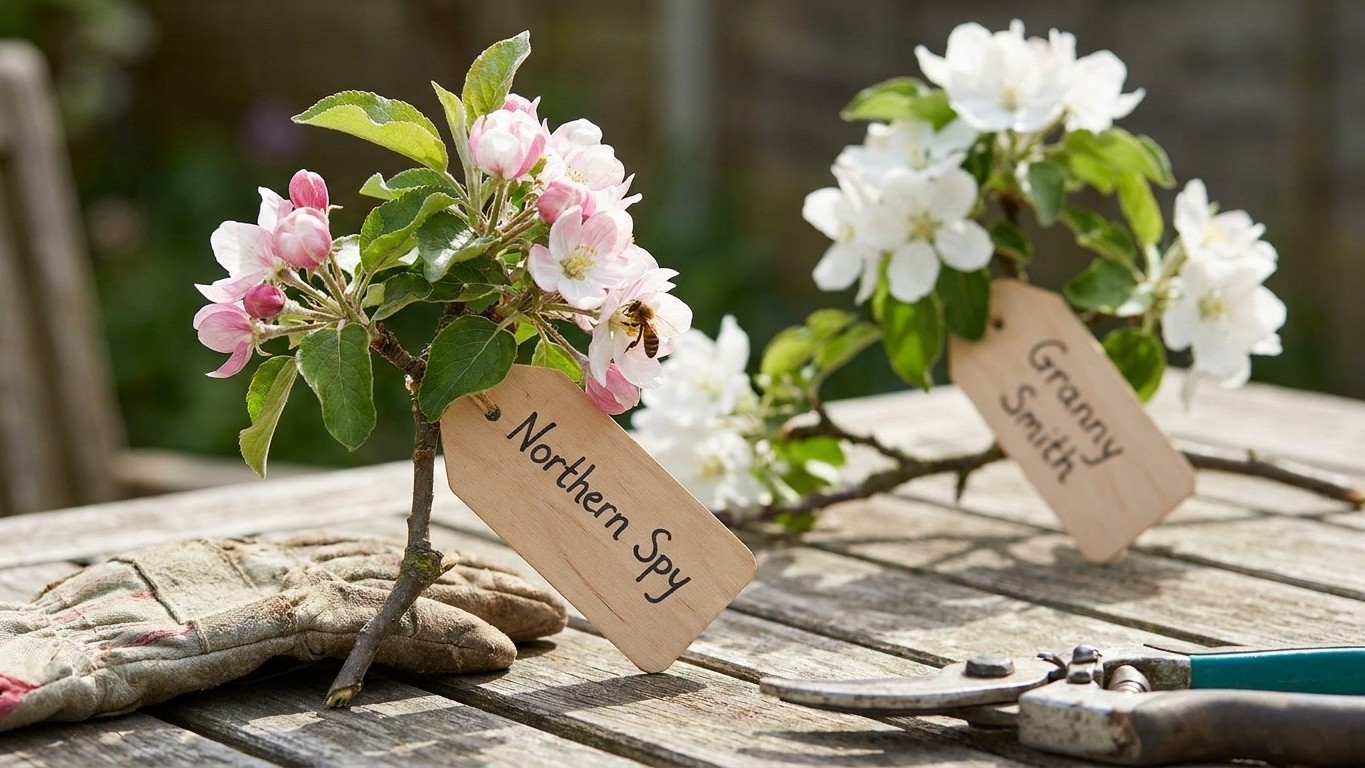

No pollination partner for Northern Spy is documented in the sources behind this page. What is documented is its bloom timing: Utah State University Extension classifies Northern Spy as a Late-blooming apple, with a hardiness range of zones (4)5-8 and an October harvest. The one thing to check before buying a second tree is that its own catalog bloom season is also Late, since that is the lever you actually control.
The short answer
What you actually need is a second apple tree whose own catalog listing also says Late bloom, planted as close to Northern Spy as your space allows. Check that listing before you buy anything, and treat every “compatible variety” claim as unverified until you’ve confirmed its bloom season matches.
Most apple varieties need at least two trees to set a full crop, since nearly all varieties crop better with a compatible partner. The reason a second tree usually solves the problem, rather than a third, is that most varieties carry fertile pollen, so each tree can feed the other back. Some old apple cultivars carry sterile pollen instead, meaning the tree accepts pollen but cannot supply any in return. The extension tables single out only four pollen-sterile varieties—Jonagold, Mutsu, Stayman, and Winesap—and Northern Spy is not among them, so treat two trees as the working minimum, keeping in mind that a third tree becomes necessary only if the partner you choose belongs to that sterile group, since two sterile trees paired together set nothing.
Before planting anything, it helps to work through the basics at Apple Pollination, since bloom timing, bee activity and self-fertility all interact in ways one variety page cannot fully cover. The practical rule for Northern Spy specifically: buy a second tree with its own catalog bloom season listed as Late, plant it as close as the garden allows, and treat any advertised “compatible variety” as unverified until you check that variety’s own bloom-season listing.
Why these varieties and not others

A pollination partner is not a fixed list of names. It is a match in timing. Two apple trees can only pollinate each other if their flowers are open on overlapping days, so nurseries and extension services sort varieties into bloom groups rather than pairing them variety by variety. Clemson Cooperative Extension explains that these groups describe a relative order, not a calendar of dates: an Early bloomer in a region opens before a Midseason variety in that same region, but the actual dates for both shift together with the weather of a given year and the climate of a given place. Northern Spy sits in the Late group according to USU Extension, meaning it opens after most other apples in the same orchard, not on a date you can circle on a calendar.
What the bloom group does not guarantee
Sharing a bloom group with another apple only confirms that the two trees are likely to have open flowers on overlapping days. It says nothing about two other things growers often assume. First, it does not confirm either tree’s pollen is fertile. A Late-blooming variety with sterile pollen can still receive pollen from another Late variety, but it cannot pollinate that variety back, so pairing it with the wrong partner leaves the planting short a functioning tree. Second, sharing a bloom group carries no information about parentage. A variety bred as a seedling of another cannot be reliably fertilized by that parent, even with overlapping bloom, because the two share enough genetic material that the cross often fails to set fruit.
If you are working out bloom groups for a whole young orchard rather than one tree, the same logic applies to any other variety planted alongside Northern Spy. The pages on What Pollinates Ozark Gold, and What Cannot and What Pollinates Autumn Crisp, and What Cannot walk through the same bloom-group check for those two varieties, and the arithmetic is identical: match the group first, then check fertility and parentage before assuming the pairing works.
What cannot pollinate it
This is the section most guides skip, and it is the reason a new Northern Spy tree sometimes blooms heavily for years and never fills out a crop. USU Extension’s variety notes do not name a sterile-pollen partner in Northern Spy’s bloom group, and they do not record a parent-offspring relationship that would rule out a particular cultivar. That is a gap in the published record, not a green light to pair Northern Spy with whatever happens to be on sale at the nursery.
Two exclusions worth understanding even without a named example
Two mechanisms account for almost every pollination failure that is not simply a timing mismatch, and both are worth checking against the catalog description of any variety under consideration.
- A tree with sterile pollen can be pollinated by another Late variety, but it supplies nothing back, so a garden of only those two trees sets no fruit even though both are blooming at once.
- A variety bred as a seedling of Northern Spy, or sharing a parent with it, can carry enough shared genetic material that fertilization fails despite overlapping bloom, the way two full siblings are a weak genetic match.
Neither mechanism is documented for Northern Spy specifically, so treat this as a checklist to run against any candidate variety’s own catalog listing rather than a warning about a named cultivar. If a nursery tag or catalog entry lists a variety as triploid, or notes sterile or non-viable pollen, that variety needs a third tree in the planting to function as a pollinator group, and it should never be one of only two trees in a small yard.
How close the second tree has to be

Pollen moves on bees and other insects, not on the wind, so distance is really a question of how far a foraging bee will travel between two trees in bloom on the same afternoon. The practical answer is closer than you think you need: the same garden beats the same street, and the same street beats a pollinator variety three properties away that a bee may never visit during a short bloom window.
What counts as a partner besides your own second tree
You do not need to own both trees. A neighbor’s apple tree, if it blooms in the same Late window and sits within easy bee range, does the job as well as one in your own yard. An ornamental crabapple flowering at the same time works too, and many gardeners already have one planted for its spring show rather than its fruit. A single grafted branch of a compatible variety, added to an existing tree, also supplies pollen without the space cost of a whole second trunk.
Planting a second tree close by does raise one separate consideration. USU Extension rates Northern Spy as moderately susceptible to fire blight, and a disease that spreads tree to tree in wet weather moves faster between two trees set right next to each other than between two spaced further apart. That is a disease management tradeoff, not a pollination one, but it belongs in the decision about exactly how close to plant.
What none of these options fix is weather. Bees forage far less in cold, wet or windy conditions, and a Late bloom period that runs into a stretch of poor weather can lose most of its pollination window regardless of how many compatible trees are nearby. There is no partner tree or technique that compensates for a week of rain during bloom. The only real defense is more flowering overlap to work with, meaning more than one partner tree if space allows, so a few bad days do not close the whole window.
If there is no room for a second tree
A small yard does not rule out a Northern Spy tree. It rules out planting a full-sized second tree next to it, which is a narrower problem with several workable answers.
| Option | What it involves | What it does not solve |
|---|---|---|
| Multi-grafted tree | Several varieties grafted onto one trunk, one of them a Late bloomer to match Northern Spy | Still needs enough sun and root space for one full-sized tree, and uneven graft growth needs yearly pruning to keep weaker varieties alive |
| Pollinator branch graft | A single scion of a compatible, Late-blooming variety grafted onto the existing Northern Spy tree | Takes a season or two to build enough bloom to matter, and the graft still needs the same bloom-timing check a separate tree would |
| Columnar variety | A narrow, upright apple planted as a second tree in a couple of feet of ground | Still has to bloom in the same Late window, since columnar habit does not change bloom season |
| Ornamental crabapple | Planted for spring flowers as well as pollen, chosen for a bloom period matching Late | Produces little or no fruit itself, and only helps if its bloom actually overlaps Northern Spy’s, which needs checking rather than assuming |
Of these, a pollinator branch grafted onto the tree you already have usually asks the least of a small garden, since it adds no new footprint at all. What none of these four options change is the underlying requirement: whatever you choose still has to open its flowers in the same Late window USU Extension assigns to Northern Spy, and that check has to happen before you graft or plant, not after.
Common questions
Can Northern Spy pollinate itself if I only have one tree?
Nearly all apple varieties, Northern Spy included, crop better with a compatible partner nearby than they do alone. A single tree may still set some fruit some years, but expect a lighter, less reliable crop until a second Late-blooming tree is in range.
Will a wild apple tree down the road pollinate my Northern Spy?
Possibly, if it happens to bloom in the same Late window and sits within reach of the same foraging bees, but there is no way to confirm that without watching both trees flower in the same spring. Seedling and wild apples bloom across a wide range of dates, so treat one as a bonus rather than a plan.
Does Northern Spy work as a pollinator for other late apples?
That depends on whether its pollen is fertile. Buy any partner variety on the strength of its own catalog bloom season and fertility notes, not on an assumption that Northern Spy will do the job for it.
How do I actually check that two trees are blooming at the same time?
Watch both trees directly during bloom rather than trusting a catalog label alone, since bloom groups describe a relative order and the real dates shift with the weather each year. A week or so of overlapping open flowers, observed in your own yard, is the only confirmation that counts.
Can I hand-pollinate Northern Spy with a cut branch instead of planting a second tree?
You can move pollen by hand from a compatible, blooming branch, but that only works if the source pollen is fertile, and Northern Spy’s own fertility is not settled. Hand-pollination saves you nothing if the branch you are using turns out to be a sterile-pollen source.