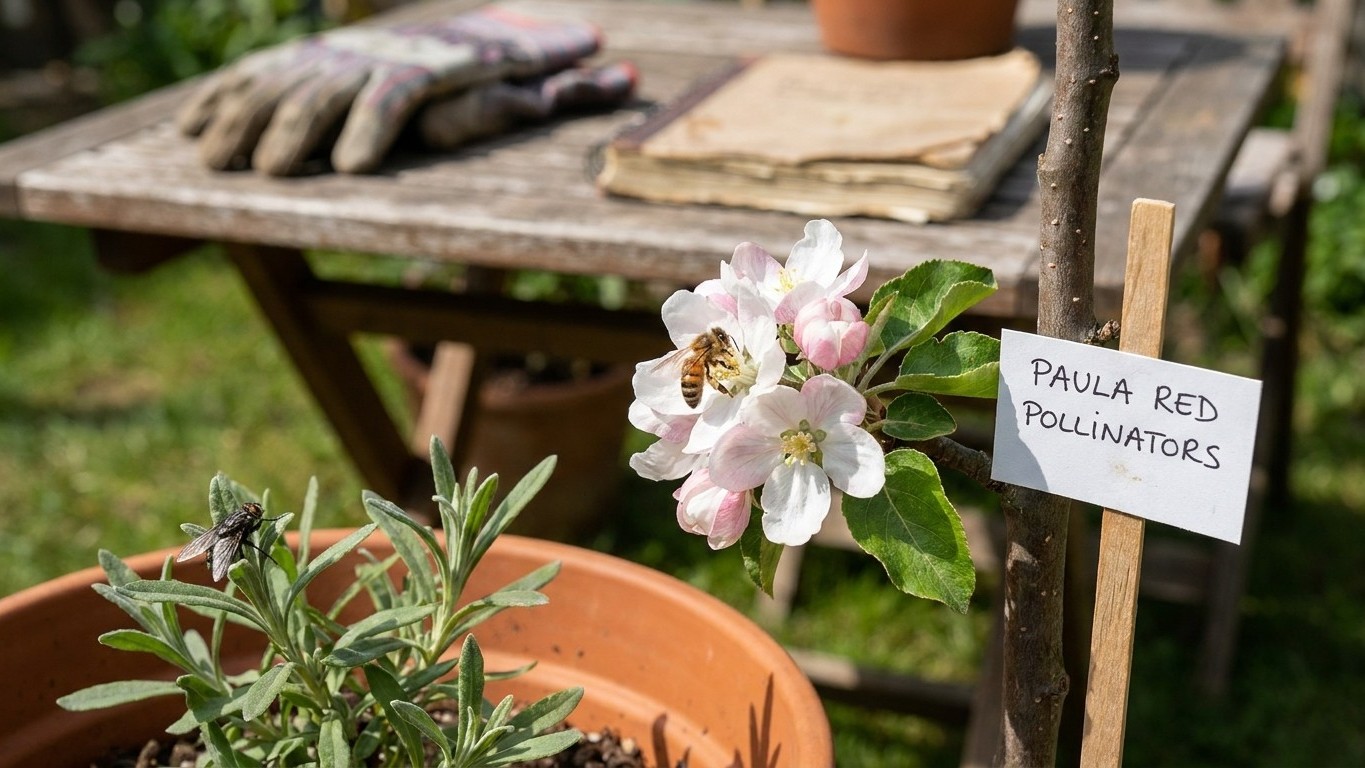

Nothing on record names a partner tree for Paula Red, so if fruit set has been thin, the tree probably isn’t the problem — the lack of a matching neighbor is. Paula Red blooms in the mid-season window, so any healthy apple flowering at the same time nearby stands a good chance of getting the job done. Walk your yard now and check what else is blooming when Paula Red is; if nothing mid-season is close enough for bees to work between the two, that’s the gap to fix this year, not next.
The short answer
USU’s reference for home apple growing does not publish a pollination partner list for Paula Red. That gap is worth stating plainly rather than filling with a guessed name: no source in front of us says plant Paula Red next to a specific variety. What USU does record is Paula Red’s Mid bloom timing, the same window as a large share of the apples sold at American nurseries, which is the practical clue to work with until a named partner shows up in a source we can cite.
How many trees you actually need
Nearly all apple varieties crop better with a compatible partner nearby, and nothing in the record carves Paula Red out as an exception. The question that decides how many trees to plant is whether the partner’s pollen is fertile or sterile. A variety with fertile pollen can fertilize its neighbor and be fertilized in return, so two trees are enough as long as both bloom at the same time. A variety with sterile pollen can accept pollen but never produce any worth using, so pairing it with one fertile variety still works, but two sterile varieties together set no fruit at all. In that case you need three trees: the two sterile varieties plus one fertile variety able to service both.
Since USU’s guide names only four pollen-sterile varieties—Jonagold, Mutsu, Stayman, and Winesap—and Paula Red is not among them, the safest move in a small planting is to pair it with an ordinary mid-season variety and confirm the pairing with a local nursery or extension office before committing two planting holes to it. The mechanics behind all of this, and why an isolated apple tree underperforms even when it manages some fruit, are covered on our Apple Pollination page if Paula Red is the first variety going into the yard.
Why these varieties and not others

A bloom group is not a calendar date, it’s a ranking. Clemson Cooperative Extension describes apple bloom timing as an order that varieties keep relative to each other from one orchard to the next, even though the actual dates on the calendar shift with the season and the region. A variety classed early opens before one classed mid, and mid opens before late, whether that plays out in a cool spring at altitude or a warm one near the coast. Paula Red’s place in USU’s Mid group tells you where it sits in that order, not the day it will open this particular year.
What overlapping bloom does not guarantee
Two trees flowering in the same window is the first requirement for pollination, and it is the only thing a shared bloom group promises. It says nothing about whether the pollen crossing between them is fertile. A handful of apple varieties, through no fault of timing, carry pollen that cannot fertilize anything, a trait tied to their chromosome count rather than to when they flower. Two such varieties can bloom in perfect unison and still set no fruit between them.
Overlapping bloom also says nothing about parentage. A seedling apple and the variety it was bred from can easily land in the same bloom group, since offspring often inherit their parent’s flowering time, but a tree cannot fertilize the parent it came from. This is a separate failure mode from sterile pollen, and it explains why two varieties that look like an obvious match on paper sometimes still fail to cross. The same logic applies if you are working through this question for other trees in the yard, including Prima and Cameo, both worth checking before you plant either one on faith.
What cannot pollinate it
This is the section that would carry a name if one existed, and it is worth being honest about why it does not. USU’s guide does not list a variety with sterile pollen sharing Paula Red’s Mid bloom group, and it does not record a parent-offspring relationship that would rule out an otherwise well-matched neighbor. Rather than guess at either, compatibility beyond bloom timing is not published in the source available to us, and a firm exclusion should not be invented just to fill that gap.
What the gap does not mean
Silence in the record is not a clean bill of health. It means the specific test, whether a given nearby variety’s pollen is sterile toward Paula Red or whether one variety descends from the other, has not been run and published anywhere we can point to. A grower who already owns a variety known elsewhere to carry sterile pollen, usually flagged on the nursery tag or catalogue description, should treat that warning as it stands rather than assume Paula Red is somehow the exception. The general rule holds no matter which specific varieties are in the ground: two sterile-pollen varieties planted together, with nothing else nearby, set no fruit, however well their bloom dates line up.
The same caution applies to parentage. If a variety already on the property is a known seedling or sport of Paula Red, or the reverse, treat that pairing as unreliable even if both tags say Mid bloom. Absent a documented list either way, the practical answer is to plant a variety with ordinary fertile pollen and no known family tie to Paula Red, then watch the actual fruit set over the next two or three seasons rather than trusting the bloom-group label alone.
How close the second tree has to be

Apple pollen moves on insects, mostly honeybees and mason bees, not on the wind, so distance is a practical bee-flight question rather than a fixed number of feet. The closer the two trees, the better the odds, and a partner planted in the same garden bed will outperform one three doors down even if both sit within flying range of a healthy hive.
What else can do the job
The second tree does not have to be one you planted yourself. A neighbor’s apple flowering at the same time counts, provided bees are working both yards during bloom. An ornamental crabapple blooming on the same schedule works too, since crabapples produce abundant, viable pollen and bees do not distinguish between a fruiting apple and an ornamental one. A single pollinator branch grafted onto an otherwise solitary tree solves the same problem without a second trunk taking up ground.
What none of these fixes is weather. A cold, wet, or windy stretch during the bloom window keeps bees in the hive no matter how many compatible varieties stand nearby, and no partner tree or crabapple substitutes for a few days of foraging weather. USU also rates Paula Red Very Susceptible to fire blight, so a grower tempted to push bloom earlier with a warm microclimate should weigh that disease risk against any gain in bloom-window certainty.
If there is no room for a second tree
A small yard does not have to mean no fruit. A few workarounds fit into tight spaces without a second planting hole:
- Multi-grafted tree: several varieties grafted onto one trunk, giving Paula Red a partner on the same root system, though the weaker grafts can get shaded out without regular pruning.
- Pollinator branch: a single scion of a compatible mid-bloom variety grafted onto the existing Paula Red, which takes a couple of seasons before it flowers reliably.
- Columnar variety: an apple bred to grow as a narrow single stem, useful in a border or large container as a standalone second tree.
- Ornamental crabapple: earns its place as a garden feature on its own, and does the pollination job too if its bloom happens to line up with Paula Red’s Mid window.
None of these changes the tree’s eventual size on its own. Whatever rootstock Paula Red or its partner is grafted onto sets the mature height and spread, not the variety, so any small-space solution still needs checking against that rootstock’s size class before it goes into a tight bed.
Common questions
Does Paula Red need a pollinator or will it fruit alone?
It will likely set some fruit alone, but nearly all apple varieties crop better with a compatible partner nearby, and nothing in USU’s guide marks Paula Red as an exception to that.
Can I plant two Paula Red trees together for pollination?
No. Two trees of the same variety are genetically identical, so one cannot fertilize the other. You need a genuinely different variety flowering at the same time.
Will a crabapple growing nearby count as the pollinator?
Yes, as long as it flowers during Paula Red’s Mid bloom window. Crabapples are prolific, reliable pollen sources and bees move between them and fruiting apples without any preference.
My neighbor has an apple tree a couple hundred feet away. Does that help?
It can, if bees are actively working both yards during bloom, but pollination odds drop the farther the partner sits. A tree in your own garden is a safer bet than one relying on a neighbor’s yard and a favorable wind of bees.
When does Paula Red actually ripen?
USU lists Paula Red’s harvest as September, though that figure comes from USU’s reference conditions and can shift earlier or later depending on the season and the local climate.