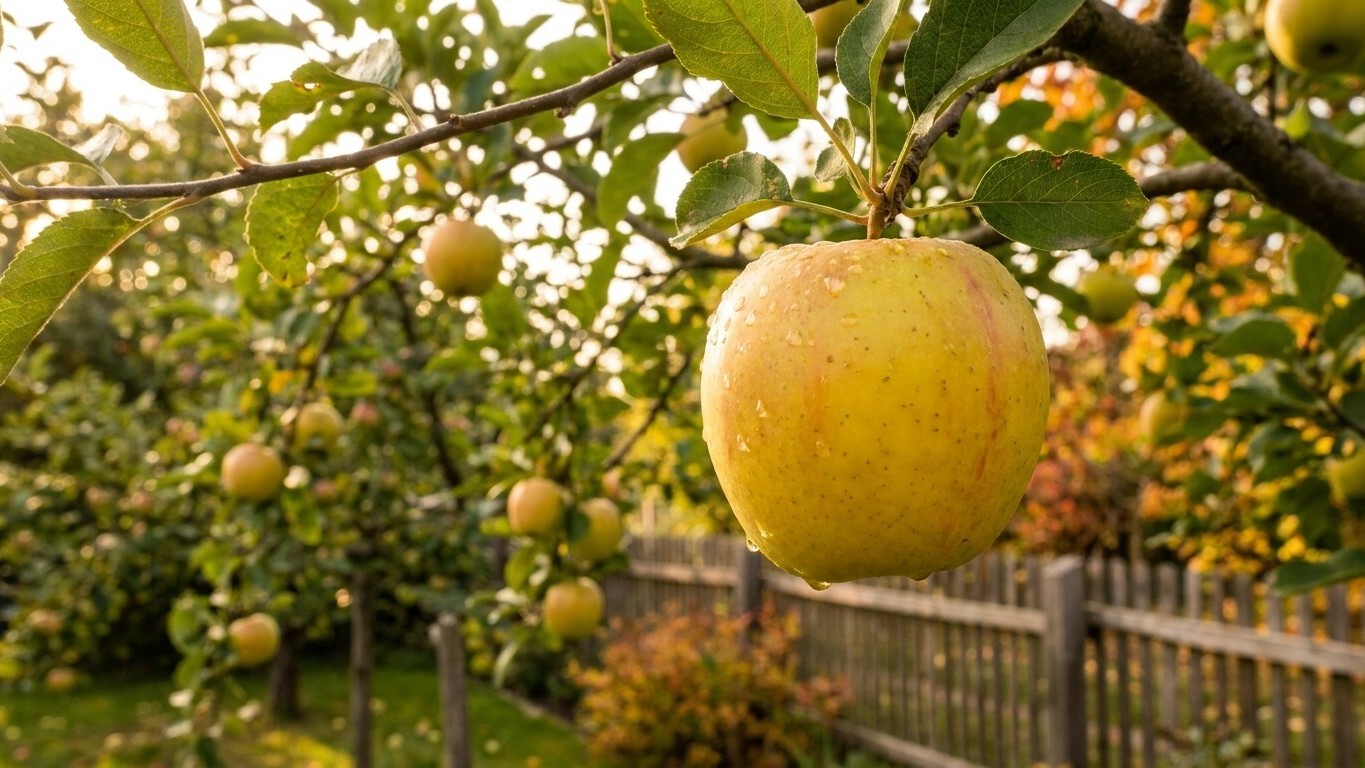

Gold Rush ripens late in the season, holds its tartness through winter storage, and asks for a pollen partner you’ll need to plant yourself since no compatible variety is documented in official extension sources for this cultivar. Here’s what that means for your yard, your climate, and what goes in the ground next to it.
What Gold Rush actually is

A grower picking up a Gold Rush tree is really getting four things, and it helps to see them before getting into the details:
- Ripening window: late September into mid October
- Flavor: semi-tart and juicy
- Best use: good fresh and cooked, with staying power for late-season baking
- Storage: holds its acidity well after harvest
Unlike some apples that carry two names depending on the catalog (Mutsu shows up as Crispin, Pink Lady as Cripps Pink), Gold Rush doesn’t have that confusion. What you see on the nursery tag is what you’re planting.
The flavor is where this variety earns its following. Ohio State University Extension describes the eating quality as semi-tart and juicy, a step sharper than the honeyed sweetness of a Fuji or Gala. That bite isn’t a flaw. It’s the reason the apple works in the kitchen long after most fall varieties have gone soft and mild. According to OSU Extension, Gold Rush is good fresh and cooked, and it keeps its acidity in storage, so it stays useful for baking late in the season. That’s the practical distinction between a dessert apple and a pie apple: flesh that holds its shape under heat, and acid that doesn’t fade after months in a cool room. A lot of sweeter varieties turn mushy and flat by January. Gold Rush doesn’t.
Bloom timing falls in the mid season, per USU Extension, which matters more than it sounds like once you start thinking about pollination (more on that below). The harvest window itself, late September into mid October, puts this apple among the last picked in most home orchards, which is exactly why its storage life matters so much to people who grow it.
Will it grow where you are
Hardiness zone range
USU Extension lists Gold Rush as hardy across zones 4 through 8. That’s a wide band, running from cold-winter regions in the upper Midwest and northern New England down through much of the transition zone into the warmer mid-South. If you’re in zone 4 or 5, winter cold isn’t the limiting factor here. If you’re in zone 8, the tree should survive the cold season without trouble. But hardiness zone is only half the picture, and it’s the half most catalogs stop at.
Winter chill requirement
The other filter is winter chill, the number of cold hours a tree needs during dormancy to break bud properly and flower on schedule the following spring. This is the number that actually determines whether an apple tree thrives or sulks in a given climate, and it’s separate from cold hardiness entirely. A tree can survive winter lows just fine and still fail to fruit well if it doesn’t get enough chill hours, or it can rot from disease pressure in a climate too mild for its own good.
What can be said with confidence is that apples as a category are cold-climate fruit, and a variety hardy to zone 4 is built for regions with real winters, not the low-chill zones of the Deep South or coastal Southern California where stone fruit and citrus take over. If you’re gardening in zones 4 through 8, and especially in the cooler half of that range, Gold Rush is working with a climate it’s suited to. Gardeners further south or in genuinely mild winter regions should check with a local extension office before planting, since chill accumulation varies enormously even within a single state.
What to plant beside it
This is the section most people search for, and here the honest answer matters more than a confident-sounding guess. No compatible pollination partner is confirmed for Gold Rush. That’s not the same as saying Gold Rush doesn’t need one. Nearly all apple varieties crop better with a compatible partner nearby, since the vast majority aren’t reliably self-fertile enough to set a full crop from their own pollen. A tree standing alone in a yard may still produce some fruit in a good year, especially if a neighbor’s crabapple happens to be within bee range, but yields are almost always lighter and less consistent.
What this means practically: if you’re planting Gold Rush, plan on adding a second apple variety nearby, one that blooms in the same window. USU Extension lists Gold Rush’s bloom season as mid, so a good pollen partner is another mid-season bloomer, something that flowers at roughly the same time so the bees have overlapping windows to move pollen between trees. Early-blooming and late-blooming varieties can miss each other by two or three weeks in a cool spring, which defeats the purpose entirely.
A few things worth remembering before you buy a second tree:
- Bloom timing has to overlap, not just the general season, but the actual week the flowers open
- A parent variety cannot reliably pollinate its own seedling, so check parentage before assuming two related apples will work together
- Crabapples are a practical backup pollen source in a small yard where a second full-size apple tree isn’t an option
The most reliable path is to check a dedicated pollination chart before choosing a second tree, and to ask the nursery directly whether the variety they’re selling alongside Gold Rush has a documented bloom overlap. For a fuller rundown on how apple pollination timing works and which pairings tend to succeed across varieties, see our apple pollination guide.
Growing it well
Fire blight pressure
USU Extension rates Gold Rush as moderately resistant to fire blight. In practical terms, that means the tree isn’t immune. In a wet spring with the right bacterial pressure, you can still see blackened, wilted shoot tips that look scorched, the classic sign of the disease. But moderate resistance means outbreaks tend to be less severe and less frequent than on a highly susceptible variety, and a grower who prunes out infected wood promptly in dry weather usually keeps it under control without losing the tree.
Growth habit and thinning
Gold Rush trees tend toward an upright habit, which affects how much light gets into the canopy and how the fruit distributes itself on the branches. Dense upright growth can shade the interior, so some structural thinning during dormant pruning helps sunlight reach developing fruit and keeps the tree from turning into a tangle over the years.
Biennial bearing tendency
Like a number of late-season varieties, Gold Rush can lean toward biennial bearing, a heavy crop one year followed by a light one the next, if the fruit load isn’t managed. Hand-thinning young fruit down to one apple per cluster in a heavy year, done a few weeks after bloom, helps even out production from one season to the next and keeps limbs from breaking under an overloaded crop.
Picking it and keeping it
USU Extension puts the harvest window at late September into mid October, but a calendar date is only a starting point. The actual moment to pick is best judged on the tree itself, using a simple sequence of checks:
- Lift and twist a sample apple gently upward. If it separates from the spur easily, it’s ready; if it resists and you have to pull hard, give it more time
- Cut one open and check the seeds. Fully ripe apples have brown to dark brown seeds; pale or greenish seeds mean the fruit needs another week or more
- Check the ground color beneath any red blush. As the apple ripens, the background color shifts from green toward a yellow-gold undertone
Storage conditions
Because Gold Rush keeps its acidity well after harvest, it’s one of the better long-storage apples for a home grower without commercial cold storage. A cool, humid spot, a root cellar, an unheated garage corner, or the back of a refrigerator, extends usable life well past when sweeter, softer varieties would already be mealy. That staying power is exactly why it remains a go-to for baking well into winter, when most of the fall harvest has already been eaten or composted.
Common questions
When does Gold Rush ripen?
Late September into mid October, according to USU Extension, making it one of the later apples to come off the tree in most home orchards.
Is Gold Rush a good pie apple?
Yes. OSU Extension notes it’s good fresh and cooked and keeps its acidity in storage, which means the flesh holds up under heat and the flavor doesn’t go flat, exactly what a pie filling needs.
What pollinates Gold Rush apple trees?
No specific compatible variety is published in the sources reviewed for this page. Plant another mid-season bloomer nearby and confirm the bloom overlap with a nursery or extension pollination chart before relying on it.
What hardiness zones can grow Gold Rush?
Zones 4 through 8, per USU Extension. Winter chill hour requirements aren’t published for this variety, so gardeners at the warm edge of that range should check with a local extension office.
Does Gold Rush get fire blight?
It’s rated moderately resistant by USU Extension, meaning outbreaks are possible in wet conditions but tend to be milder than on highly susceptible varieties, and are manageable with prompt pruning.