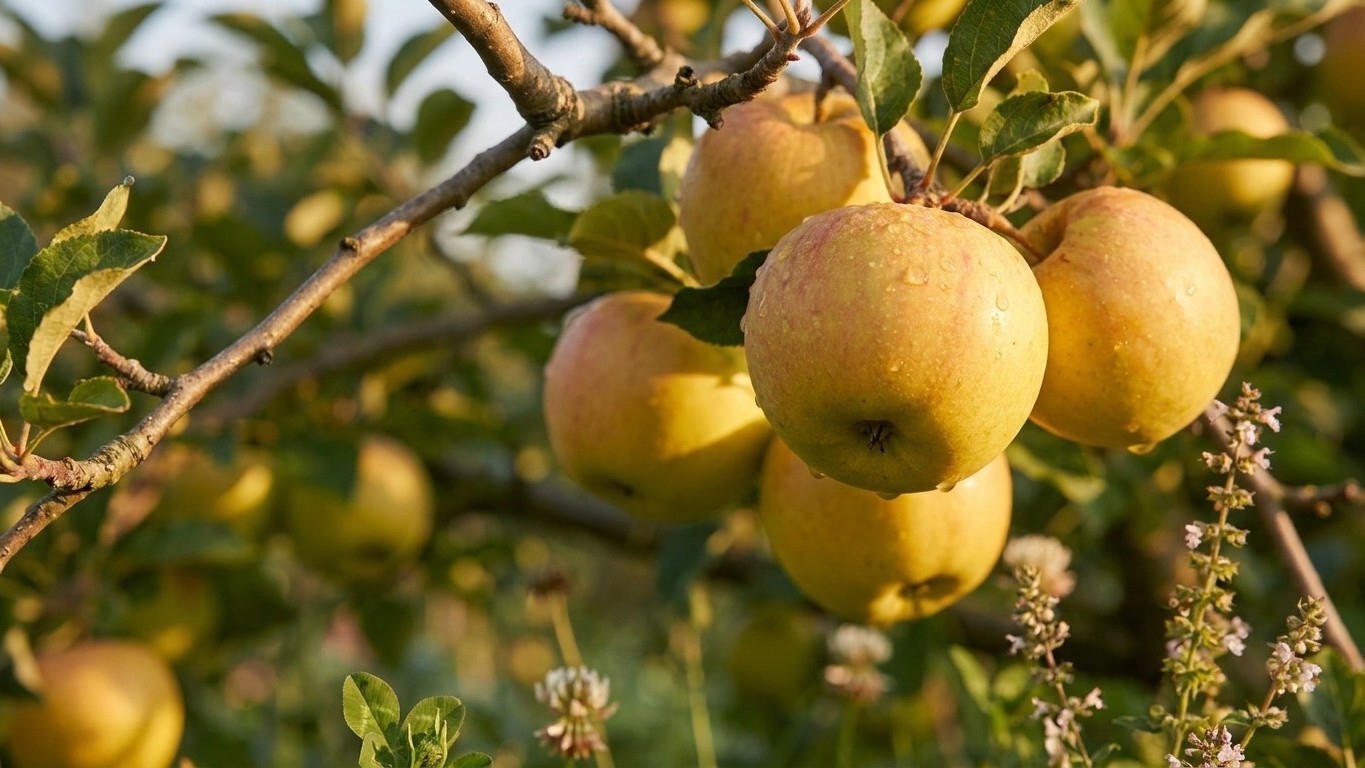

Golden Supreme is a late-September dessert apple prized for sweet, honeyed flesh and low acidity, hardy across USDA zones 4-8, with a bloom season that runs mid to late spring. If you’re weighing whether it belongs in your yard, the answer turns on three things: your climate, what you plant next to it, and how you handle the harvest window.
What Golden Supreme actually is

Before anything else, here’s what a grower actually gets with this variety:
- Ripens: late September to early October
- Taste: sweet and honeyed, tender flesh, low acidity
- Best for: eating fresh or cooking into a sauce without added sugar
- Keeps: a fresh-eating apple, not bred for long cold storage
Utah State University Extension’s guide to apple production lists Golden Supreme with a mid to late bloom season and a harvest window of late September to early October, putting it squarely in the second wave of fall apples, after the earliest varieties are already picked and before the true late-keepers come off the tree.
The eating experience is what sets this apple apart from a sharper, firmer variety. The flesh is tender rather than crisp, and the acidity is low enough that the sweetness carries the whole bite. That combination makes it a fine hand fruit for someone who wants dessert-level sweetness without the tartness of a Granny Smith or a Jonathan.
In the kitchen, that same low acidity and tender flesh point toward one use more than another. It’s best fresh or cooked into a sauce where its own sugar does the work, because it needs no added sweetening. A pie apple, by contrast, needs flesh that holds its shape under heat and acid that doesn’t disappear when cooked, and Golden Supreme isn’t built for that job. Treating it like a firm baking apple in a pie shell will get you a softer, sweeter filling than the recipe expects. Treat it like what it is, a fresh eater and a sauce apple, and it performs exactly as advertised.
Will it grow where you are
Hardiness zones 4 through 8
Golden Supreme is rated for USDA hardiness zones 4 through 8, according to USU Extension. That’s a wide band, stretching from cold-winter states like Minnesota and Vermont down through the mid-South. It’s not a single-zone plant, so don’t rule it out just because your winters get genuinely cold or your summers run hot and humid. The range matters more than a single number, because a tree planted at zone 4 faces a very different winter than one at zone 8, even though both are technically within range.
Winter chill, the filter most people skip
Hardiness zone tells you whether the tree survives winter. It doesn’t tell you whether it fruits well the following year. That’s a separate question, governed by winter chill, the number of cumulative hours a tree needs at cold-but-not-freezing temperatures to break dormancy properly and bloom on schedule. Apples in general lean toward the higher end of the chill spectrum compared to, say, a fig or a pomegranate, which is part of why the whole category clusters in cooler and temperate states rather than the Deep South or the low desert.
For Golden Supreme specifically, a published chill-hour figure isn’t available in the sources behind this guide, so it isn’t stated here as a number. What is clear from the hardiness range and bloom timing is that this variety belongs on the cooler and temperate end of the country’s apple map, not in a mild-winter coastal or low-desert setting where chill accumulation runs short most years. If you’re gardening in zone 7 or 8, it’s worth checking with a local extension office before committing, since chill accumulation varies block by block in warmer zones far more than it does further north.
What to plant beside it
This is usually the question that brings someone here, and it deserves a straight answer: a specific list of pollination partners for Golden Supreme isn’t published in the sources behind this guide. That’s worth saying plainly rather than guessing at a name, because planting the wrong partner wastes a growing season and, with apples, a few years of tree establishment before you find out.
What can be said with confidence is the general rule that governs every apple variety, including this one. Nearly all varieties crop better with a compatible partner nearby, because apple pollen doesn’t reliably fertilize flowers on the same tree in the quantities needed for a full crop. Some varieties are partly self-fertile and will set a light crop alone, but yields go up sharply once a second variety, or even a crabapple with overlapping bloom time, is planted within bee range.
Two other wrinkles matter here, and they trip up more gardeners than the basic self-fertility question does:
- Bloom timing has to overlap. Golden Supreme blooms mid to late season, so a partner that flowers very early and finishes before Golden Supreme opens won’t help, even if it’s a fine apple in every other respect.
- A variety can have sterile pollen. Some apples can be pollinated but produce pollen that can’t fertilize anything else, so they need a partner but can’t return the favor, meaning the third tree in a small orchard still needs a fertile pairing between the other two.
- A parent can’t pollinate its own seedling. Where a variety is a direct offspring of another, that parent tree typically can’t fertilize it, even with overlapping bloom, so lineage matters as much as timing.
Since Golden Supreme’s own parentage and pollen fertility aren’t detailed in the sources used here, the safest path is to plant it alongside two other apple varieties with mid to late bloom overlap, rather than betting the harvest on a single unconfirmed pairing. For a fuller walkthrough of how to match bloom windows and check fertility before you buy, see our apple pollination guide.
Growing it well
Fire blight: moderately susceptible
USU Extension rates Golden Supreme as moderately susceptible to fire blight, a bacterial disease that spreads fastest during warm, wet bloom periods. In the garden, that rating shows up as blackened, wilted shoot tips that curl into a shepherd’s-crook shape, usually starting at blossoms or new growth in late spring. It’s not the most vulnerable rating an apple can carry, but it’s enough to warrant real attention rather than a wait-and-see approach. Prune out any infected wood well below the visible damage, sanitizing tools between cuts, and avoid heavy nitrogen fertilizer that pushes soft, blight-prone new growth right when the bacteria are most active.
Cropping and thinning
Like most apple varieties that set a heavy bloom, Golden Supreme benefits from hand-thinning young fruit down to one apple per cluster, spaced several inches apart, a few weeks after bloom. Thinning isn’t cosmetic. It redirects the tree’s energy into fewer, larger apples and reduces the swing between a heavy crop one year and a light one the next, a pattern common enough across apple varieties in general that it’s worth building the habit regardless of which variety you’re growing.
Rootstock decides the size, not the variety
Whatever mature height you’re picturing for a Golden Supreme tree, that number comes from the rootstock it’s grafted onto, not from the variety itself. A dwarfing rootstock keeps the tree small and easier to spray, prune, and pick from the ground; a semi-dwarf or standard rootstock produces a much larger tree with a longer wait before first fruit. Ask specifically which rootstock a tree is grafted to before you plant, since that answer matters more to eventual size and spacing than the variety name on the tag.
Picking it and keeping it
USU Extension puts the harvest window for Golden Supreme at late September to early October, but a calendar date is only a starting point. Weather shifts that window by a week or more in either direction depending on the year, so the tree itself is the better guide. Work through these checks in order:
- Lift and twist: cup a fruit in your hand, lift it to a horizontal angle, and give a gentle twist. A ripe apple separates from the spur cleanly, without tugging or tearing bark.
- Seed color: cut one test apple open. Seeds that have turned fully brown signal the fruit is mature; pale or greenish seeds mean it needs more time.
- Ground color: check the background skin color, away from any red blush, and look for it to shift from green toward yellow, matching the variety’s typical finish.
Storage
Golden Supreme is built for fresh eating rather than months in a root cellar. Sweet, low-acid, tender-fleshed apples of this type tend to soften faster in storage than firm, high-acid varieties bred for long keeping. Plan to eat or process most of the crop within a few weeks of picking, and keep whatever you’re not using immediately in a cold, humid environment, such as a refrigerator’s crisper drawer, to slow softening as long as possible.
Common questions
Is Golden Supreme related to Golden Delicious?
The name suggests a connection, but the sources behind this guide don’t document Golden Supreme’s parentage, so no lineage claim is made here.
Can I grow Golden Supreme in a container?
Nothing in the facts above addresses container growing specifically. What does matter is rootstock: a dwarfing rootstock is the piece that makes container culture realistic for any apple variety, so ask for one by name when buying.
Does Golden Supreme need a second tree to fruit at all?
Nearly all apple varieties crop far better with a compatible partner nearby, and a documented partner list for Golden Supreme isn’t available here, so planting at least two other mid to late blooming apples nearby is the safer approach.
Why does the fire blight rating matter if my area rarely gets it?
Moderately susceptible still means real risk during a warm, wet spring, which is unpredictable year to year even in areas that don’t see the disease often. Pruning habits and nitrogen management are worth keeping up regardless.
Is Golden Supreme a good pie apple?
Not really. Its tender flesh and low acidity are suited to fresh eating and sauces, but a pie needs flesh that holds shape and acid that survives baking, qualities this variety wasn’t bred for.