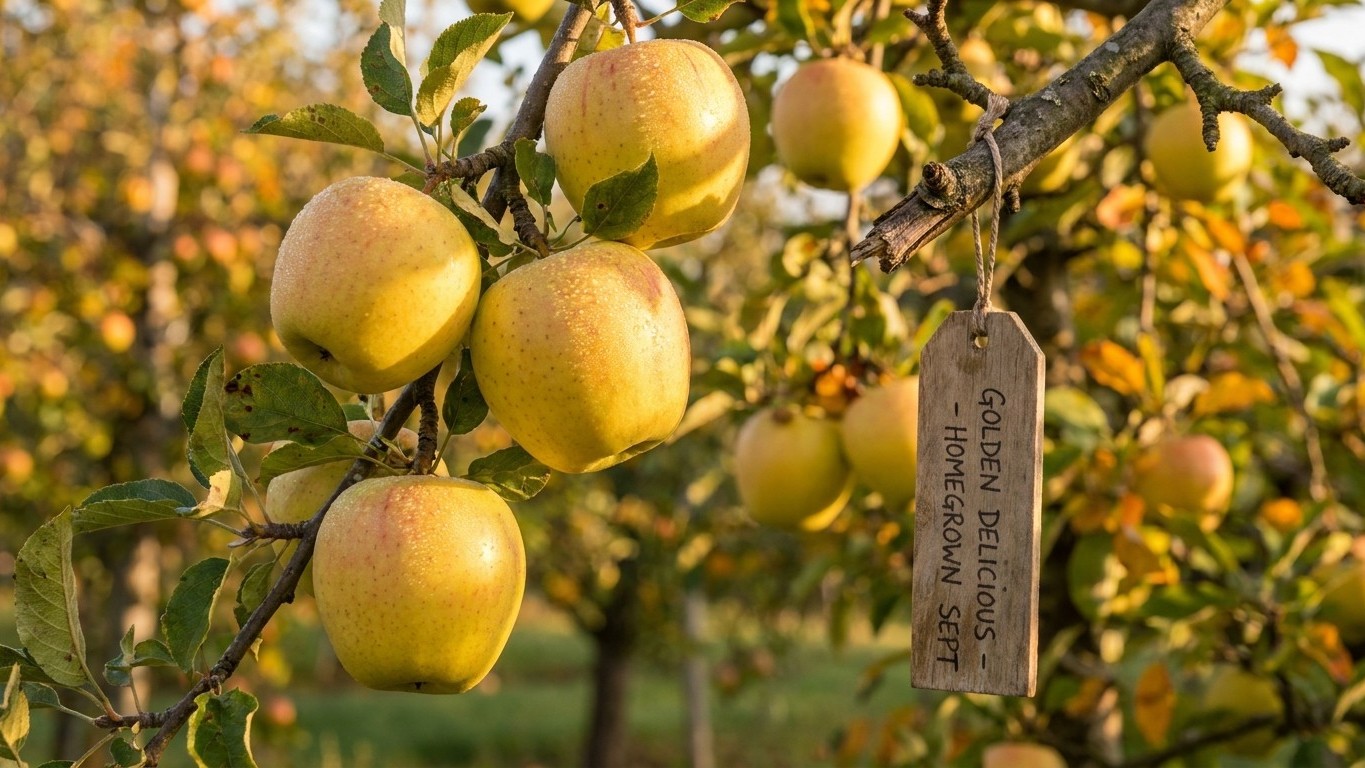

Golden Delicious ripens late in the season, from late September into October, and rewards the wait with a firm, sweet apple built for the fruit bowl and the salad bowl rather than the pie dish. It’s sold under its own name almost everywhere in the U.S., unlike Mutsu (marketed as Crispin) or Pink Lady (sold as Cripps Pink), so what you see on the nursery tag is what you plant. It’s a dependable dessert variety for home orchards in USDA zones 4 through 8. The catch: like nearly every apple, it needs a compatible partner tree nearby, and not just any tree flowering at the same time will do.
What Golden Delicious actually is

A Golden Delicious tree gives the home grower four straightforward facts to work from:
- Ripens: Late September to October
- Tastes: Firm, crisp; sweet
- Suited for: Fresh eating or salads
- Keeps: Well in cool storage, though the longest published figures assume commercial controlled-atmosphere rooms
The ripening window comes from Utah State University Extension’s guide to apple production for home gardens, which places this variety in the late-harvest group alongside other apples that need most of the growing season to finish. The eating quality and kitchen use come from Clemson Cooperative Extension’s HGIC 1350 variety table: firm, crisp flesh with a genuinely sweet flavor, best suited to fresh eating and salads rather than cooking.
That last point matters more than it sounds. A dessert apple and a pie apple aren’t interchangeable, and the reason is physical, not just a matter of taste. Pie apples hold their shape under sustained oven heat because their flesh stays firm and their acidity cuts through added sugar. Golden Delicious is milder and less acidic, so it tends to soften and turn one-dimensional after twenty minutes at 375°F. Slice it raw into a salad or eat it out of hand and none of that matters.
On storage, the source is careful to separate two very different numbers. What a home grower gets from a cool cellar or a spare refrigerator drawer is one figure. What shows up in produce-industry literature assumes controlled atmosphere, rooms with regulated oxygen and temperature that only a packhouse can run. Nobody with a root cellar should expect the commercial figure. Expect this apple to hold its quality well into the cooler months in ordinary cool, humid storage, and treat any longer figure you see elsewhere as a packhouse number, not yours.
Will it grow where you are
Hardiness zones
USU Extension places Golden Delicious in USDA hardiness zones 4 through 8. That’s a wide band, and it’s worth reading as a range rather than picking one zone and stopping there: a tree in zone 4 faces winter lows a standard tree elsewhere never sees, while a zone 8 planting deals with a much shorter, milder winter and hotter summers. The variety tolerates both ends reasonably well, which is part of why it’s planted from the mountain West to the mid-Atlantic.
Winter chill
Hardiness zone isn’t the only filter. Winter chill, the number of cold hours a tree needs to break dormancy properly, decides just as much, and it’s the one most home gardeners never check before buying. A specific chill-hour figure for Golden Delicious isn’t published in the sources behind this guide, so none is given here rather than guessed at. What the hardiness range does tell you is that this is a variety built for regions with a real winter, not the mild coastal South or the low desert Southwest, where insufficient chill leaves apple trees blooming late, unevenly, or not at all. If you garden somewhere winters barely dip near freezing, that’s the bigger question to answer before the hardiness map even comes into play.
What to plant beside it
Nearly all apple varieties crop better with a compatible partner nearby, and Golden Delicious is no exception. It falls into bloom group C, a mid-season flowering group, which sets the order it opens relative to other varieties rather than fixing a calendar date. The named partners that can pollinate it are:
- Arkansas Black
- Ozark Gold
- Priscilla
- Rome Beauty
Any one of those, planted within pollinating distance and flowering at overlapping times, should set a good crop of Golden Delicious. For a broader look at how bloom timing and compatibility work across varieties, see our apple pollination guide.
Here’s where it gets specific, and where a lot of home orchards go wrong. Jonagold and Stayman both flower at the same time as Golden Delicious, so on paper they look like fine partners. They aren’t. Both carry sterile pollen, meaning they can be pollinated by other varieties but can’t return the favor. Plant only Golden Delicious next to Jonagold or Stayman and you’ll get a beautiful bloom and a disappointing harvest, because matching bloom times isn’t the same as matching pollen. If either of those two is already in your yard, or on your must-plant list, you’ll need a third tree, one of the four named partners above, to get fruit from all of them.
This is also a case worth flagging for anyone assuming a seedling or a related variety will pollinate its parent. It doesn’t always work that way in apples generally: a parent variety can be genetically incompatible with its own offspring even when the bloom windows line up. The safest approach stays the same one nurseries recommend for any apple planting: pick from the named compatible list, plant within roughly 50 feet, and don’t rely on guesswork about what’s blooming next door.
Growing it well
Fire blight
USU Extension rates Golden Delicious as moderately susceptible to fire blight. In the garden, that shows up as blackened blossoms and shoot tips that curl into a shepherd’s-crook shape, usually after a warm, wet spring during bloom. It’s not the most vulnerable variety on the market, but it’s not resistant either, so the usual precautions apply: skip heavy nitrogen fertilizer, which pushes soft, blight-prone new growth, and prune out any infected wood well below the visible symptom during dry weather, disinfecting shears between cuts.
Growth habit
How large the tree ultimately gets depends on rootstock, not on the Golden Delicious variety itself. Nurseries typically offer it grafted onto dwarfing or semi-dwarfing rootstocks for home gardens, which keeps the tree manageable for pruning, spraying, and harvest without a ladder. Anyone comparing mature sizes across trees should ask what rootstock each one is grafted to before assuming the numbers are comparable.
Biennial bearing and thinning
Like many productive dessert apples, Golden Delicious can fall into a pattern of a heavy crop one year followed by a light one the next if the fruit is left to set unchecked. Thinning young apples down to one per cluster in late spring, once the “June drop” has passed, spreads the tree’s energy more evenly across seasons and tends to produce steadier, better-sized fruit year after year instead of a boom-and-bust cycle.
Picking it and keeping it
Harvest runs late September into October, per USU Extension, but a date on a calendar is a starting point, not a signal. The tree itself tells you when it’s ready:
- Lift and twist a sample apple gently. If it separates from the spur with a light twist, without tearing, it’s likely ready.
- Cut one open and check the seeds. Ripe apples generally show brown to dark brown seeds; pale or greenish seeds mean more time is needed.
- Check the ground color, the background color beneath any blush. As Golden Delicious matures, that background shifts from green toward a fuller yellow.
Run all three checks on a few fruit before picking the whole tree, since apples on the sunnier, outer branches often ripen ahead of those inside the canopy.
Storage
Once picked, Golden Delicious holds up well in ordinary cool, humid storage, a root cellar, an unheated garage, or a spare refrigerator drawer, and keeps its eating quality for a meaningful stretch into the colder months. Longer figures floating around in produce literature assume controlled-atmosphere storage, the regulated, low-oxygen rooms commercial packhouses use, and those numbers don’t apply to a home setup. Store fruit unwashed, check periodically for soft spots, and remove any apple that starts to go, since one bad apple genuinely does affect its neighbors in storage.
Common questions
Is Golden Delicious self-pollinating?
Not reliably. Like nearly all apple varieties, it sets a better crop with a compatible partner nearby, such as Arkansas Black, Ozark Gold, Priscilla, or Rome Beauty, rather than relying on its own pollen alone.
Can I plant Golden Delicious next to Jonagold?
They bloom at the same time, but Jonagold has sterile pollen and can’t pollinate Golden Delicious. You’ll need a third variety from the compatible list in the yard for either to fruit well.
Is Golden Delicious good for baking or pies?
It’s classed for fresh eating and salads rather than cooking. Its flesh softens and its flavor flattens under sustained oven heat, unlike firmer, more acidic pie apples that hold their shape.
How cold-hardy is Golden Delicious?
USU Extension lists it for USDA zones 4 through 8, a wide range that covers most of the continental U.S. outside the mildest, low-chill regions.
How do I know when to pick Golden Delicious?
Check three things together: whether the apple lifts and twists free easily, whether the seeds have turned brown, and whether the background skin color has shifted from green toward yellow. Harvest generally falls late September into October.