
A New York Early bulb only forms where summer daylight runs long enough, roughly between 38 and 50 degrees north latitude. Below that band the plant stays leafy and never bulbs at all, and what does form tends to rot in the root cellar rather than keep. Check your latitude against that range before you order seed, not after the plants are six inches tall and going nowhere.
Will New York Early bulb where you are

New York Early is a long-day onion. It sets a bulb only after the days get long enough to trigger that response, and its published range for doing that reliably is 38 to 50 degrees north latitude. That covers most of the northern half of the country and Canada’s southern tier, from around the New York-Pennsylvania border up through the Great Lakes states and New England and on into the Pacific Northwest.
Outside that band, the plant does not simply make a smaller onion. It puts out leaves all season, waiting for a day length that never arrives where you live, and by the time cold weather shuts things down you’re left with soft green tops and no bulb worth pulling. Whatever did start to swell rarely cures out into anything that stores. This is the one fact on this page that decides whether the variety is worth growing at all, so it’s worth getting right before you commit a row to it.
Why day length matters more than heat
It feels backwards, but onions bulb in response to hours of daylight, not to temperature. A long, hot stretch in a southern garden will not push a long-day onion into bulbing if the days themselves are short. Counterintuitively, it’s the far north that gets the longer summer days, which is exactly why long-day types like New York Early are bred for northern latitudes and short-day types are bred for the Gulf Coast and the Southwest. Heat affects how fast the plant grows leaves; day length decides when it stops growing leaves and starts growing a bulb.
If you garden close to either edge of that 38 to 50 degree range, you’re in a blurred zone rather than a clear yes or no. A gardener at 37 degrees north might still get bulbs in a warm year with good early growth, and one at 51 degrees might get by most seasons but see it falter in a cool, cloudy one. Nobody can hand you a hard line at 38 or 50. What you can do is know that the closer you are to the middle of that range, the more predictable this variety will be, and the closer to either edge, the more you’re gambling on the specifics of a given year. If you want a variety with a different day-length behavior for a garden outside this range, it’s worth comparing notes with a page like Onion Varieties before you settle on seed.
What New York Early tastes like, and what to do with it
An onion’s bite comes from volatile sulfur compounds. The more of them a bulb produces, the sharper it tastes raw, and the same compounds act as a chemical shield in storage, which is why pungent onions last through winter and mild ones don’t. New York Early sits on the sweet side of that line: it carries few sulfur compounds, so the flesh is gentler on the tongue, but that mildness is exactly what leaves it undefended once it’s out of the ground. There’s no way to have both the sweetness and the shelf life; the trade-off is built into the chemistry.
That puts New York Early firmly in the eat-it-fresh camp rather than the cure-and-store camp. Treat it as a season onion: pull it, use it soon, and don’t count on it holding through the winter in a mesh bag the way a storage variety would. It’s suited to slicing raw for sandwiches and salads, or cooking where you want onion flavor without the sharp aftertaste that a pungent bulb leaves behind. What it is not suited to is sitting in a root cellar until spring.
Color reinforces the same point rather than adding a new one. Yellow onions, as a group, are the best keepers of the three common colors, with red in the middle and white the shortest-lived. That general ranking exists because of the same sulfur-compound pattern, not because of pigment itself. New York Early is yellow, which would normally suggest better-than-average storage odds — but the documented sulfur content for this variety overrides that tendency here. Low sulfur wins out, and the practical result is a sweet, fresh-eating onion despite its yellow skin, not a yellow onion that keeps.
What New York Early is like
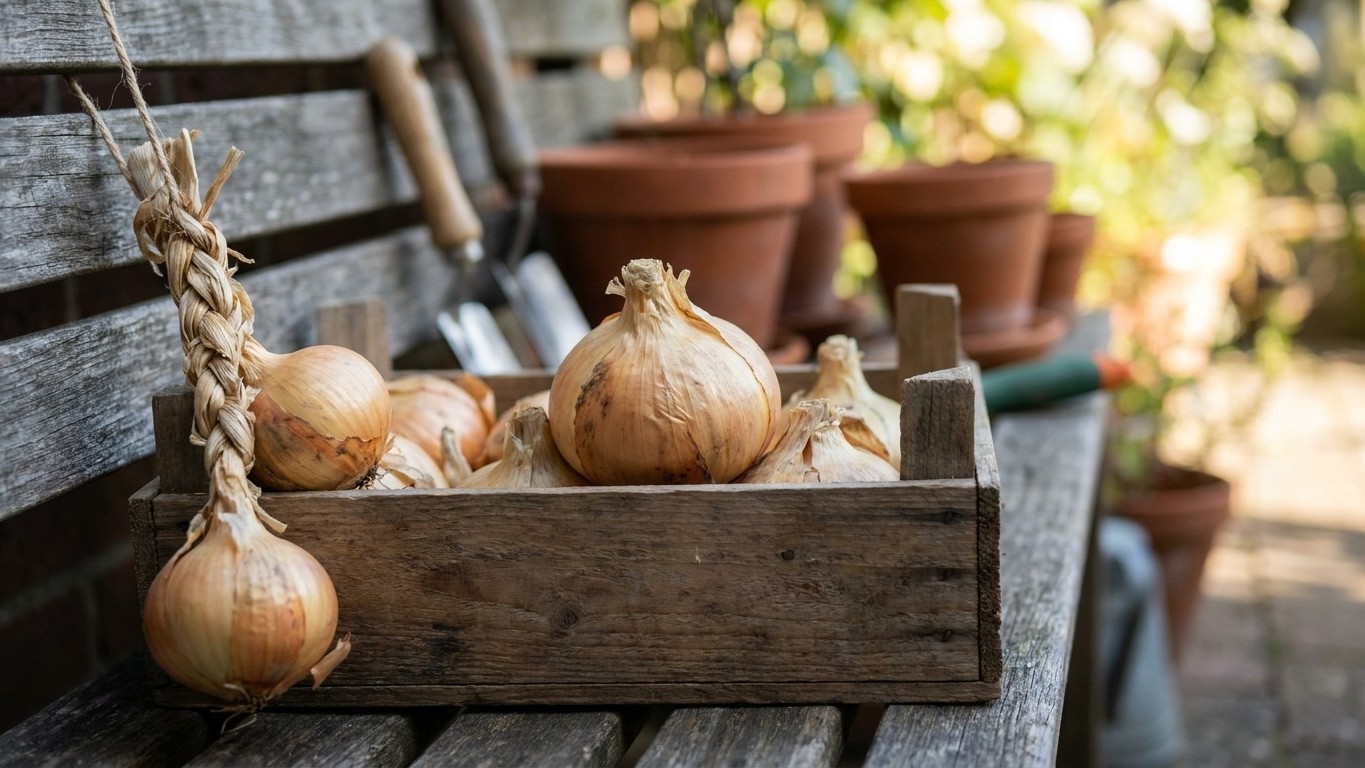
Once it does bulb, New York Early produces a yellow onion, globe-shaped, of medium size, maturing in about 98 days from transplant. That figure is counted from the date you set out transplants, not from seeding, and it will shift by a week or so either direction depending on how warm or cool the season runs.
The flavor is on the sweet side. It carries relatively few of the sulfur compounds that give a storage onion its bite, which is exactly what makes it pleasant eaten fresh, sliced raw into a sandwich or cooked quickly in a pan. But that sweetness comes at a direct cost, and it’s a mechanism worth understanding rather than a coincidence: the same sulfur compounds responsible for a sharp, eye-watering onion are also what protect the bulb’s cell structure in storage. Strip most of them out and you get a milder onion that also breaks down faster once it’s out of the ground.
What that means for how you use it
In practical terms, New York Early keeps for about three months under decent storage conditions. That’s not a flaw so much as the trade-off you’re buying when you choose a sweet yellow onion over a pungent one. Treat it as a variety to eat through in the months right after harvest rather than one you’re counting on for the pantry come spring. If you want a bulb that will still be sound in March, that’s a different variety with a different flavor profile, and no amount of curing technique on this one will change what’s already set by its chemistry.
When to plant it
Planting timing for onions follows the day-length group, and this trips up a lot of gardeners who assume every onion goes in the ground at the same time everywhere. Short-day types are planted in autumn in mild-winter regions and harvested the following late spring. Long-day types, which is where New York Early belongs, go in during late winter to early spring in the north, giving the plant a full stretch of cool weather to build leaf growth before the long days of early summer trigger bulbing.
That timing matters less as a calendar date and more as a growth target. What actually determines bulb size is not the day you planted, but how large the plant’s tops are at the moment day length crosses the threshold that triggers bulbing. A small, stressed seedling that hits that trigger point still bulbs, but it bulbs small, because it only has as much leaf mass on hand as it’s grown by then. A well-established plant with several strong leaves at that same moment channels a lot more into the bulb.
The test that matters more than the date
So the real question to ask isn’t “did I plant on the right day,” it’s “is this plant big enough before the days get long.” That means getting transplants in early enough, and giving them conditions to grow steadily, rather than fussing over an exact planting date. A gardener further along in choosing varieties for their region might find it useful to look at how a related type like the Frontier Onion handles this same timing question, since the underlying logic of tops-before-bulbing applies across long-day varieties generally.
Growing it well

Onions are shallow-rooted and slow to establish a canopy, which makes them poor competitors against anything growing faster nearby. Weeds cost you bulb size directly, not just indirectly: every bit of light, water and nutrients a weed takes is light, water and nutrients that don’t go into leaf growth before bulbing starts, and leaf growth at that point is what the bulb is built from. A weedy onion bed doesn’t just look untidy, it produces smaller onions across the board.
The same logic applies to water. Onions don’t have the root system to go looking for moisture the way a deeper-rooted crop does, so a dry stretch during the leaf-growing weeks shows up later as undersized bulbs, even if the plant looks fine at the time. Keeping the top few inches of soil consistently moist during that stretch matters more than any single heavy watering later on.
Watch for bolting
Bolting is the other thing to watch for. A plant that sends up a flower stalk has shifted its energy into seed production, and a bulb from a bolted plant will not store well even if it looks normal at harvest. The fix isn’t complicated: pull bolted plants and use them first, fresh, rather than setting them aside for storage. They’ll taste fine. They just won’t last.
- Keep the bed weeded from the day seedlings go in, since onions can’t outcompete anything.
- Water consistently through the leaf-growing stage, before bulbing starts.
- Pull any plant that sends up a flower stalk and eat it right away.
Harvesting and keeping it
The signal that New York Early is ready has nothing to do with the calendar. The tops fall over on their own, flopping down at the neck as the bulb finishes sizing up and the plant shifts out of active growth. That’s the cue to stop watering and let the bed dry out, not a date circled weeks in advance.
Curing before storage
Curing is the step most gardeners skip, and it’s the reason a lot of home-grown onions rot within a few weeks of coming out of the ground. After pulling, the bulbs need to sit somewhere warm, dry and well-ventilated until the necks dry down and go papery, tight and closed rather than thick and moist. That papery neck is what keeps moisture and rot organisms out during storage. Skip it, or rush it, and even a well-grown bulb will start softening within days of going into a bin.
Once cured, New York Early keeps for about three months. In practical terms, that means treating it as a onion for the season it’s harvested in rather than one to ration out over winter. Plan to work through it in the months right after curing, in salads, on the grill, in anything where you want a mild, sweet onion rather than a sharp one, and reserve the pantry-through-spring role for a variety bred for that instead. If you’re weighing that longer-keeping role against this one, the Elsye Onion is worth a look for comparison on both flavor and storage life.