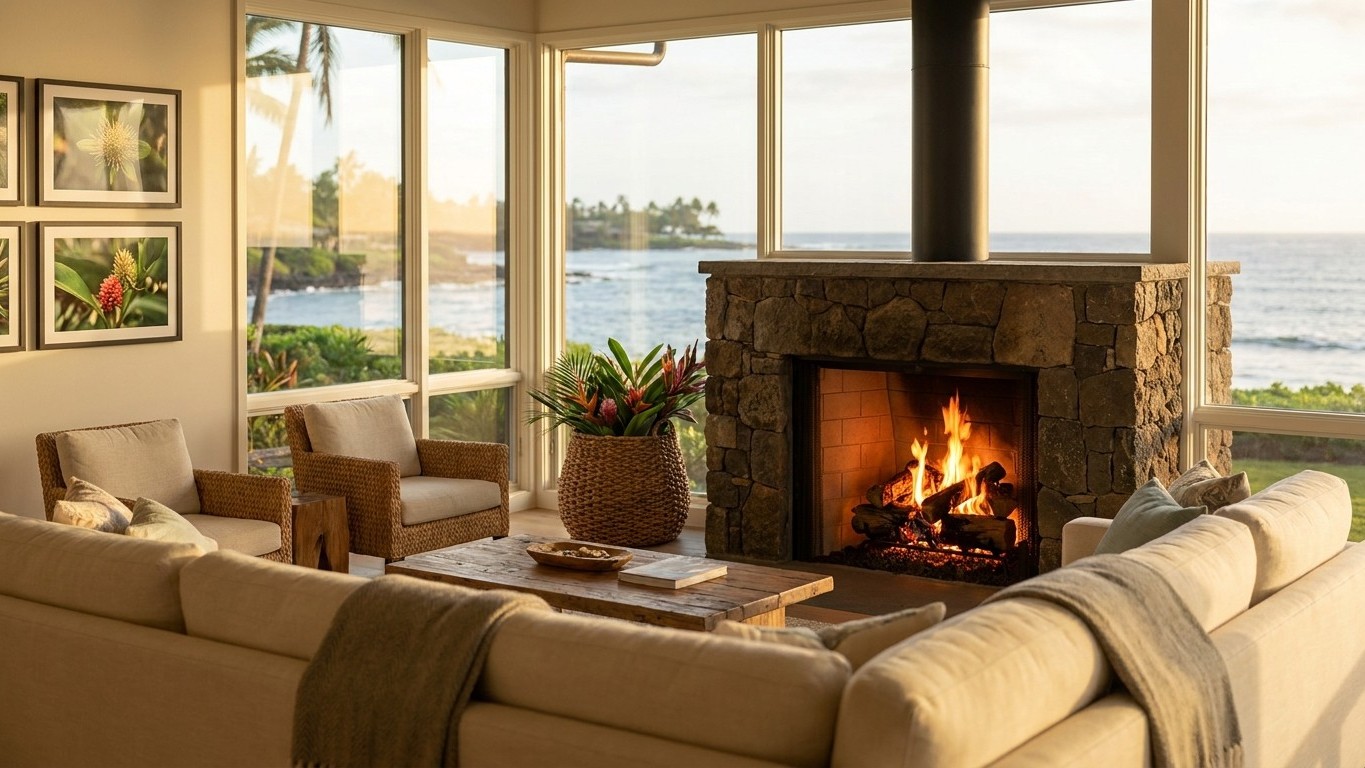

Firewood in Hawaii isn’t about survival. With winter lows that barely dip below 67°F, a woodstove here is closer to a fireplace on a cruise ship than a lifeline against frostbite. What matters instead is picking wood that burns clean for ambiance, doesn’t waste money on species you don’t need, and dries fast enough in island humidity to actually be ready when you want it.
How cold it actually gets here
The number that decides everything about firewood on any territory guide is the average low of the coldest month. For Honolulu, the reference station for the islands, that figure is 66.8°F, according to NOAA’s 1991-2020 Climate Normals. That’s not a typo, and it’s not the record low from some freak storm decades ago. It’s the average minimum temperature during the coldest stretch of the year, and it’s warmer than most mainland readers keep their thermostat set in July.
Compare that to a place where the coldest-month low sits in the teens or single digits, and you start to see why the entire calculus of firewood changes on this page. Where winter genuinely threatens pipes and bodies, a homeowner needs to know how many cords will carry them through months of sustained heating demand. Here, the question is different. Nobody in Hawaii is burning wood to keep from freezing overnight.
What a 66.8°F low does mean is that any wood heat in the islands is discretionary. Maybe it’s a stove in a mountain cabin on the Big Island where elevation knocks a few degrees off the coastal average. Maybe it’s an outdoor fire pit on a rare chilly evening in Waimea or up in the Kula district on Maui, where nights can feel crisper than the official numbers suggest. Either way, the fire is there for light, smell, and the social pull of gathering around flame, not because the alternative is hypothermia.
That distinction changes what “worth the effort” means for wood selection. On a mainland cold-climate page, density and BTU output per cord are survival math: get it wrong and you run out of heat in February. In Hawaii, getting it wrong just means a fire that burns faster than you’d like, or one that smokes more than it should. Lower stakes, but not zero stakes; anyone who has fought a smoky, damp fire in a beach house living room knows it can ruin an evening just as effectively as it would ruin a cold night anywhere else. Write off wood quality here as irrelevant and you’ll still end up frustrated a few times a season.
So this page is written for the reader whose winter doesn’t demand tonnage. It’s written for whoever wants a good fire, not a rescue plan.
Which woods are worth the effort here
On a colder territory, the whole conversation starts with density, because a cord is a fixed volume (4 feet by 4 feet by 8 feet, or 128 cubic feet, packed with wood and air gaps) and a denser cord simply packs more burnable mass into that same box. Michigan State University Extension puts the average heat value of a cord of well-seasoned hardwood at about 20 million BTU, roughly equivalent to 145 gallons of #2 fuel oil or 215 gallons of LP gas. That’s the number that matters when a stove is the only thing standing between a household and a genuinely cold night.
In Hawaii, that 20-million-BTU average is still useful, but it’s not the deciding factor it would be somewhere with a coldest-month low near freezing. Nobody here needs to squeeze every possible BTU out of a cord to make it through a heating season, because there effectively isn’t one. What actually matters locally is availability and dryness, more than density rankings pulled from a mainland species chart.
This is where local reality overrides theory. A dense hardwood species that would be the obvious choice in a cold-climate guide might be nearly impossible to source seasoned on an island where firewood isn’t a mainstream commodity. Shipping costs, limited demand, and the sheer logistics of importing cordwood to an archipelago mean that what’s actually sitting at a local supplier, already split and dried, often matters more than what a density table says is theoretically best. A moderate species you can buy properly seasoned this week beats a supposedly superior one you’d have to special-order and then wait months to dry.
For the reader trying to match wood to purpose rather than chase a theoretical maximum, the practical split is simpler than a full species-by-species breakdown. Lighter, faster-burning wood is what you want for getting a fire going quickly and for shorter, casual evening fires, the kind that don’t need to hold coals overnight because nobody’s counting on that heat at 4 a.m. Denser wood, wherever you can source it seasoned, is what you reach for on the rare night you actually want a long, slow burn, say for an extended gathering or a stove that’s expected to hold through several hours.
The honest advice for anyone shopping firewood in the islands: ask the supplier how it was dried and how long, before asking what species it is. A well-seasoned average hardwood outperforms a poorly dried premium one every time, and that gap matters more here, where drying conditions are trickier, than it does in a dry mainland climate where wood seasons itself in a few months without much effort.
How much wood a winter takes
Any published number claiming “you’ll need X cords a winter in Hawaii” should be treated with suspicion, because that figure depends on three things that vary from one household to the next, and none of them are fixed by geography alone.
The first is the cold figure itself, and in Hawaii’s case that figure is so mild that the entire premise of “getting through winter” on wood heat mostly doesn’t apply. The second is how well the specific structure holds heat: a beach house with single-pane windows and no insulation loses whatever warmth a fire produces almost as fast as it’s generated, while a tighter, well-sealed cabin holds it. The third is whether wood is the primary heat source or purely supplemental, which in the islands it almost always is; very few Hawaii households depend on a woodstove as their main heating system, because there’s rarely enough sustained cold to justify one.
That third variable is the one that most separates Hawaii from a cold-climate territory. Where wood is the main heat source, running out mid-winter is a real emergency, so estimates there tend to run generous on purpose. Where it’s supplemental or purely for atmosphere, as it is across nearly all of Hawaii, the estimate shrinks to “how many evenings a season do you actually want a fire,” which is a personal habit question, not a climate math problem.
The mechanism that would make an estimate swing wildly in a colder climate, a poorly insulated house needing roughly double the wood of a tight one in the same winter, still applies in principle here, just at a much smaller scale. A drafty lanai-adjacent room will eat through a stack of wood faster than a closed, insulated den, even if the total volume either one uses in a year is modest by mainland standards. The lesson carries over even though the stakes don’t: fix the draft before buying more wood, because insulation always outperforms volume.
For most Hawaii households, the practical approach is to buy in small batches as needed rather than laying in a full cord for a season that may only bring a handful of fire-worthy evenings. That keeps wood fresher, avoids storage headaches in a humid climate, and matches the actual, modest demand.
Drying wood in this climate
Seasoning matters more than species selection everywhere firewood is burned, and Hawaii is no exception, but the islands’ humid, warm climate changes the timeline in ways worth understanding before buying or cutting anything.
MSU Extension is specific about the target: firewood should burn at 20 percent moisture content or less, while green, freshly cut wood can run over 60 percent. That difference isn’t cosmetic. Water inside the wood has to boil off before any of the wood’s stored energy becomes usable heat, and that boiling process consumes energy that would otherwise go toward warming a room. A fire built from green or under-seasoned wood spends much of its output just fighting its own moisture, which shows up as hissing, sizzling, heavy smoke, and a stove that never quite gets hot.
In a typical mainland climate, split and properly stacked wood reaches that 20 percent target after one full summer of air moving through the stack. Hawaii’s humidity works against that timeline. Persistent moisture in the air slows evaporation from split wood the same way it slows laundry drying on a line, and the source is explicit that it’s air movement and time that dry wood, not direct sun exposure. A pile crammed against a humid wall with no airflow will stay wet far longer than one stacked loosely with open space on all sides and some cover from rain.
Red oak gets a specific mention as an exception even in mainland conditions: MSU notes it dries slowly due to its cell structure and needs more time than most hardwoods regardless of climate. In a slower-drying environment like Hawaii’s, that kind of species would need even more patience than a mainland stacking season would suggest, another reason to ask a supplier directly how long a given batch has actually been drying rather than assuming a species-based rule of thumb applies unchanged.
Tie this back to the cold figure that opened this page, and the most common local mistake becomes obvious: wood split in spring for burning that same year is rarely ready by the time anyone wants a fire, even in a climate as mild as Hawaii’s. If a fire is planned for a specific gathering or a stretch of cooler evenings up in Kula or Volcano, the wood for it needed to be split and stacked with real airflow months earlier, not weeks. Buying pre-seasoned wood from a supplier who can say honestly how long it’s been drying remains the simplest way around that timing trap.