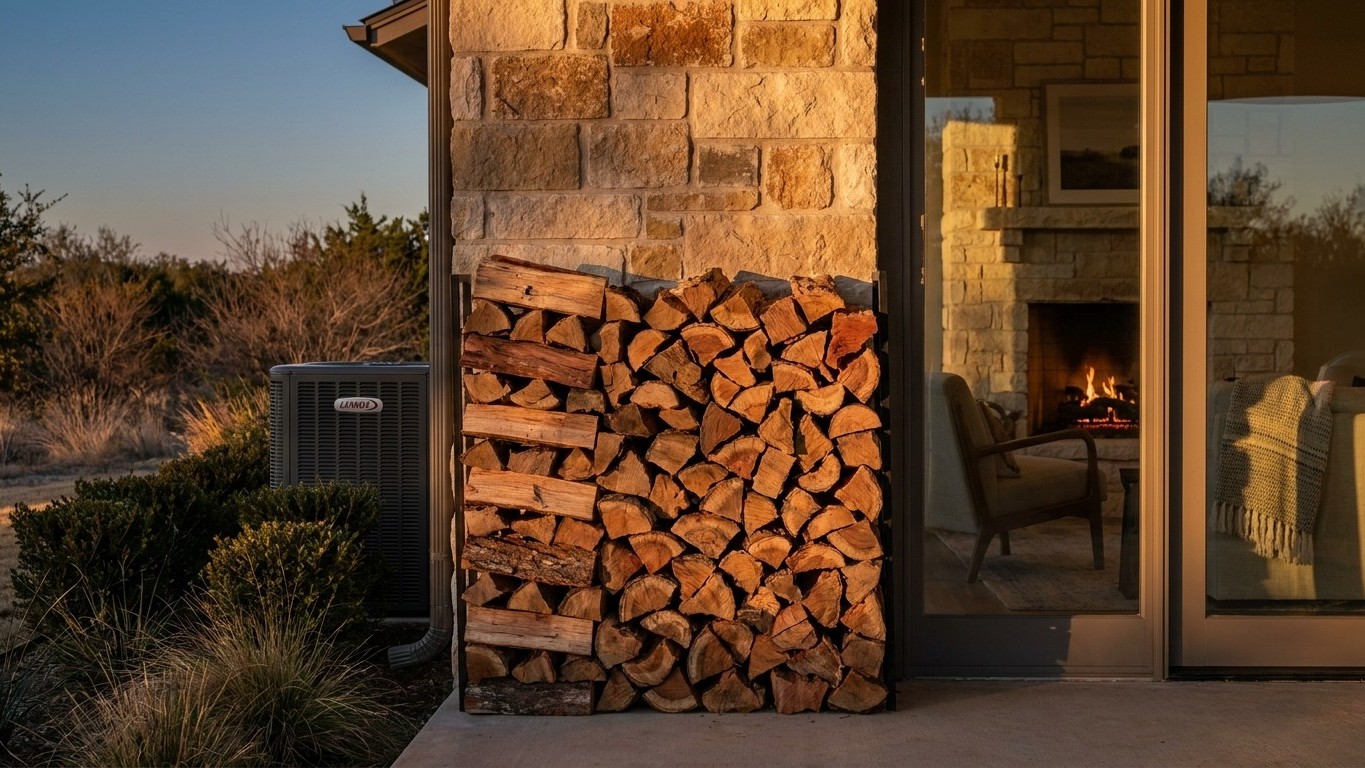

The average low in Houston’s coldest month sits at 43.7°F, according to NOAA’s 1991-2020 climate normals. That number changes the whole conversation about firewood in Texas: this is not a state where a wood stove keeps a family alive through January. It’s a state where a fire is a choice, and that changes which species matter and how much you actually need to stack.
How cold it actually gets here

Forty-three point seven degrees is a mean minimum, not a record low and not a daily average. It’s the number NOAA uses to describe how hard a typical cold snap bites in the coldest stretch of the year, and for most of Texas, that answer is: not very hard. Compare that to states where the same figure drops into the teens or single digits, and where a furnace failure in January is a genuine emergency. Here, a night in the low 40s is uncomfortable, not dangerous, for a house with working insulation and a working HVAC system.
That doesn’t mean wood heat is pointless. It means the job it’s doing is different. In a place where winter bottoms out near 44°F on average, a fire is rarely the only thing standing between a household and hypothermia. It’s supplemental heat for the handful of nights that do dip lower, and it’s ambiance for the many nights that don’t need heat at all. That’s a legitimate reason to burn wood. It’s just not the same reason a homeowner in Minnesota or Maine has.
What this means for how you shop
Once you accept that framing, the buying decision gets simpler. You’re not stockpiling for survival, so you don’t need to over-buy out of fear of running short mid-February. You’re buying for a handful of genuinely cold nights, plus whatever number of “nice to have a fire going” evenings you want through the season. That’s a smaller, cheaper, more manageable pile of wood than the multi-cord stacks you’ll read about in colder-climate firewood guides, and it’s worth saying plainly so you don’t over-order and end up with wood you’re still burning through two summers later.
There’s also a practical upside to a mild winter climate: seasoning wood is easier here than almost anywhere else in the country, a point that matters more later in this guide. The tradeoff is that dense, slow-burning species that make sense in a northern climate (built for an overnight burn through single-digit cold) are less necessary here. You can lean toward wood that’s easy to source and easy to season, rather than chasing the single densest species on the market.
Which woods are worth the effort here
Density is the variable that decides how much heat comes out of a cord, because a cord is a fixed volume (4 feet by 4 feet by 8 feet, or 128 cubic feet) no matter what species fills it. A denser species packs more wood fiber, and therefore more potential heat, into that same box. According to Michigan State University Extension, a cord of well-seasoned hardwood delivers roughly 20 million BTU on average, comparable to about 145 gallons of #2 fuel oil or 215 gallons of LP gas. That average hides real variation between species, and it assumes the wood is properly seasoned, which matters as much as the species itself.
In a mild-winter climate like most of Texas, the case for chasing the single densest, slowest-burning wood on the market is weaker than it would be further north, because you’re rarely trying to carry a fire through eight hours of hard cold. What matters more is having something dense enough for the genuinely cold nights, something easy to light for everything else, and above all something you can actually buy locally and get seasoned in time. A prized dense species that sits at the yard unseasoned, or that you can’t source consistently, is worse than a modest hardwood you can get split, stacked, and dry.
Reading the comparison
The table below sorts common firewood categories by how they behave in a firebox, not by per-species BTU figures. Use it to match wood to the job: dense hardwood for the coldest nights and for an overnight burn, lighter or resinous wood for starting a fire or for a quick evening blaze that doesn’t need to hold heat for hours.
| Wood category | Relative density | Smoke | Sparks | Best use |
|---|---|---|---|---|
| Dense hardwood (oak, pecan, mesquite) | High | Low once seasoned | Low | Coldest nights, overnight burn |
| Medium hardwood (hackberry, ash) | Medium | Moderate | Low to moderate | General everyday burning |
| Softwood/resinous (cedar, pine) | Low | Heavier, more creosote-prone | Higher | Kindling, quick starts, shoulder season |
None of these categories are worth much if you can’t find them seasoned near you. Local availability, not the table, is usually the deciding factor: ask what a local seller actually stocks and how long it’s been split and stacked before you plan a season around a species you’ve only read about.
How much wood a winter takes
There’s no honest single number for “how many cords a Texas winter needs,” and any guide that hands you one without asking about your house is guessing. The real answer depends on three things working together, and changing any one of them can double or halve what you actually burn.
- The cold figure for your area. A mean coldest-month low near 44°F, like Houston’s, means far fewer heating-degree hours than a location where that figure drops into the 20s, even within the same state.
- How well your house holds heat. An older home with gaps around doors, thin attic insulation, and single-pane windows can lose heat fast enough that it needs close to double what a tightly sealed, well-insulated house needs in the identical outdoor climate.
- Whether wood is your main heat source or a supplement. A household using a wood stove or fireplace insert as backup to a working furnace burns a fraction of what a household relying on wood as primary heat needs, even if both live in the same neighborhood.
Run your own situation down that list before you buy. If your coldest-month lows resemble Houston’s, your house is reasonably sealed, and wood is purely supplemental, you’re likely looking at a fraction of a single cord for the whole season, mostly used on the handful of genuinely cold nights plus however many evenings you want a fire for its own sake. If your house leaks heat badly or you’re leaning on wood more heavily, adjust upward accordingly, and lean toward buying a little more than you think you’ll need rather than running out mid-winter and buying unseasoned wood in a hurry.
Drying wood in this climate
Seasoning matters more than species selection almost everywhere, and Texas is no exception. Michigan State University Extension puts the target at 20 percent moisture or less to burn efficiently; green, freshly cut wood can hold more than 60 percent moisture, and every bit of that water has to boil off inside the firebox before the wood gives off usable heat. That’s energy you paid for in wood that goes toward steam instead of warmth in your living room.
What actually dries wood is airflow and time, not sunshine, which is a common misconception. Wood needs to be split first, then stacked loosely enough that air moves through the pile, ideally off the ground and under some cover to shed rain while the sides stay open. Texas’s warm, often humid summers can work for or against you here: heat helps evaporation, but humidity slows it, so a stack that would dry in a matter of weeks in a dry western climate may need a full season here to get properly under 20 percent.
The most common mistake
Wood cut and split in spring is usually not ready for the following winter, no matter how warm the summer felt. MSU’s guidance is that split, stacked wood typically needs a full summer of airflow to reach that 20 percent target, and red oak is a named exception that dries even more slowly because of its cell structure, so it needs extra time beyond that baseline. If you’re buying or cutting wood in spring for this year’s cool season, plan to burn it next winter instead, and use whatever’s already fully seasoned from last year’s stack for the fires you’re building right now. A moisture meter, cheap and widely available, is the only reliable way to know where your wood actually stands rather than guessing by how many months have passed.