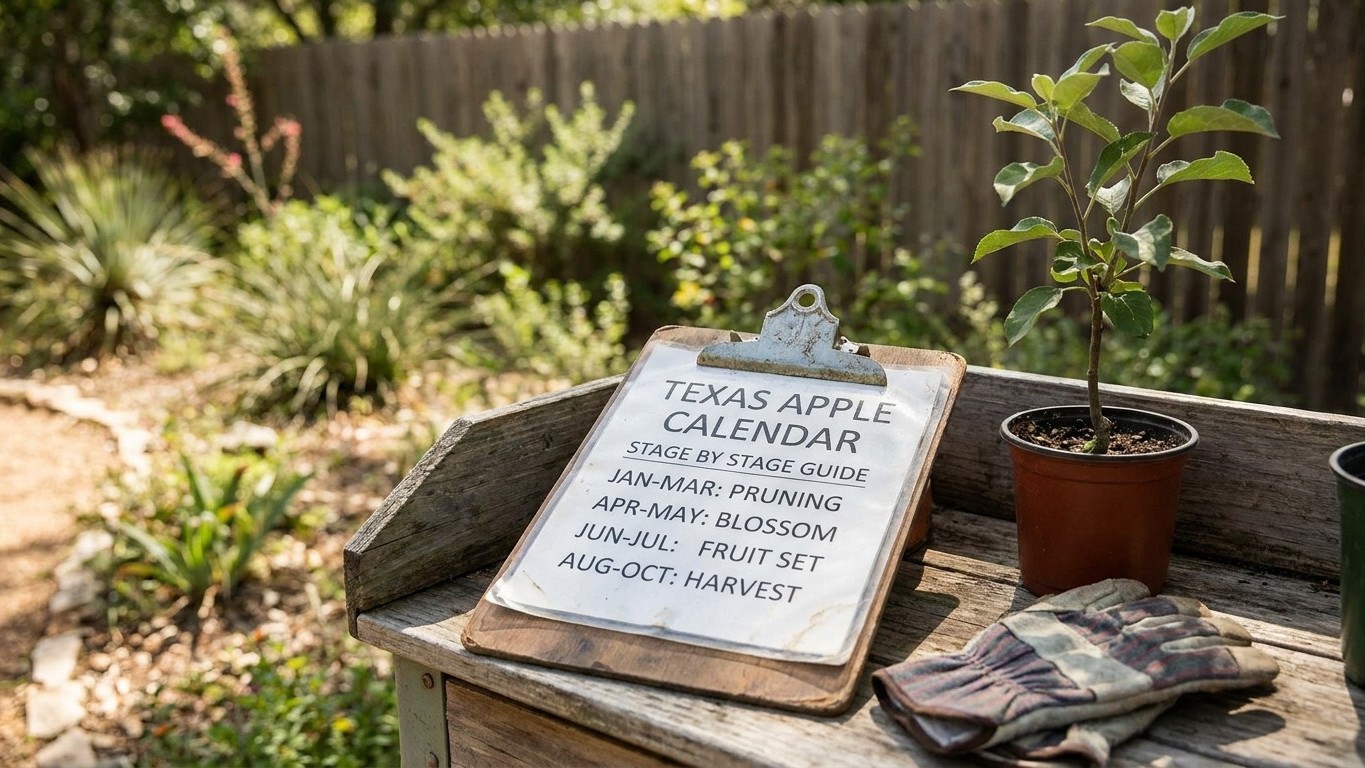

Texas apple timing runs off the tree’s stage, not a date on the wall, and the frost dates that anchor those stages vary by hundreds of miles across the state. In the Houston area, NOAA’s 1991-2020 climate normals put the last spring freeze at Bush Intercontinental Airport (IAH) between February 4 and March 1, and the first fall freeze between December 1 and December 19. Check your own county’s freeze window before picking a bloom-time cultivar, because a variety timed for Houston can bloom straight into a frost farther inland.
The short answer for Texas
Chill hours decide this calendar long before frost does. An apple tree that hasn’t banked enough winter cold breaks dormancy unevenly, no matter how warm April turns — and Houston’s winters, averaging a 43.2°F low in the coldest month, only suit the lowest-chill cultivars. Move inland, gain elevation, and the math changes again. So the real question isn’t “what date,” it’s which stage your tree is in, starting with pink bud, the point the whole season actually hinges on.
Why the stage matters more than the month
What that answer depends on is chill hours as much as frost. Apples need a stretch of winter cold to break dormancy evenly, and the amount required differs by cultivar. NOAA’s normals put Houston’s coldest month at a mean daily minimum of 43.2°F, mild enough that only the lowest-chill apple cultivars reliably get what they need there. Farther inland and at higher elevation, winters run colder and longer, and cultivars with a heavier chill requirement become an option, but the frost windows shift too. If you haven’t chosen a cultivar yet, The Best Apple Varieties for Texas goes through chill and hardiness by name before you get to timing. Whichever region you’re in, match the cultivar’s chill requirement to the winter your orchard actually gets, and match its bloom time to your own area’s last-frost window, not Houston’s.
Working through it

Apple trees in Texas move through the same seven stages every year: dormancy, green tip, pink, bloom, petal fall, fruit set and harvest. Only the calendar dates shift with the winter. If you’re still working out site, soil, and rootstock, Growing Apples in Texas covers those decisions before timing becomes the question.
Dormancy through green tip
Dormancy in the Houston area runs from leaf drop, usually well before the first fall freeze recorded by NOAA at IAH (December 1 to December 19), through the coldest weeks of winter. This is the period when chill hours accumulate. Because Houston’s winters are mild, low-chill cultivars finish accumulating chill and push green tip earlier than gardeners farther north would expect, sometimes as early as January. Green tip is a visual cue, not a date: the bud scales split and a sliver of green leaf shows through. Once you see it, dormant-season pruning and dormant oil sprays are done for the year.
Pink through bloom
The pink stage follows within a couple of weeks. The flower bud swells and shows pink color before the petals separate. Bloom itself, in a low-chill cultivar on the mild Gulf Coast, often lands inside NOAA’s own last-freeze window for IAH, February 4 to March 1. That overlap is the single riskiest moment on the Texas apple calendar. A freeze that arrives inside that window, or even a little after it closes at the mild end, can take out an open bloom and with it the whole crop for the year.
Petal fall through fruit set
Petal fall marks the end of bloom, and fruit set follows within days if pollination and temperature cooperated. This is where thinning happens, removing extra young fruit so the tree isn’t carrying more than the branch can support, and where the first cover sprays for pests go on. Watch the stage rather than the calendar, because a cool wet spring can stretch bloom to fruit set over three weeks, while a warm one compresses it into ten days.
Harvest and the return to dormancy
Harvest for low-chill cultivars on the Gulf Coast comes early relative to the rest of the country, in step with the early bloom. The tree then spends summer and fall rebuilding leaf reserves before dropping leaves ahead of winter, and the clock resets toward NOAA’s first fall freeze date at IAH.
| Stage | What’s happening | What to do |
|---|---|---|
| Dormancy | Chill hours accumulate | Prune, apply dormant oil |
| Green tip | Bud scales split, leaf tip shows | Stop dormant sprays |
| Pink | Flower bud swells, shows color | Watch forecasts closely |
| Bloom | Petals open, pollination window | Cover or protect if freeze threatens |
| Petal fall | Petals drop, fertilization confirmed | Begin pest cover sprays |
| Fruit set | Young fruit visible and swelling | Thin excess fruit |
| Harvest | Fruit reaches cultivar’s mature color and size | Pick, then let the tree rebuild reserves |
What changes across Texas
The frost dates above are Houston-area figures from NOAA’s IAH station, and they describe the mild Gulf end of the state, nothing more. Move to a different part of Texas and both the frost windows and the winter’s chill shift with them.
Regions that run colder, warmer, or different
The Panhandle, around Amarillo, sits at a much higher elevation and latitude than Houston. Its winters run colder for longer, which satisfies the chill requirement of cultivars that never break dormancy properly on the coast, but its last spring freeze also comes weeks later than IAH’s February-to-March window, and its first fall freeze arrives earlier. A bloom timed for Houston would be badly out of step there.
Hill Country, around Austin and San Antonio, sits on rolling limestone terrain where cold air can pool in the low valleys on a clear, calm night even while the surrounding hilltops stay several degrees warmer. An orchard planted in one of those low pockets sees a harder, later frost than a site a few hundred feet upslope on the same property.
North Texas, around Dallas-Fort Worth, runs colder and accumulates more chill than Houston without the extreme elevation of the Panhandle, which puts it in an easier middle ground for cultivars that need a moderate amount of winter cold.
South Texas and the Rio Grande Valley run warmer than Houston, not colder, and the chill problem that already limits cultivar choice on the Gulf Coast only gets worse there.
The mistakes this climate punishes
Three failure points
Three mistakes show up over and over in Texas apple orchards, and each one is tied to a specific stage rather than a season.
- Planting a high-chill cultivar on the Gulf Coast. NOAA’s normals put Houston’s coldest month at a 43.2°F mean daily minimum, too mild for a cultivar bred for a hard northern winter. The tree survives, but it blooms erratically over weeks instead of days, pollination fails, and the harvest is thin.
- Choosing a very early-blooming cultivar where the last freeze runs late. On the Gulf Coast, bloom in a low-chill cultivar can land inside NOAA’s own February 4 to March 1 last-freeze window for IAH. A freeze that arrives while the bloom is open can wipe out the crop for the year, and it shows up as blackened, wilted blossoms within a day or two of the cold snap.
- Feeding or pruning late enough to push soft new growth into fall. New growth that hasn’t hardened off is the first thing damaged when the first fall freeze arrives, December 1 to December 19 at IAH by NOAA’s normals, and the dieback from that damage often isn’t obvious until the following spring’s green tip fails to appear evenly along the branch.
All three mistakes are avoidable at the point of planting or at the point of the seasonal fertilizer application, well before the weather forces the issue. A late-summer nitrogen feeding is the usual culprit behind the third one, since it’s applied for a burst of growth that has no time to toughen up before the cold arrives.
Checking this against your county
Every figure above comes from one NOAA station at Houston’s Bush Intercontinental Airport, and Texas AgriLife Extension, the state’s land-grant extension service, is the place to check what your own county’s frost dates and chill actually look like: agrilifeextension.tamu.edu. County extension offices keep planting and pruning guidance built around their own local weather records rather than Houston’s, and can tell you which cultivars have actually performed in orchards near you. Before you commit to a bloom date, run it past your county office.
Common questions
Can apples even grow in Houston?
Yes, with the right cultivar. Low-chill apples that don’t need a hard winter can produce there, while a cultivar bred for a northern climate generally won’t bloom evenly on the coast no matter how well it’s cared for.
Do I need two different apple trees to get fruit?
Most apple cultivars need a second variety blooming at the same time nearby for pollination, since a single tree of one cultivar often sets little or no fruit on its own. Check the pollination notes on the nursery tag before you plant just one tree.
My tree bloomed fine but dropped all its fruit. What happened?
The two most common causes are a late frost that damaged the flowers or young fruit without killing them outright, and poor pollination from cool, wet, or windy weather during bloom. A tree also naturally sheds some fruit in early summer, but losing the whole set points to one of the first two.
How many chill hours does Houston actually get?
There’s no single chill-hour count that applies to every winter or every yard in the area, since it depends on how cold that particular year runs. Your county extension office is the source to check for local chill accumulation records rather than a figure repeated from one station or one year.