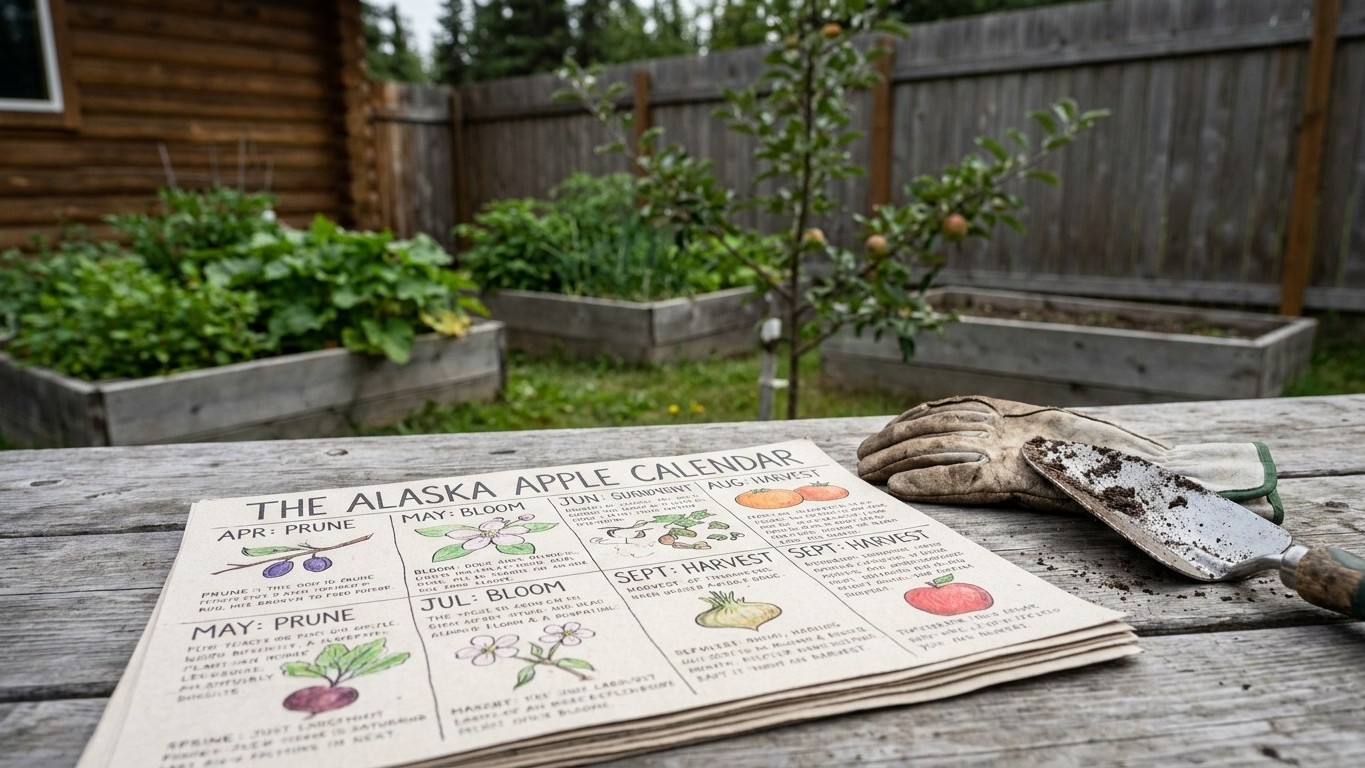

Anchorage’s apples run on a frost calendar, not a wall calendar. NOAA’s 1991-2020 Climate Normals put the last spring freeze there between May 3 and May 12, and the first fall freeze between September 22 and October 1, which works out to roughly 143 frost-free days. Match your pruning, spraying, and picking to the tree’s actual bud stage against that window, rather than to a date you circled on paper.
The short answer for Alaska
For Southcentral Alaska, anchored on the Anchorage reference station, the frost-free window NOAA’s 1991-2020 Climate Normals describe runs from the last spring freeze (May 3 to May 12) to the first fall freeze (September 22 to October 1). That is about 143 frost-free days, short compared to most of the Lower 48, but Anchorage’s long summer daylight pushes an outsized amount of growth into that stretch.
The short answer: plant a cold-hardy, short-season apple cultivar, expect bloom to land well after the calendar says “May” some years, and plan to have fruit off the tree before the fall frost window opens rather than racing it. Growing Apples in Alaska starts with matching rootstock and cultivar to Anchorage’s mean coldest-month minimum of 11.1°F, per NOAA NCEI’s 1991-2020 Climate Normals. That figure is a hardiness filter: it tells you whether the wood survives winter, not whether the tree flowers well.
What the answer actually depends on is threefold: the site’s own microclimate (a low spot collects cold air even a mile from Anchorage’s official station), the cultivar’s chill requirement measured against what a given winter delivers, and how the tree is managed at each stage rather than by the number on the calendar. The stage the tree is in decides what to do next, because a cool May or an early September can shift the whole sequence by two or three weeks in either direction, and the frost dates above are themselves a 30-70% probability band, not a guarantee.
Working through it

Every apple season is a sequence of visible stages, and each one has a different tolerance for cold. Anchoring each stage against NOAA’s Anchorage frost normals tells you how much risk you’re carrying at any given point in the season, which the calendar date alone never does.
Dormancy

Through winter the tree is bare and bud-tight. This is the stage where Anchorage’s mean coldest-month minimum of 11.1°F, from NOAA NCEI’s 1991-2020 Climate Normals, decides whether the rootstock and cultivar you planted survive the winter at all. There’s little to do except prune while the branch structure is visible and check for snow-load damage on limbs.
Green tip

Buds swell and the first sliver of green shows at the tip. This usually happens as the season approaches the May 3 to May 12 last-frost window, so it’s the point to finish any dormant spray program before green tissue is exposed and more vulnerable to a late freeze.
Pink

Flower buds show color but stay closed. Tissue at pink stage is still more frost-tolerant than it will be a week later at bloom, but it’s worth watching closely if the calendar still sits inside Anchorage’s last-frost window.
Bloom

Open blossoms are the most frost-sensitive point in the whole year. A freeze that a closed pink bud would shrug off can kill an open flower outright, which is exactly why cultivar choice, covered on The Best Apple Varieties for Alaska, matters more than any date on a calendar: a variety that blooms early relative to Anchorage’s frost window is gambling every year it’s planted.
Petal fall

Petals brown and drop, and the fertilized ovary starts swelling into a fruitlet. This is when to thin if you’re going to, since it’s the first point you can tell a viable fruit from one that never set.
Fruit set

Small green fruit hold on the spur through the long summer daylight. Routine feeding and watering matter here, but nitrogen applied too late in this stage carries into the next problem below.
Harvest
Pick before Anchorage’s first fall freeze window of September 22 to October 1, per NOAA’s normals, opens. A hard freeze on unpicked fruit still hanging can turn flesh mealy and shorten storage life even when the apples don’t actually drop.
What changes across Alaska
Anchorage’s numbers describe Southcentral Alaska at low elevation near tidewater, and the rest of the state runs on a different clock. The Interior, centered on Fairbanks, has a shorter frost-free season and colder winters than Anchorage, though no figures for that station are cited here, so treat any Fairbanks date as narrower than Anchorage’s rather than assume it matches.
Cold air behaves like water and pools in low ground, which matters most in valley bottoms of the Matanuska-Susitna Valley, where a site fifty feet lower than a neighboring bench can hold frost longer into spring and pick it up earlier in fall. Coastal Southeast Alaska, around Juneau and Sitka, runs milder and wetter than Southcentral thanks to the maritime influence, which changes disease pressure (more scab risk from persistent damp) even where hardiness is less of a limiting factor.
The Kenai Peninsula sits closer to Anchorage’s coastal moderation but gets more wind exposure in open sites, which can desiccate buds in a dry, cold winter even when the air temperature itself isn’t extreme.
- Interior (Fairbanks area): shorter frost-free window and colder winters than Anchorage; no local NOAA figure cited here, so check the extension service directly.
- Matanuska-Susitna Valley: valley-bottom sites pool cold air and lag bench sites in both spring green-up and fall hardening.
- Southeast coast (Juneau, Sitka): milder, wetter, more scab and canker pressure, less winter-kill risk.
- Kenai Peninsula: coastal moderation similar to Anchorage but more wind exposure in open ground.
None of this means apples can’t be grown outside Southcentral. It means the Anchorage-based frost dates above are a starting point to adjust, not a figure to copy onto a Fairbanks or Kenai calendar unchecked.
The mistakes this climate punishes
Four mistakes show up again and again in this climate, and each one has a specific point in the season where it becomes visible.
Planting a cultivar that blooms early relative to Anchorage’s own frost window is the costliest, because it puts open flowers at risk in exactly the stretch NOAA’s normals flag as a 30-70% freeze probability. The damage shows at bloom, as blackened, collapsed flower centers, and by the time it’s obvious the crop for that year is already gone.
Feeding nitrogen late in the season pushes soft new shoot growth right when the tree should be hardening wood for winter. That soft growth is the first tissue killed when the first fall freeze arrives in the September 22 to October 1 window, and the dieback shows up as blackened, mushy tips the following spring, well after the actual damage was done.
Choosing a rootstock or cultivar that isn’t reliably hardy to Anchorage’s mean coldest-month minimum of 11.1°F is a slower mistake. It doesn’t show the first winter, or even the second. It shows the one winter that runs colder than the ten-year average, as a graft union or lower trunk that cracks and dies back while the rest of the tree looks fine, because hardiness ratings describe an average, not a promise.
Ignoring microclimate on your own lot is the mistake that looks like bad luck but isn’t. A tree planted in a frost pocket, a low spot where cold air settles overnight, blooms into frost that a tree thirty feet away on higher ground never sees. This shows up as one tree in a small planting cropping well while its neighbor sits bare, and the explanation is almost always elevation within the yard, not the cultivar.
Checking this against your county
Every figure above is measured at or near Anchorage, and Alaska’s terrain means a few miles can move a frost date meaningfully. Before committing to a planting date or a spray schedule, check the current guidance from the University of Alaska Fairbanks Cooperative Extension Service, which maintains region-specific fruit-growing information for the state.
The extension service is also the right first call if you’re planting somewhere the Anchorage figures clearly don’t apply, such as the Interior or a higher-elevation site, since no single reference station describes a territory this size. Their county and district offices can point you to whatever local frost data exists for your specific area.
Common questions
Do apple trees in Alaska need a lot of winter chill hours?
No, the opposite problem is more common. Alaska’s long, cold winters almost always deliver more chill than an apple cultivar needs, so chill requirement is rarely the limiting factor here.
The real filter is hardiness, meaning whether the wood survives the coldest nights of winter at all, which is a different question from chill and needs checking separately for any cultivar you’re considering.
Can you grow apples in Fairbanks or the Interior?
The Interior’s growing season runs shorter and colder than Anchorage’s, so the frost-free window does not transfer directly.
Check with the University of Alaska Fairbanks Cooperative Extension Service for Interior-specific guidance before choosing a cultivar or a planting date.
My apple tree bloomed before the last frost date passed. What do I do?
Cover the tree overnight if a freeze is forecast and bloom has already opened, since open blossoms are the most frost-sensitive stage of the year. A frost cloth or an old sheet draped over the canopy and removed by morning can save a bloom that would otherwise be lost.
How do I actually tell what stage my tree is in?
Look at the buds and flowers directly rather than guessing from the date. Tight brown buds mean dormancy, a green point at the tip means green tip, closed buds showing color mean pink, open flowers mean bloom, and browning fallen petals with a small green swelling behind them mean petal fall.