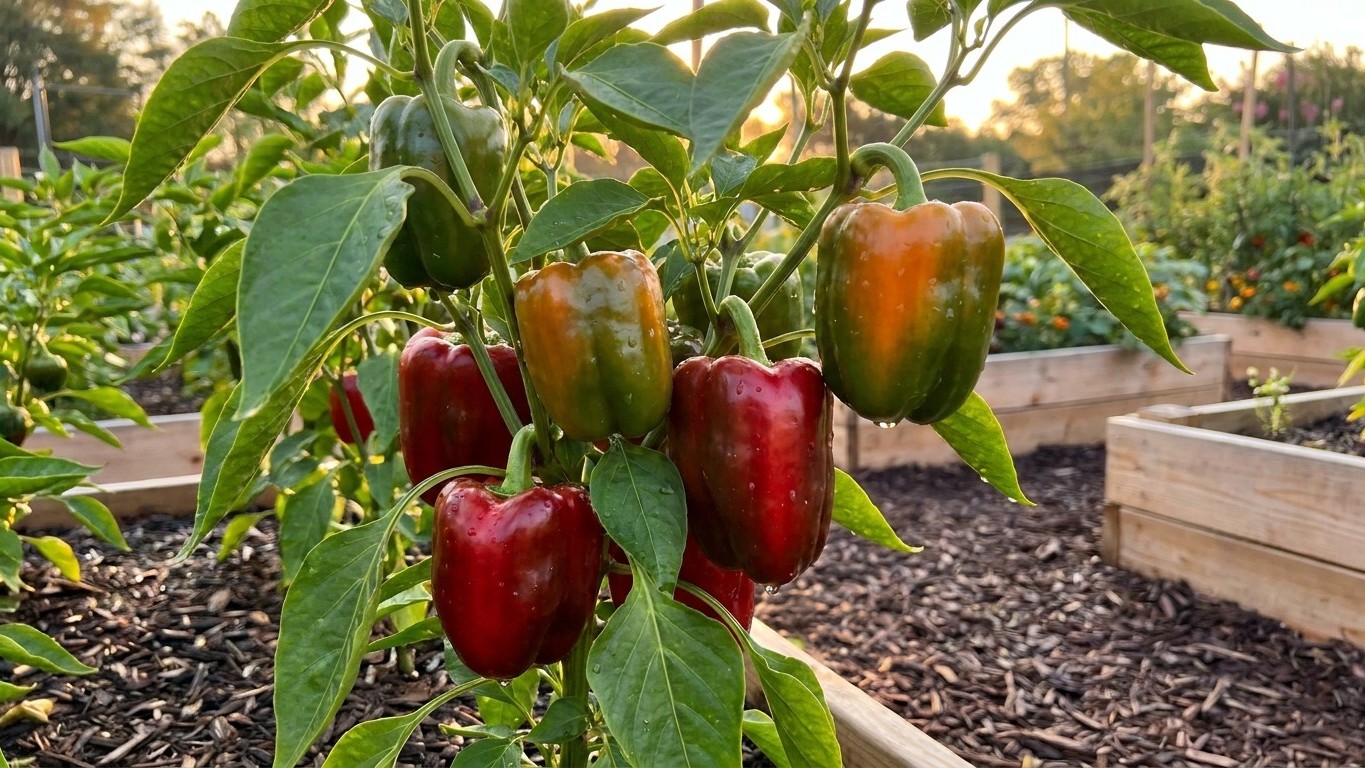

In Texas, the first things to eat into a pepper harvest are weather: days above 90 F, nights below 55 F, hard sun and uneven watering. This page reads “what eats pepper” that way. Insect pest calendars fall outside the verified figures here, so none appear. What does appear is the timing logic. Transplant after frost, once the soil reaches 60 F, and start seed 8 to 10 weeks before that date.
The short answer
The Houston reference station logs 102.4 days a year at or above 90 F, according to NOAA NCEI Climate Normals. That is an average count of days, not one continuous stretch, and it measures heat load: water demand, heat stress, and the failure of cool-weather plants. It is not the average summer temperature. Still, 102.4 days is nearly fifteen weeks’ worth of days, and peppers have a ceiling.
Utah State University Extension puts it plainly: pepper fruit set fails at both ends, with days above 90 F or nights below 55 F. A plant can look healthy, with green leaves and open flowers, while the flowers fail to turn into fruit. That makes heat a bigger scheduling problem here than it is in northern states. A pepper that flowers during a long run of 90 F days may produce leaves all summer and little else. The goal is to get flowers open and fruit set before those days stack up, and to treat a stalled plant in a hot spell as normal behavior rather than a dead one. For the full mechanics, see Why Peppers Fail to Set Fruit in Texas.
The other end of the range is nights under 55 F, and this site does not carry summer night minima for Texas. Nothing here can tell you what your nights do. Guessing from latitude is a mistake, and so is reasoning from how cold January gets, because a cold winter says nothing about July or May nights. The reader has to watch their own. A cheap min-max thermometer set at plant height will record the overnight low, and a few weeks of readings around flowering will show whether your garden crosses the 55 F line.
One more caution on the numbers. The 102.4 figure comes from a single Houston station, which is the mild, humid Gulf end of the state. Texas spans four USDA zones, and the Panhandle, the Hill Country and North Texas each run on their own calendars. Use the Houston count as a yardstick for how seriously to take the hot end, not as a forecast for your county. If you are new to the crop here, Growing Peppers in Texas covers the wider picture, and Pepper Varieties That Ripen in a Texas Season covers what to plant.
When to start seed here
Seed timing works backward from one date: the day you can safely set transplants outside. Utah State University Extension gives the rule as transplanting after frost, when the soil reaches 60 F, with 8 to 10 weeks of indoor growing beforehand. The arithmetic takes five steps, and you can redo it for any county.
- Find your last spring frost date. For the Houston IAH station, NOAA NCEI lists February 4 to March 1, taken from the 30 to 70 percent band of 32 F freeze probabilities. That is a window, not a single day, and it is the mild Gulf end of Texas. Hobby airport runs about two weeks milder than IAH, so even inside Houston the date moves.
- Check the soil, not just the calendar. Transplant on the later of two events: the frost window closing and the soil reaching 60 F. A soil thermometer pushed a few inches down settles this in a minute.
- Count back 8 weeks for the late edge of your seed window and 10 weeks for the early edge. In weeks, that is 56 days and 70 days.
- Run the numbers with a sample date. If the soil reaches 60 F on March 1, then 8 weeks back lands around January 4 and 10 weeks back lands around December 21. If your transplant date is February 4, the same count gives roughly November 26 to December 10. Leap years shift these by a day.
- Check the far end. Clemson Cooperative Extension says peppers should be ready for harvest about 70 to 85 days after transplanting. A March 1 transplant date puts first harvest around May 10 to May 25, which shows how little room there is before the 90 F days arrive.
Those dates are a worked example, not a Texas planting calendar. The Panhandle, North Texas and the Hill Country freeze at different times than Houston, and each needs its own count from its own frost date. Start from your county’s frost window and your own soil reading, and subtract. If a late cold snap pushes the transplant date back, the seedlings can wait a little in their pots, but a plant sitting indoors well past 10 weeks is not what the guideline describes, so shift the seed date rather than stretching the plants.
What goes wrong here
Three failures account for most of the disappointment, and each has a fix you can start before it shows up.
- Blossom drop. Flowers fall off instead of becoming fruit when days climb above 90 F or nights fall under 55 F. Hot spells are the likelier problem in a place that averages 102.4 such days at the Houston reference station, but cool nights can do it too, and your own thermometer is the only way to know. Afternoon shade cloth during heat waves helps, and so does steady watering. Hand-feeding extra nitrogen does not, since it pushes leaves rather than fruit. New flowers often follow once the weather eases, so do not rip out a plant that has paused.
- Sunscald. Fruit exposed to strong sun develops pale, papery, sunken patches that later turn gray or moldy. It tends to follow leaf loss from disease, drought or heavy pruning, which strips the cover that was shading the fruit. Protect the canopy. Keep leaves healthy, skip aggressive pruning, and use shade cloth or staking that keeps foliage over the fruit during the brightest weeks.
- Blossom-end rot. A dark, leathery, sunken patch forms at the bottom of the fruit, opposite the stem. It reflects calcium not reaching the developing pepper, often because watering swings between soaked and dry. Even moisture is the remedy: mulch to hold it, and water deeply on a schedule instead of in bursts. A soil test before adding calcium is worth the small cost, since the soil may already hold enough and the real problem is delivery.
Insects are real, but they come with a local calendar that this page does not carry. Your county extension office is the right place to get one.
Common questions
Does 102.4 days at or above 90 F mean peppers will not set fruit in Texas?
No. It means a large share of the year is hot enough to interfere, according to the Houston reference station, so timing matters. Utah State University Extension names days above 90 F as one failure point and nights below 55 F as the other. Plan around both, and expect a pause in the hottest weeks.
Can I use February 4 to March 1 as my Texas frost window?
Only if you garden near Houston’s IAH station. The window comes from NOAA NCEI Climate Normals, 32 F freeze probabilities in the 30 to 70 percent band, and it reflects the mild Gulf end of the state. Hobby airport runs about two weeks milder than IAH. The Panhandle, North Texas and the Hill Country each need their own frost date.
How do I know if cool nights are hurting my peppers?
Measure them. This site does not carry summer night minima, and the figure cannot be worked out from latitude or from the coldest month of the year. A min-max thermometer at plant height shows whether your lows drop under 55 F during flowering.
Should I keep harvested peppers in the refrigerator?
Not for long, and it is the mistake nearly everyone makes. Clemson Cooperative Extension gives the best storage conditions as 45 to 50 F with 80 to 90 percent relative humidity, which is warmer than a household refrigerator. Below about 45 F, peppers pit and soften from chilling injury. The two to three weeks Clemson cites is a maximum under those ideal conditions, not a promise. The source is the Clemson Home & Garden Information Center pepper factsheet.