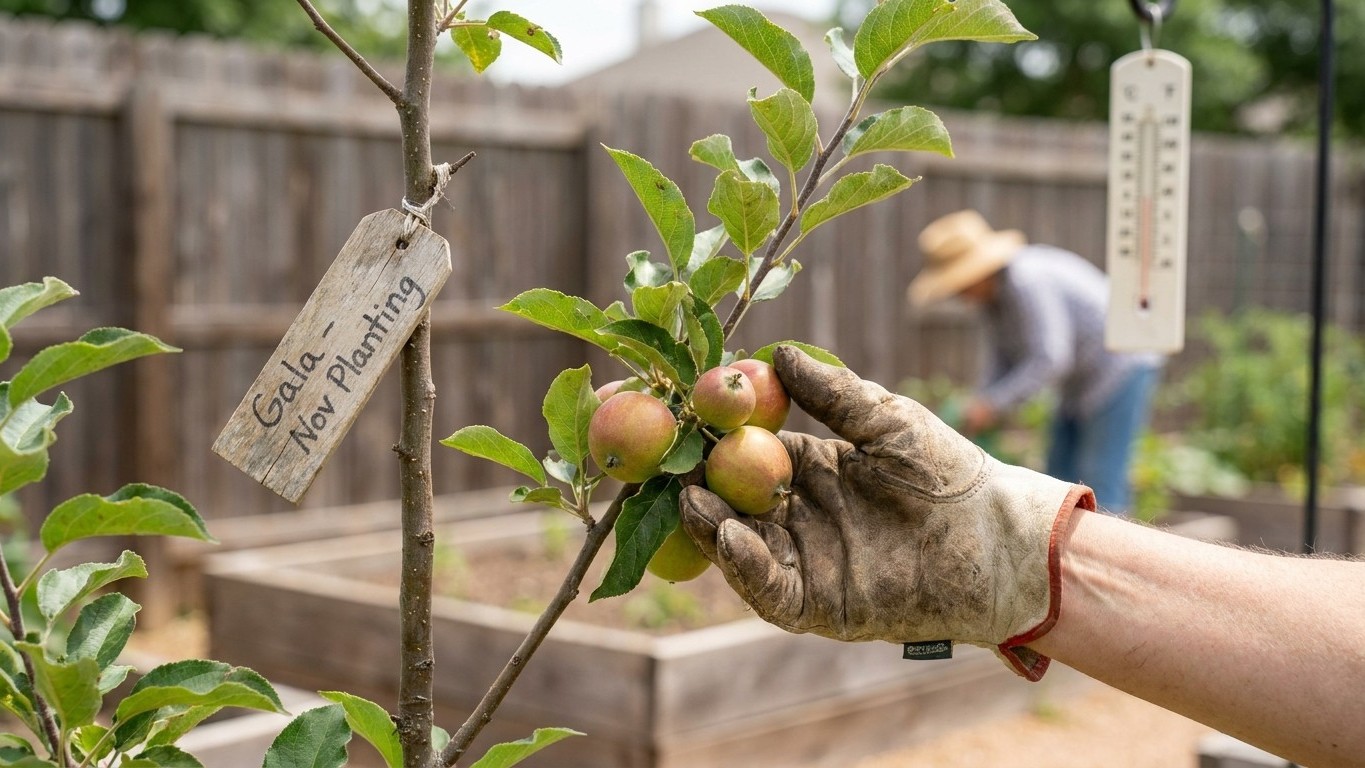

Texas apples come down to one question: how cold does your own winter actually run? Near Houston, winters stay so mild that dormancy is the problem, not frost — the tree lives fine but never banks enough chill to flower well. Head into North Texas, the Hill Country, or the Panhandle, and that flips: you get real cold, real chill, and access to the same varieties grown across the Midwest. So the first move isn’t picking a variety at all — it’s checking your average winter low and chill-hour count, because that number decides which apples belong on your land.
Can you grow apples in Texas
Apples grow in Texas, but which apple and where matters more here than in almost any other state. The USDA’s 2023 Plant Hardiness Zone Map places Texas across zones 6a to 10a, a span wide enough to run from winters that barely touch freezing on the Gulf Coast to Panhandle cold that would suit a Midwest orchard. Near Houston, at the mild end of that range, NOAA’s NCEI 1991-2020 climate normals put the mean daily minimum of the coldest month at 43.2F, which tells you winters there rarely deliver a hard, sustained freeze.
That mild reading matters for apples specifically because the tree’s dormancy depends on cold, not on surviving the cold. An apple tree needs a certain number of hours below roughly 45F each winter to break dormancy evenly and flower on schedule the following spring. Where the coldest month barely dips into the 40s, as it does near Houston, that chill requirement is the harder threshold to clear, not the risk of the tree freezing to death outright.
Move away from the Gulf Coast and the picture flips. North Texas, the Hill Country around Austin and San Antonio, and especially the Panhandle sit at the colder end of the state’s 6a-10a range, and they bank far more winter chill in an ordinary year. Growers there can plant varieties bred for classic apple country, the kind grown throughout the Midwest and the upper South without a second thought. The Panhandle is the closest thing Texas has to traditional apple ground, and it is where a standard-chill orchard is the safer bet by a wide margin.
Humidity along the Gulf Coast also raises disease pressure that the drier, colder inland regions mostly avoid, particularly fire blight and cedar apple rust. That is a real management burden, but it is not what decides whether a tree fruits at all. Chill hours decide that, and they decide it before disease or heat ever enters the picture.
So the honest answer is not one variety or one planting date for the whole state. Apples work on the Gulf Coast if you plant for low winter chill. Apples work inland and north if you plant for a longer, colder winter and lean on the same varieties that succeed farther up the country. See The Best Apple Varieties for Texas to match your region’s chill hours to the right cultivar. A Texas apple Calendar can help translate these regional chill differences into actual planting and care dates. Houston’s numbers describe Houston, and they should not be read as a Texas-wide planting calendar. Amarillo, Lubbock, and the Hill Country will differ, sometimes by whole USDA zones, and figuring out which side of that divide your orchard sits on is the first real decision, before any variety name gets chosen.
Which varieties suit this climate

Once you know which end of the state you are planting on, matching a variety comes down to two catalogue figures: the USDA hardiness zone the nursery lists, and the winter chill hours the variety needs to flower well. Both numbers matter, and they answer different questions. Hardiness tells you whether the tree survives your coldest night. Chill hours tell you whether it flowers on schedule the following spring, and getting that second number wrong gives a thin, ragged bloom rather than a dead tree, which is why so many first apple trees in warm climates leaf out fine and simply never flower properly.
Low-chill varieties for the Gulf Coast and South Texas
Near Houston and along the rest of the Gulf Coast, where NOAA’s NCEI normals put the coldest month’s average low at 43.2F, an orchard needs varieties bred for a short, mild winter. ‘Anna’ and ‘Dorsett Golden’, both developed for warm-winter climates and typically listed around 250 to 300 chill hours, are the standard low-chill choice for this part of the state. ‘Ein Shemer’, a similar low-chill selection bred in Israel and usually listed near 300 hours, is commonly planted alongside them. All three are diploids with fertile pollen, which matters directly for the pairing question below.
Higher-chill varieties for North Texas, the Hill Country and the Panhandle
Move north or up in elevation and the chill accumulates fast enough to grow familiar supermarket apples. ‘Gala’, typically listed around 500 chill hours, ‘Fuji’ around 400 to 450, and ‘Granny Smith’ around 400 to 500, are the varieties most catalogues describe as suited to a zone 6a-7b winter, a description that fits the Panhandle and much of North Texas far better than it fits Houston. ‘Jonagold’ asks for more chill still, often listed near 600 to 700 hours, and does best where winters run long and cold. It is also a triploid, meaning its own pollen is sterile, a point worth flagging before it is planted alone.
| Variety | Published chill hours | Typical USDA zone listed | Pollen |
|---|---|---|---|
| ‘Anna’ | ~250-300 | 5-9 | Fertile |
| ‘Dorsett Golden’ | ~250-300 | 5-9 | Fertile |
| ‘Ein Shemer’ | ~300 | 5-9 | Fertile |
| ‘Gala’ | ~500 | 4-8 | Fertile |
| ‘Fuji’ | ~400-450 | 5-8 | Fertile |
| ‘Granny Smith’ | ~400-500 | 5-8 | Fertile |
| ‘Jonagold’ | ~600-700 | 5-8 | Sterile (triploid) |
A grower in the Panhandle banks enough winter chill in a typical year to plant almost anything bred for the Midwest, the same way a grower in Oregon‘s apple country picks freely from a long list of mid- and high-chill cultivars without worrying whether the tree will flower. That freedom does not extend to the coast, where the chill-hour figure on the tag is the first thing to check, ahead of variety name, ahead of disease resistance, ahead of anything else on the label.
Texas A&M AgriLife Extension does not publish a single statewide “recommended” apple list, because chill hours vary so much across the state that a state-level recommendation would fit almost nowhere in it. Use your own region’s typical winter chill, not the state name, to shortlist a variety, and confirm the published figure against the nursery tag rather than the marketing copy.
Planting a pair that works here
An apple tree needs a second, different variety blooming at the same time nearby to set any fruit, and almost none of the varieties suited to Texas are reliably self-fertile in practice. Plant two trees, not one, and make sure at least one of them carries fertile pollen.
On the Gulf Coast, ‘Anna’ and ‘Dorsett Golden’ are the pairing most nurseries in the region actually sell as a set, precisely because both need the same low chill and bloom on the same short timetable once that chill has been met. ‘Ein Shemer’ works as a third tree, or as a substitute for either one, and its bloom overlaps closely enough to act as a backup pollinizer if a late freeze thins one tree’s flowers before the other opens.
Inland and north, where ‘Gala’, ‘Fuji’ and ‘Granny Smith’ are viable, any two of that trio planted together will generally cross-pollinate, since all three carry fertile pollen and bloom in the same window. The variety to watch is ‘Jonagold’. Its pollen is sterile, so it needs two other, fertile varieties in the yard, and neither of those two pollinizers can be another triploid or the whole planting sets little fruit. This is the same rule that trips up beginning growers wherever apples are planted, from the Gulf Coast to a small backyard orchard in Alaska, where an equally narrow bloom window makes the pairing choice just as unforgiving.
A crabapple with a long bloom period is the fallback pollinizer serious growers keep in reserve, since it tends to overlap with more varieties’ flowering than any single apple cultivar does. It will not replace a second full apple tree if you want fruit off both, but it insures the orchard against a pollinizer variety that blooms unusually late or early one year and misses its partner’s window entirely.
The frost that costs a crop here

Near Houston, NOAA’s NCEI 1991-2020 climate normals put the last spring freeze at the IAH station in a window running from February 4 to March 1, with a 30 to 70 percent chance of a 32F freeze landing somewhere in that stretch. That window describes the Houston area specifically. Farther north and inland, the last freeze runs weeks to months later, and a grower there needs their own region’s date, not this one, before planning around it.
The frost that actually costs an apple crop is not the one that kills the tree. It is the one that lands after the buds have opened to pink, when the flowers themselves are exposed. A freeze at that stage kills the blossoms, not the wood, and the tree will leaf out looking perfectly healthy weeks later while carrying no fruit at all for the year. That distinction trips up a lot of first-time growers, who see a green, thriving tree in June and assume the earlier cold snap did no real harm.
What a grower can actually do
There is not much a home orchard can do to protect open bloom against a hard freeze across a whole yard. On a few cold nights, covering a young tree overnight with a sheet or frost cloth, or running overhead sprinklers continuously if the freeze is marginal and short, can save a percentage of the flower buds on a small tree. Commercial growers use wind machines and orchard heaters for exactly this reason, at a scale most home growers cannot match. Texas springs are also prone to sharp swings, a week of unseasonable warmth pulling buds forward followed by a sudden reversion to freezing air, so the calendar date matters less than watching the bud stage itself once late winter arrives.
The real insurance is timing the bloom to miss the frost window in the first place. A late-blooming variety, one that will not show pink until the freeze risk in that specific location has mostly passed, is the actual protection where the last frost date runs late into the season. Where the window runs from early February into early March, as it does near Houston according to NOAA’s NCEI normals, a variety that blooms conservatively late gives the flowers a real chance of opening after that risk has cleared, rather than squarely inside it.
The apple year in Texas
Apple growth is read off the bud, not off a date on the wall, and every stage below moves earlier or later depending on how mild the preceding winter and early spring turned out to be. Near Houston, where NOAA’s NCEI normals put the last spring freeze between February 4 and March 1 and the first fall freeze between December 1 and December 19, the whole cycle runs earlier than it will farther north or inland. Treat these stages as an order of events, not as a calendar to write dates on.
- Dormancy: the tree is bare and chill hours are accumulating. Prune during this stage, while the branch structure is visible and no sap is moving.
- Green tip: the first green shows at the bud tip. This is the last safe window for a dormant oil or copper spray before tender new tissue is exposed.
- Pink: the flower bud swells and shows color but has not opened yet. From here on, a freeze threatens the crop, not the tree, so this is the stage to watch the forecast closely if the last-frost window for your area has not passed.
- Bloom: flowers are open and pollinators need to be active in the yard. Avoid spraying anything that harms bees during this window.
- Petal fall: petals drop and tiny fruit begin to swell. Fungal disease pressure often rises here, especially in the humidity along the Gulf Coast.
- Fruit set: the tree naturally sheds a portion of its fruit over the following weeks. Thin the remainder by hand if the tree set heavily, so what stays sizes up properly.
- Harvest: timing depends on the variety, not the season. A low-chill ‘Anna’ on the coast and a ‘Fuji’ in the Panhandle finish weeks apart even in the same calendar year.
Late-ripening varieties still hanging on the tree also need to finish before the first fall freeze, which near Houston falls between December 1 and December 19 by the same NOAA normals. A variety that typically ripens well past that window is a poor match for the Gulf Coast regardless of how well it tolerates the winter itself.
Keep a simple written log of the date each stage actually arrived at your own orchard, for a few years running. Because the last-frost window near Houston alone spans nearly a month, and the true date shifts earlier or later depending on the winter it follows, your own record for your own yard will tell you more than any published date ever will.
Local help
Texas A&M AgriLife Extension is the right first call for anything specific to your county, from a current list of varieties field-tested in your region to a spray schedule for fire blight and cedar apple rust that matches local disease pressure. Reach the statewide office through agrilifeextension.tamu.edu and ask for the horticulture agent covering your county. Recommendations differ enough between the Gulf Coast, the Hill Country and the Panhandle that a single statewide answer will not fit any one of them well.
Common questions
Can I grow Honeycrisp in Houston?
Probably not well. Honeycrisp is typically listed at a fairly high chill requirement, and near Houston, where NOAA’s NCEI 1991-2020 normals put the coldest month’s mean daily minimum at 43.2F, a winter that mild rarely banks enough chill hours for a high-chill variety to flower evenly. Choose a low-chill cultivar like ‘Anna’ or ‘Dorsett Golden’ on the coast instead, and save the high-chill varieties for the Panhandle or the Hill Country.
How many years before a new apple tree fruits?
Most apple trees on dwarfing or semi-dwarfing rootstock, the kind most home nurseries sell, begin producing a meaningful crop within a few years of planting, while a tree on standard seedling rootstock takes longer. Rootstock, not variety, is usually the bigger factor in how soon a young tree fruits, so check the tag before assuming a slow start means something went wrong.
Will an apple tree survive a Texas summer heat wave?
Established apple trees generally tolerate Texas summer heat fine once their roots are settled, though a newly planted tree in its first year is far more vulnerable to heat stress on top of transplant shock. Deep, infrequent watering and a layer of mulch over the root zone matter more in the first year than any variety choice.
Do I really need two different varieties, or will one tree ever fruit alone?
Plant on the assumption that you need two. A handful of apple varieties are marketed as partially self-fruitful, but nearly all of them still set more and better fruit with a second, compatible variety nearby, and the low-chill and mid-chill varieties suited to Texas are not the self-fruitful exceptions.
What if a freeze hits right after I see pink buds?
Expect a reduced crop that year rather than a dead tree. The flowers exposed at the pink and bloom stages are what a freeze damages, and the degree of loss depends on how cold it got and for how long, not on anything you can undo after the fact. The tree itself will almost certainly recover and bloom normally the following spring.