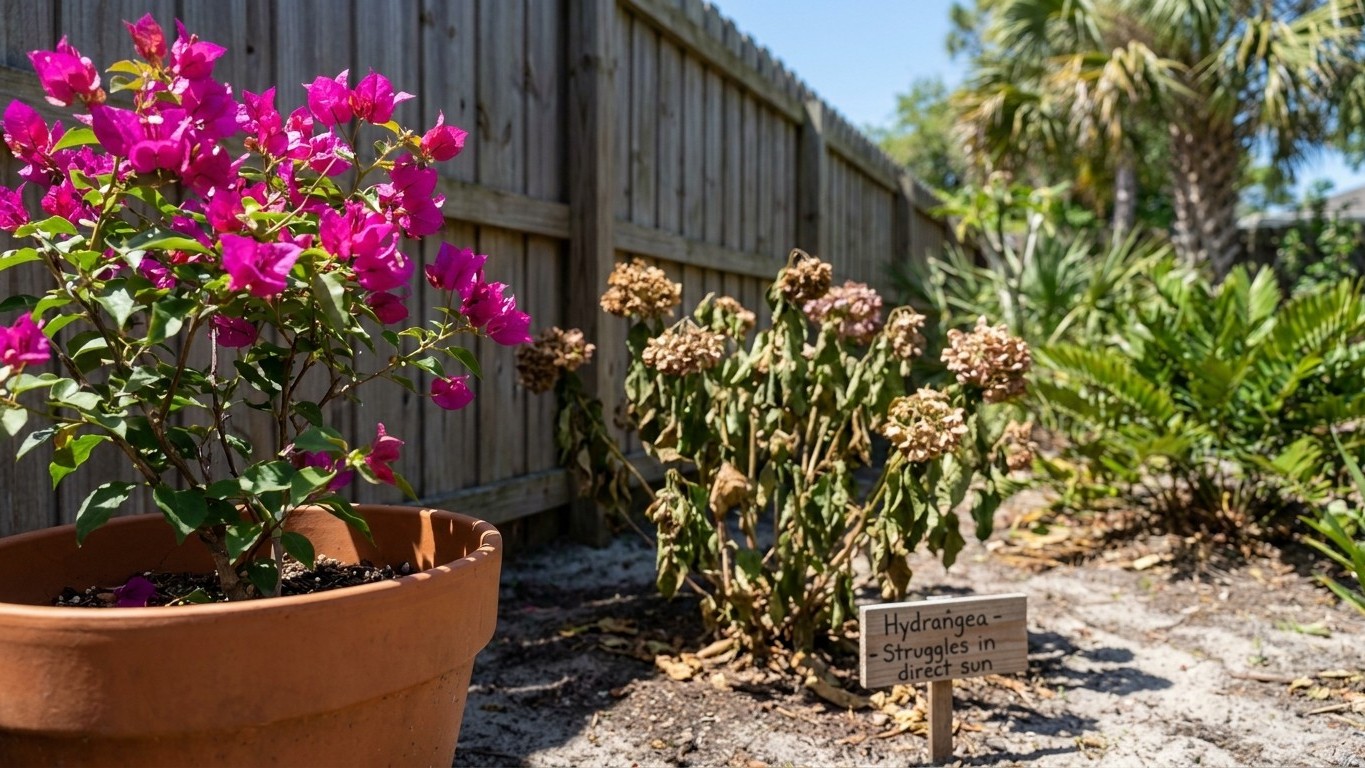

Florida flowers that thrive share one trait above all: tolerance for heat and humidity, not cold. USDA’s Plant Hardiness Zone Map puts the state at zones 8b to 11b, and NOAA’s 1991-2020 climate normals record 73.2 days a year above 90°F at the Jacksonville reference station, a heat load most temperate garden perennials never see. Match your bed to your own zone and your own summer, and you’ll skip most of the plant failures that fill Florida gardening forums.
What thrives in Florida

A flower that struggles through a hard Nebraska winter often fails here for the opposite reason: too much heat, not too little cold, the way our Nebraska flowers guide lays out for that state’s much shorter, cooler season. In Florida the filter runs the other direction. A plant needs to keep photosynthesizing through weeks of 90-degree days, shrug off humidity that would rot a peony’s foliage in a season, and tolerate soil that swings from soaked to bone-dry between afternoon storms.
Heat and humidity above all
NOAA’s 1991-2020 climate normals put the Jacksonville reference station at 73.2 days a year with a high of 90°F or more, and central and south Florida run hotter and longer than that. Heat tolerance is the first filter, before color, before bloom size, before anything else on a plant tag. Humidity is the second: fungal leaf spot and powdery mildew move fast in muggy air, so plants with narrow or waxy leaves that shed water quickly, like salvias and lantanas, outperform broad soft-leaved types like garden phlox.
Cold at the northern edge
USDA’s zone map (2023 edition, based on the 1991-2020 normals) spans zones 8b to 11b across the state, and that range matters more than the state average. Near Jacksonville, NOAA’s normals put the mean minimum temperature of the coldest month at 42.9°F, meaning most nights stay well above freezing even in January, but the occasional hard freeze still happens. A tropical hibiscus or bougainvillea planted in north Florida needs a spot against a south-facing wall or a plan to cover it; the same plant in south Florida’s warmer zones rarely sees frost at all. Check which end of the state a plant tag was written for before you trust its cold claims.
The families that handle both ends of that spread well include Asteraceae (coreopsis, gaillardia, zinnia), Lamiaceae (salvia, plectranthus), and Verbenaceae (lantana, verbena). All three have deep-rooting or drought-hardy relatives, take full sun without scorching, and recover fast after a stray cold snap knocks the top growth back.
Native plants worth the space
Plants native to Florida and the wider Southeastern coastal plain evolved with this exact rainfall pattern and heat load, which is why they need less coddling once they’re in the ground. A native coreopsis or blanket flower spends its first season building roots deep enough to reach moisture between storms, and after that it rarely needs supplemental water except in extended dry spells.
Less water once established
Florida’s state wildflower, tickseed (Coreopsis species), tolerates both the sandy soils common across the state and the heavy summer rain, and reseeds itself readily in an open bed. Blanket flower (Gaillardia pulchella) and black-eyed Susan (Rudbeckia hirta) do the same job with a longer bloom window. Once established, usually after one full growing season, these plants need irrigation only during unusually long dry stretches, which cuts a homeowner’s water bill and the time spent dragging a hose.
Pollinator value
Milkweed, particularly Asclepias tuberosa and Asclepias incarnata, is the only host plant monarch caterpillars can eat, and a bed without it is a bed monarchs pass over on migration. Scarlet sage (Salvia coccinea) and tropical sage draw hummingbirds and native bees through most of the warm season. A short list worth building a native bed around:
- Tickseed (Coreopsis species) – full sun, reseeds readily
- Blanket flower (Gaillardia pulchella) – full sun, tolerates poor sandy soil
- Black-eyed Susan (Rudbeckia hirta) – full sun to light shade
- Milkweed (Asclepias tuberosa, Asclepias incarnata) – full sun, monarch host plant
- Scarlet sage (Salvia coccinea) – part shade to full sun, hummingbird favorite
None of these need fertilizer beyond an initial compost amendment at planting, and heavy feeding actually pushes soft, floppy growth that mildew and wind both exploit.
Perennials that come back

Whether a flower comes back next year in Florida depends on where in the state’s 8b-to-11b range you garden, and on reading the plant tag against that number rather than against a national average.
What survives Florida winters
Pentas, firebush (Hamelia patens), plumbago, and most lantana cultivars are perennial across the bulk of Florida’s zone range and come back reliably from the roots even if a cold night burns the top growth. Gardeners just over the state line face a similar zone-edge call, and our Georgia flowers guide walks through how the same tags read a full zone cooler there. In Florida, a tag that says “hardy to zone 9” means a plant in zone 8b, roughly the Jacksonville area and points north, may die back hard or fail outright in a sharp freeze, while the identical plant in zone 10 or 11 near the coast or in south Florida sails through winter untouched.
Grown as annuals here
Some plants that are true perennials in cooler climates get treated as one-season annuals in Florida because our summer, not our winter, kills them. Petunias are the classic case: they bloom hard in spring, then collapse into fungal rot once summer humidity and heat set in, so most Florida gardeners replant them each fall. Pansies and snapdragons run the opposite way. NOAA’s 1991-2020 normals put Jacksonville’s typical frost window between February 16 and March 7 for the last spring freeze and November 26 to December 13 for the first fall freeze, and gardeners there plant pansies and snapdragons as cool-season color once that fall freeze risk has passed. Farther south, where frost is rare to absent, the whole calendar flips: winter becomes the main growing season for cool-tolerant flowers, and summer is the dead zone to plan around instead.
Putting a border together
A border reads as designed rather than scattered when it’s built in layers, not planted flower by flower as impulse buys come home from the nursery.
Height and layering
| Tier | Height role | Example plants | Typical bloom season |
|---|---|---|---|
| Backdrop | 3-6 ft | Firebush, canna lily, Mexican sunflower | Summer through fall |
| Mid-border | 1-3 ft | Pentas, lantana, scarlet sage | Spring through fall |
| Edging | Under 1 ft | Verbena, moss rose, blue daze | Spring through fall |
Plant the tall backdrop layer first and work forward, so shorter plants never end up shaded out by something you added later.
Bloom succession and color repetition
Stagger bloom times so something is always flowering: pair a spring-heavy native like coreopsis with a summer workhorse like pentas and a fall bloomer like Mexican sunflower, and the bed never goes flat for a full month. Repeat one or two colors in drifts of three to five plants rather than scattering single specimens of many colors, which reads as busy rather than designed from more than a few feet away. Leave real gaps at planting, roughly the plant’s expected mature spread apart, even though the bed looks sparse for the first month. Crowded transplants compete for water and light immediately, and in Florida’s humidity, crowding also traps moisture against foliage and invites the fungal problems this climate already favors.
Local help
Every county in Florida has a University of Florida IFAS Extension office, and most run a Master Gardener Volunteer program that answers plant questions and keeps a list of species that perform well in that specific county, which matters given how far a coastal south Florida yard sits from a north Florida one. Start at UF/IFAS’s Solutions for Your Life site to find your county office, and browse our other Florida guides for related planting and maintenance topics before you buy a single flat.
Common questions
Can I grow tulips or peonies in Florida?
Not reliably as perennials. Both need a sustained period of winter chill that most of Florida’s zone 8b-to-11b range doesn’t provide, so gardeners who want them treat tulip bulbs as one-season annuals, pre-chilling them in a refrigerator before planting, and generally skip peonies altogether in favor of a heat-tolerant substitute.
Why do my petunias die every summer?
Heat and humidity, not anything you did wrong. Petunias are cool-season bloomers here, and once nighttime temperatures stay warm and the humidity climbs, fungal stem and root rot set in fast. Most Florida gardeners pull them in early summer and replant fresh in fall.
Does south Florida even get frost?
Rarely to never. The frost dates in this article, drawn from NOAA’s 1991-2020 normals, come from the Jacksonville station in north Florida. Central and south Florida are effectively frost-free most years, which is why the growing calendar there runs opposite to the north: winter is prime planting season and summer is the stretch to manage around.
Should I trust the hardiness zone printed on a nursery tag?
Trust it, but check which end of it applies to you. A tag listing “zones 9-11” is telling you the plant fails in 8b, so if you garden near Jacksonville or another north Florida location, that plant needs winter protection or isn’t worth the bed space, while the same plant is a safe bet in central or south Florida.
Related guides
- Flowers That Actually Thrive in Georgia, and the Ones That Struggle
- Flowers That Actually Thrive in Alabama, and the Ones That Struggle
- Flowers That Actually Thrive in Kentucky, and the Ones That Struggle