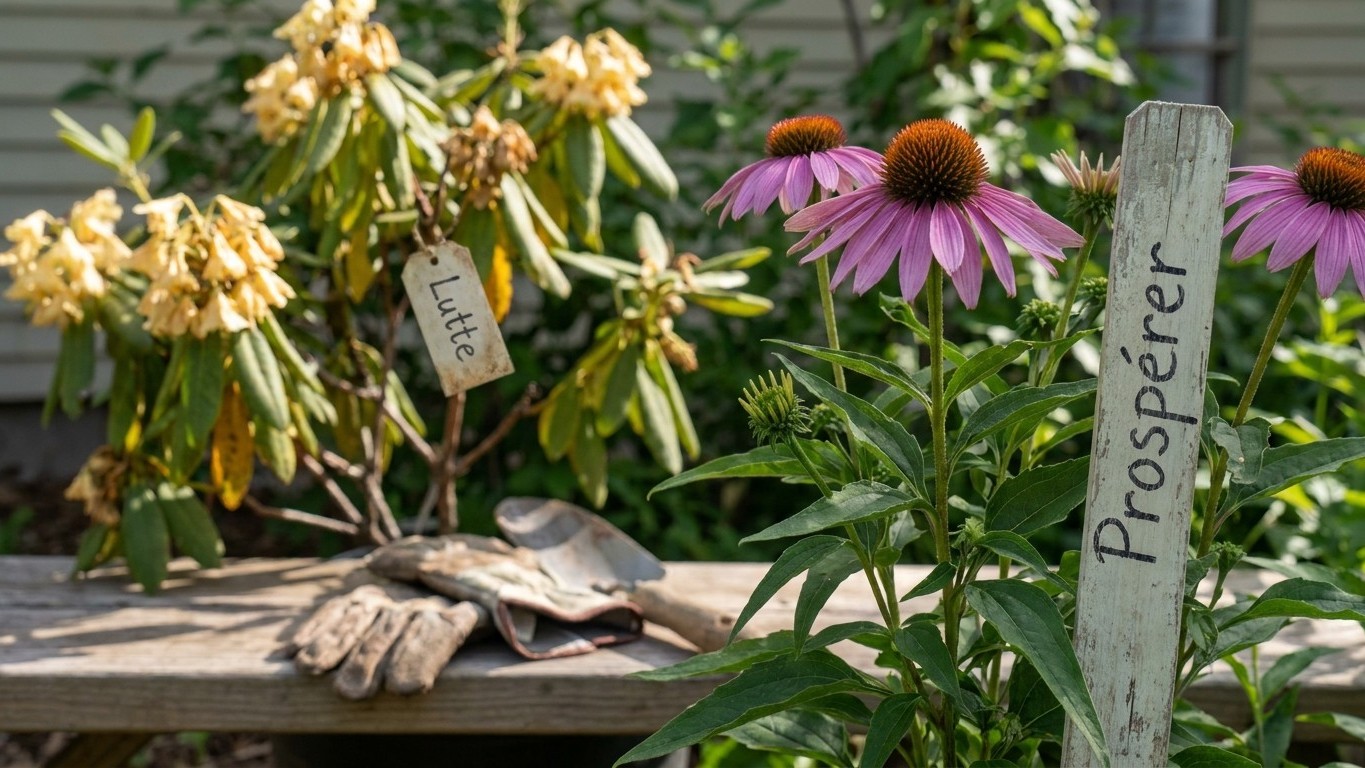

Coneflower, blanket flower, yarrow, and Russian sage shrug off what Nebraska throws at them; roses bred for softer climates and anything craving humidity mostly don’t. The line between the two isn’t luck. It’s roots built for a hard freeze followed by a dry, brutal summer, with no humid cushion in between. That combination — deep cold, then dry heat — is what actually runs the show here, and it plays favorites early.
What thrives in Nebraska

Nebraska’s climate asks a lot of a flower. Winters bring a mean coldest-month minimum of 15.2F at the Omaha reference station, according to NOAA’s National Centers for Environmental Information, and that number is what actually decides whether a plant’s roots survive the season, not the occasional deep freeze that makes the evening news. The state’s USDA Plant Hardiness range runs from 4a in the northwest to 5b along the Missouri River bluffs near Omaha, per the 2023 USDA Plant Hardiness Zone Map. A gardener in North Platte and a gardener in Omaha are working with different plants even though both call it Nebraska.
Summer heat is the other filter. Omaha averages 28.1 days a year at or above 90F, NOAA’s normals show, and that heat arrives dry more often than humid, which changes which plants fail and how. A flower bred for the humid Southeast can rot at the crown here even in a mild summer, while the same plant would struggle with fungal disease in a place like Delaware, where humidity does the damage instead of dry heat. Nebraska’s stress is water loss, not mildew.
The families that handle both ends of this range well are the prairie natives and their garden relatives: Asteraceae (coneflower, black-eyed Susan, aster), Lamiaceae (catmint, Russian sage, salvia), and the bunchgrasses that anchor the Great Plains, like little bluestem. These evolved with the region’s freeze-thaw winters and its dry, hot summers, so they arrive with the traits a gardener would otherwise have to breed for: deep taproots that reach subsoil moisture, narrow or silvery foliage that sheds heat, and crowns that sit low enough to ride out a bad winter under snow cover or mulch.
At the cold end of the state’s range, gardeners face nearly the same winter test as growers just across the border in North Dakota, where the coldest zones push even lower. If a plant is rated hardy to zone 3 or 4, it will generally take anything Nebraska’s winter can do. A plant rated only to zone 6 or warmer is a gamble anywhere in the state, and an outright loss in a harder winter across the Panhandle or the Sandhills.
None of this rules out flowers that need a little help. Raised beds warm faster in spring and drain better in a wet spell, row cover buys a borderline annual a few extra weeks at each end of the season, and a thick mulch layer going into winter protects the crown of a perennial that’s otherwise hardy enough to make it through. The point isn’t to avoid every flower outside this profile. It’s to know before you plant which ones need that extra help and which ones will simply take care of themselves.
Native plants worth the space
Plants native to the central and northern Great Plains arrive with a head start no cultivar bred elsewhere can match. They’ve spent thousands of years adapting to this exact combination of a 15.2F coldest-month low at Omaha and a summer that regularly tops 90F, so once their roots are established, usually by the second season, they need far less supplemental water and almost no fertilizer. The tradeoff is patience: many natives put their first year of energy into a root system you’ll never see, and look unimpressive above ground until year two.
That underground investment is also what makes them drought-tough later. A purple coneflower’s taproot can reach several feet down by its second or third year, well past where an afternoon watering ever touches. That’s the opposite strategy from a shallow-rooted annual, which needs frequent watering because it never develops the reach to find its own moisture.
Natives also carry the pollinator relationships that garden-center hybrids often lose in breeding for bigger blooms or longer bloom time. A few reliable choices for the wider region:
- Purple coneflower (Echinacea purpurea): upright daisy-form flower, magenta-pink petals around a spiny bronze cone, blooms mid to late summer
- Black-eyed Susan (Rudbeckia hirta): bright yellow petals around a dark brown center, self-seeds freely
- Butterfly milkweed (Asclepias tuberosa): clusters of bright orange flowers, the only host plant for monarch caterpillars
- Blazing star (Liatris spicata): tall purple spikes that bloom top-down, a favorite of bees and butterflies
- Little bluestem (Schizachyrium scoparium): a native grass, not a flower, but its blue-green summer foliage and copper fall color anchor a native planting and give pollinators winter shelter
None of these need the soil amending or the weekly watering a bed of petunias asks for. Most do better in average or even poor soil, since rich, fertilized ground pushes them toward floppy growth instead of the tight, upright habit they have on the open prairie. Skip the fertilizer and skip the daily hose. Once these are established, the biggest maintenance job left is cutting them back in late winter, and even that can wait for a bird to eat the seed heads first.
Perennials that come back

At Nebraska’s zone range of 4a to 5b, per the USDA’s 2023 hardiness map, a solid list of perennials returns reliably year after year without special winter protection. Peonies, daylilies, hostas, sedum, coneflower, black-eyed Susan, catmint (Nepeta), and Russian sage (Perovskia) all handle the state’s coldest-month lows without trouble in most gardens. These are the backbone plants worth building a border around, because you’re not replanting them every spring.
Reading a plant tag against your zone
The tag on a perennial usually lists a hardiness range, something like “zones 6-9” or “zones 3-8.” If the low end of that range is higher than your own zone, treat the plant as an annual, not a perennial, however the garden center displays it. A tag reading “zones 6-9” means the plant is rated to survive winters no colder than zone 6, and most of Nebraska sits colder than that. Buy it if you want it for one season, but don’t count on it coming back.
This is exactly why plants like lantana, many salvias, and some ornamental sages get sold every spring in Nebraska garden centers despite being genuine perennials in warmer states. They aren’t lying to you. They’re perennial somewhere, just not here.
| Plant | Typical tag hardiness | Status in most of Nebraska (zone 4a-5b) |
|---|---|---|
| Peony | Zones 3-8 | Reliable perennial |
| Russian sage | Zones 4-9 | Reliable perennial |
| Daylily | Zones 3-9 | Reliable perennial |
| Lantana | Zones 8-11 | Grown as an annual |
| Many salvias (S. splendens types) | Zones 9-11 | Grown as an annual |
Not every failure to return is about zone mismatch, though. A perennial rated well within Nebraska’s range can still die over winter if it sits in heavy clay that stays waterlogged, since a soggy crown rots faster than a cold one freezes. Good drainage matters as much as the zone number on the tag, especially for plants like lavender and sedum that come from naturally lean, fast-draining soil. If a perennial that should be hardy keeps disappearing, check the drainage before you blame the winter.
Putting a border together
A border that looks planned rather than scattered comes down to four decisions made before anything goes in the ground: height, bloom timing, color repetition, and spacing.
Layering by height
Put the tallest plants at the back of a bed viewed from one side, or in the center of an island bed viewed from all sides. Russian sage and tall garden phlox can run several feet tall and belong at the back. Coneflower and black-eyed Susan sit at a middle height. Catmint, sedum, and shorter native grasses edge the front. Skipping this layering is the most common reason a new border looks flat: everything ends up visible at once instead of stepping back in tiers.
Succession of bloom
A border planted for one big show in July goes bare the rest of the season. Spread bloom time across spring, summer, and fall instead. Spring bulbs and early perennials like peony carry April and May. Coneflower, black-eyed Susan, and daylily fill early to midsummer. Sedum, aster, and Russian sage carry the border into September and October, right up to Omaha’s first fall frost window of October 15 to 26 by NOAA’s 1991-2020 normals, a date that arrives earlier in outlying counties than at the airport station where it’s measured.
Repeating color
Buying one of everything is the fastest way to make a border look busy instead of designed. Repeat the same two or three colors in groups of three or five plants, spaced through the length of the bed, so the eye reads a rhythm instead of a random assortment. A run of purple coneflower and Russian sage repeated every few feet does more visual work than ten different single plants scattered along the same stretch.
Leaving room
Every perennial on the nursery tag lists a mature spread, and that number is the one gardeners ignore most often. A coneflower that looks like a small tuft in a one-gallon pot can spread eighteen inches or more within two seasons. Plant to the mature spread, not the pot size, and accept that the bed will look sparse and gap-filled for the first year. Filling those gaps with a season of annuals, rather than cramming in extra perennials, keeps the border from turning into a shoving match by year three.
Local help
Nebraska Extension’s Master Gardener program, run through the University of Nebraska-Lincoln, trains volunteers county by county and keeps plant lists tuned to local conditions rather than the state-wide averages used here. Start at the UNL Extension website to find your county office and its current recommendations. For more on planning a whole-yard approach across the state, our Nebraska guides cover vegetables and shrubs alongside flowers.
Common questions
Why didn’t my perennials come back this year?
The most common reasons are a hardiness mismatch between the plant’s rated zone and your actual zone, or a crown that sat in wet soil over winter and rotted rather than froze. Check the tag’s low-end zone number against your county’s USDA zone, and check whether the spot drains well after snowmelt before replanting the same variety there.
Can I grow hydrangeas in Nebraska?
Some types, yes. Panicle hydrangeas and smooth hydrangeas generally handle Nebraska’s winters without special protection, while bigleaf hydrangeas often lose their flower buds to a hard freeze and bloom poorly or not at all. Check which type you’re buying before you plant, since the tag rarely spells this out clearly.
Do I need to deadhead native wildflowers?
Not for the plant’s health. Deadheading coneflower or black-eyed Susan can extend bloom by a few weeks, but leaving the seed heads standing feeds birds through fall and gives the planting winter structure. Cut them back in late winter instead of fall if you want that benefit.
When is it safe to plant flowers outside in spring?
Around Omaha, NOAA’s 1991-2020 normals put the last spring freeze between April 12 and April 23, but that’s measured at the airport station, and rural or suburban gardens often see a later last frost by a week or two. Wait until after your own area’s typical last frost, and check with your county extension office if you’re not sure where that falls.
Related guides
- Flowers That Actually Thrive in South Dakota, and the Ones That Struggle
- Flowers That Actually Thrive in Iowa, and the Ones That Struggle
- Flowers That Actually Thrive in North Dakota, and the Ones That Struggle