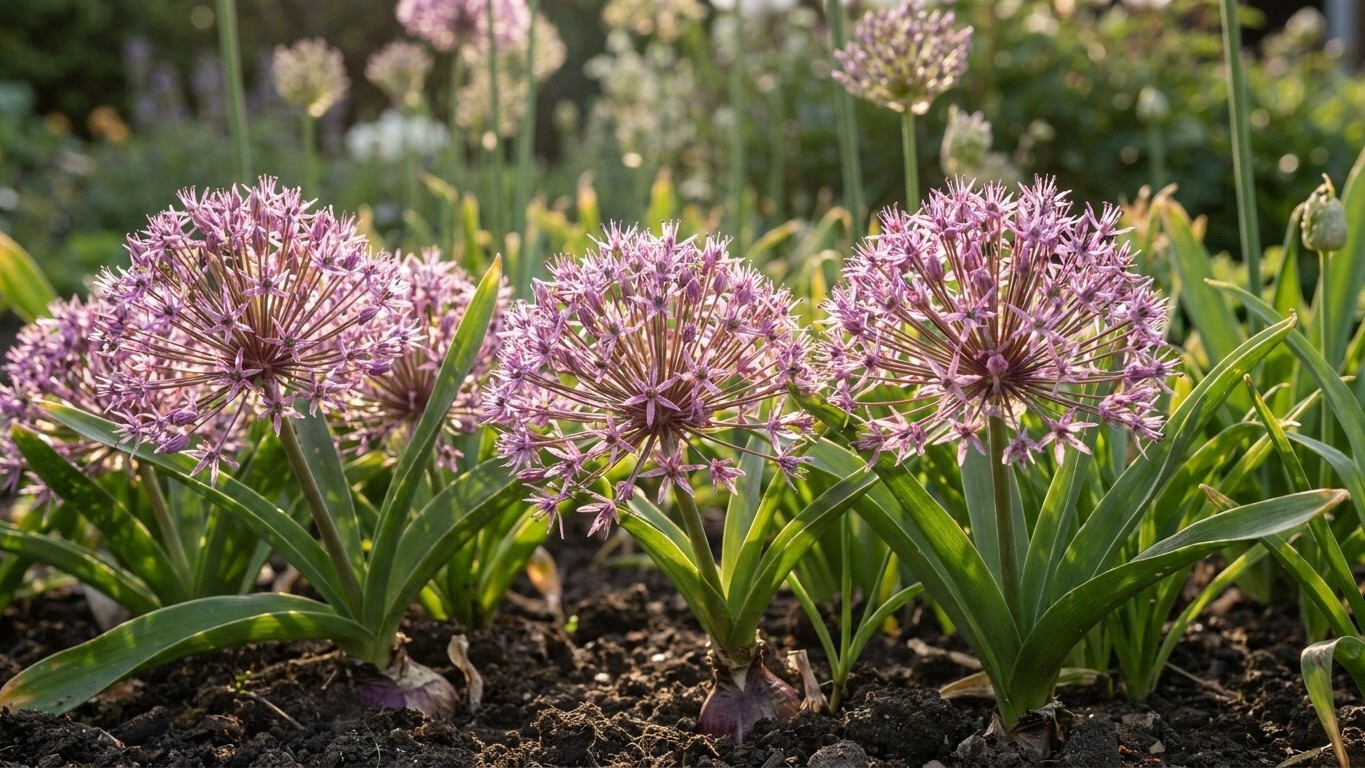

Ornamental Allium needs 12 to 14 weeks below 45F to flower properly, and it only performs reliably in USDA zones 4 through 8. Plant the bulb three times as deep as it is tall, space large kinds 6 to 8 inches apart, and leave the foliage alone after bloom, that’s the whole system in one sentence.
What Ornamental Allium actually is

Two numbers matter before you buy a single bulb. The first is the hardiness range: USDA zones 4 through 8, using the USDA’s own zone system based on average annual minimum temperature. If your planting zone comes from a different scale : Canadian gardeners work from a system built on seven separate climate variables — don’t try to line the two numbers up. They aren’t measuring the same thing.
The second number is the cold requirement: 12 to 14 weeks with soil temperatures below 45F, according to Cornell University, Department of Horticulture : Flower Bulb Research Program. This is the figure that decides whether you get a flower at all. Fall short of it and the bulb usually still sends up leaves, but the flower stalk stays short or never forms. A bulb that gets close to 12 weeks but not quite there doesn’t necessarily fail outright — it often blooms weakly, a smaller flower on a shorter stem, so gardeners near the edge of the range should treat their results as uncertain rather than doomed.
Ornamental Allium is, botanically, an onion. That single fact explains most of its behavior in the garden. It flowers in late spring, arriving toward the tail end of the spring bulb season, in globes of purple or white held on bare stems. Here’s the detail that catches people off guard: the strap-like foliage starts yellowing and collapsing while the flower head is still fully open and looking good. It’s not a sign of disease or a watering problem, it’s just how the plant is built. Because of that habit, it’s worth placing Allium behind something leafy that will hide the fading foliage while the bloom is still doing its job up top.
How deep and how far apart
The planting depth is set relative to the bulb, not a fixed inch measurement: plant three times the height of the bulb. That buffer of soil matters more than it sounds like it should. In climates that swing through repeated freeze-thaw cycles, a shallow bulb can literally get pushed up out of the ground as the soil expands and contracts, ending up half-exposed by late winter with no soil contact to protect it. Depth is what keeps that from happening.
Spacing does something different, it decides what the bed looks like in May. Planted too far apart, large-flowered kinds read as a scattered row of individual dots. Planted at the recommended interval, they read as a drift. For large kinds, that interval is 6 to 8 inches apart.
- Depth: three times the height of the bulb
- Spacing: 6 to 8 inches apart for large kinds
Orientation in the hole
Bulbs go in pointed end up, flat (root) end down. Most Allium bulbs make this obvious, there’s a visible tip and a papery, slightly indented base where old roots were attached. When a bulb is round enough that neither end is clear, plant it on its side rather than guessing. The shoot will find its way upward regardless; laying it sideways just removes the risk of planting it upside down, which delays emergence and can weaken the eventual bloom.
Will it come back next year
Return performance comes down to whether the site actually delivers what the bulb needs, not luck. Inside its hardiness range, zones 4 through 8, and in soil that reaches 12 to 14 weeks below 45F over winter, an Allium bulb is set up to bloom again the following spring. Outside that range, or in a mild winter that doesn’t supply enough sustained cold, flowering weakens or drops off even though the bulb may still be alive underground.
The other variable is entirely in the gardener’s hands: what happens to the foliage after bloom. The leaves that look tired and yellowing are, at that exact moment, still feeding the bulb. Photosynthesis in those fading leaves is how the bulb builds and stores the flower bud for next year, tucked inside the bulb tissue over summer and fall. Cut the foliage back while it’s still green, and that process stops mid-build, the plant survives, but the next spring’s flower is undersized or missing entirely. This is the single most common reason a once-reliable Allium planting quietly stops flowering after a year or two.
The fix is simple, if a little unglamorous: let the leaves go fully yellow and papery on their own schedule, then remove them. It usually takes several weeks after bloom finishes. Resist the urge to tidy the bed early, and the bulb has what it needs to repeat the following year.
What eats it, and what leaves it alone
Ornamental Allium is an onion relative, and that lineage is exactly why nothing eats it. The sulfur compounds that give onions and garlic their sharp smell run through the whole Allium genus, bulb included, and they’re enough to make squirrels, voles, chipmunks, deer, and rabbits leave the planting alone. Where tulip and crocus bulbs get dug up and eaten through fall and winter, Allium bulbs sitting in the same bed typically go untouched.
That makes Allium a useful tool beyond its own flower display. Gardeners in areas with heavy rodent pressure sometimes interplant Allium bulbs among more vulnerable ones, on the theory that the onion smell in the soil helps mask the more appealing bulbs nearby. There’s no need for wire mesh, cages, or repellent sprays here, the plant’s own chemistry is doing the protective work that other spring bulbs need hardware to achieve.