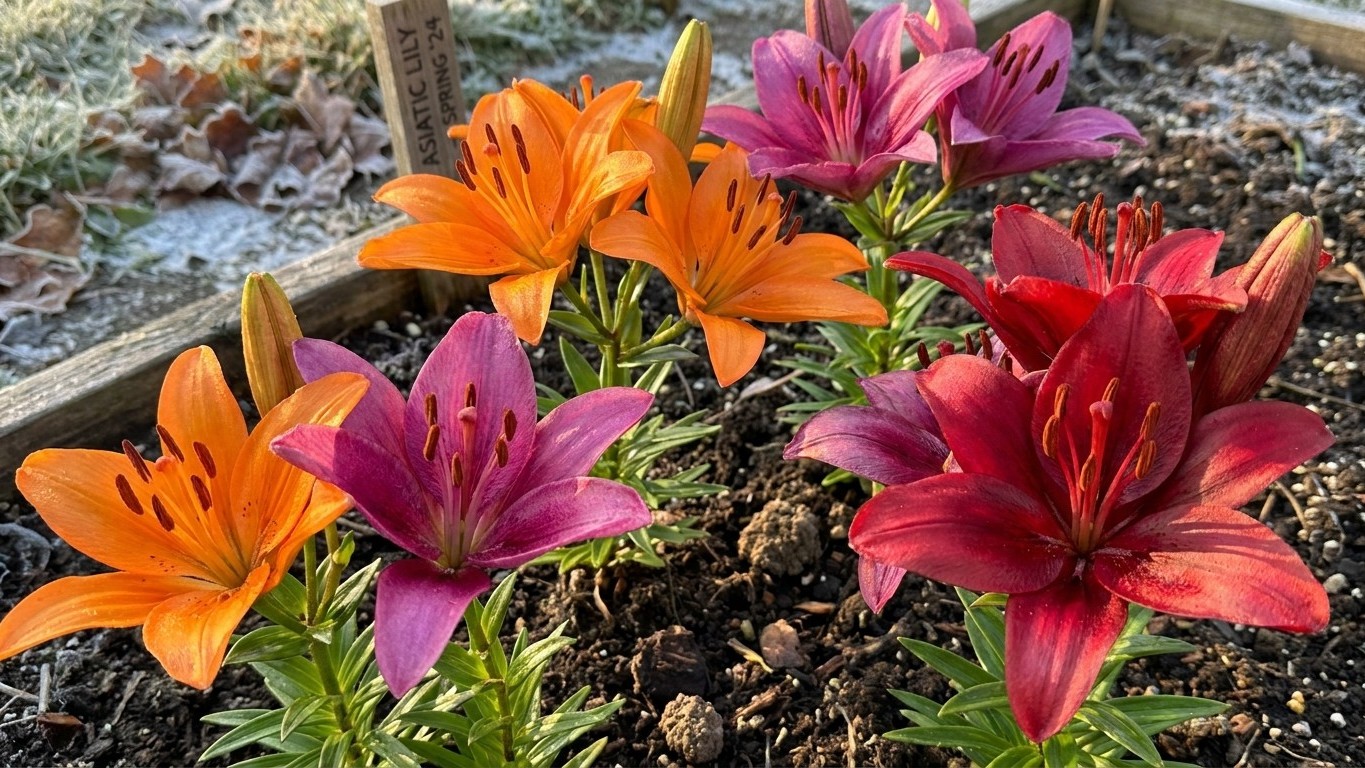

Asiatic lilies need a genuine winter to bloom right, and how you plant them decides everything else. Get the depth, the spacing, and the cold exposure correct, and a single order of bulbs can outlast the mortgage. Get any one of them wrong, and you get leaves with no flowers.
What Asiatic Lily actually is

Two numbers matter before you buy a single bulb. The plant is hardy in USDA zones 3 through 8, a wide enough range to cover most of the continental U.S. outside the hottest desert pockets and the coldest interior of Alaska. The second number is less familiar to most gardeners and far more important: this lily needs 12 to 14 weeks below 45F to flower properly. That figure comes from Cornell University’s Department of Horticulture, Flower Bulb Research Program, and it isn’t a rough guideline. A bulb that gets less cold than that will often still send up leaves, but the flower stalk stays short or the bud never opens at all. If your winter runs close to that 12-week line, don’t assume failure, expect a weaker show rather than none.
Asiatic lilies belong to the genus Lilium, and they flower in early summer, ahead of the Oriental and trumpet lilies that follow later in the season. That timing puts them past the tulips and daffodils but well before the peak of a border’s midsummer stretch. Colors run across the full spectrum the genus offers, so the choice at planting time is really about placement in the bed, not about worrying whether a shade exists.
One habit is worth flagging before the bulbs go in the ground rather than after. This is a true scaly bulb, meaning it has no papery outer tunic protecting it the way an onion or a tulip bulb does. That makes it dry out fast once it’s out of soil or packaging. A bulb that sits in a warm garage for a week loses moisture it can’t easily get back, and a shriveled scale is a bulb that struggles to establish. Buy them close to your planting date, and treat the delay between delivery and digging as the enemy.
How deep and how far apart
Depth on this bulb isn’t a matter of taste. Planting shallow leaves the bulb exposed to freeze-thaw cycles that can heave it partway out of the soil over a winter, cracking scales and drying the bulb from the top down. Planting at the right depth buffers it against that swing in soil temperature and gives the root system enough undisturbed ground to anchor into before the top growth even appears. Spacing, meanwhile, is what decides whether the bed reads as a natural drift of color or a line of isolated dots, since Asiatic lilies don’t spread wide on their own in the first year or two.
- Depth: 6 to 8 inches, measured to the base of the bulb
- Spacing: 8 to 12 inches between bulbs
Orientation is straightforward once you look closely. The bulb’s basal plate, the flattened area where the roots emerge, goes down. The pointed or slightly tapered top, where you may already see a small green shoot tip, goes up. On a bulb that looks nearly identical on both ends, and scaly lily bulbs sometimes do, plant it on its side rather than guess. Lily bulbs are resilient enough to correct their own orientation underground, and a sideways bulb will right itself faster than one planted upside down, where the shoot has to fight its way around the bulb mass to reach the surface.
Because this bulb has no tunic, it’s more vulnerable to drying out between purchase and planting than most spring bulbs sold in the same bins. If the bulbs feel dry or the scales look papery and loose rather than firm and slightly moist, don’t plant them straight into a hot, dry bed and hope. Get them into the ground as soon as the site is ready, and water the planting hole thoroughly right after covering it, rather than waiting for the next scheduled watering day.
Will it come back next year
This is where Asiatic lilies earn their reputation as a genuine perennial rather than a one-season bulb dressed up as one. Left undisturbed, a healthy planting doesn’t just survive winter after winter, it multiplies, with the original bulb producing offsets that eventually need dividing every three to four years to keep the clump from crowding itself into fewer, smaller flowers. That’s a different story from bulbs that bloom big the first spring and fade to nothing by year three.
The mechanism behind that longevity is entirely about what happens after the flowers drop, not before. Once the bloom fades, the leaves keep working, pulling in sunlight and building the starch reserves that get packed into the bulb for next year’s flower stalk. That process isn’t finished the day the petals fall. It continues until the foliage yellows and dies back on its own, which can take several weeks after bloom.
The single most common reason an Asiatic lily planting stops flowering isn’t disease or the wrong soil. It’s a gardener cutting back green foliage right after the flowers fade, in the name of tidiness. That cuts off the bulb’s food supply mid-build, and the following spring’s flower, which is essentially being assembled inside the bulb that very summer, comes up stunted or doesn’t come up at all. Leave the leaves alone until they’ve gone yellow and papery, then remove them. It’s an unglamorous instruction, but it’s the one that separates a bed that blooms for a decade from one that quietly declines.
What eats it, and what leaves it alone
Voles eat the bulbs. That’s stated plainly because it needs to be: gardeners who lose an entire planting over a single winter are almost always dealing with voles working underground, not a disease or a planting mistake. Unlike daffodil bulbs, which carry compounds that make them unpalatable to most rodents, Asiatic lily bulbs offer no chemical defense, which is part of why they’re a reliable target where vole populations are active in garden beds and mulched borders.
The fix that actually works isn’t a repellent spray or a scattering of gravel, both of which tend to wash away or lose their effect within weeks. It’s a physical barrier: lay wire mesh, hardware cloth with openings small enough that a vole can’t push through, directly over the planting area at the time you plant, and leave it in place until the ground freezes solid for the winter. Voles do most of their bulb damage during the fall and early winter, tunneling through soft, unfrozen soil to reach bulbs before they’ve rooted in. Once the ground locks up hard, the risk drops sharply, and the mesh can come off in spring once the shoots need room to reach the surface.