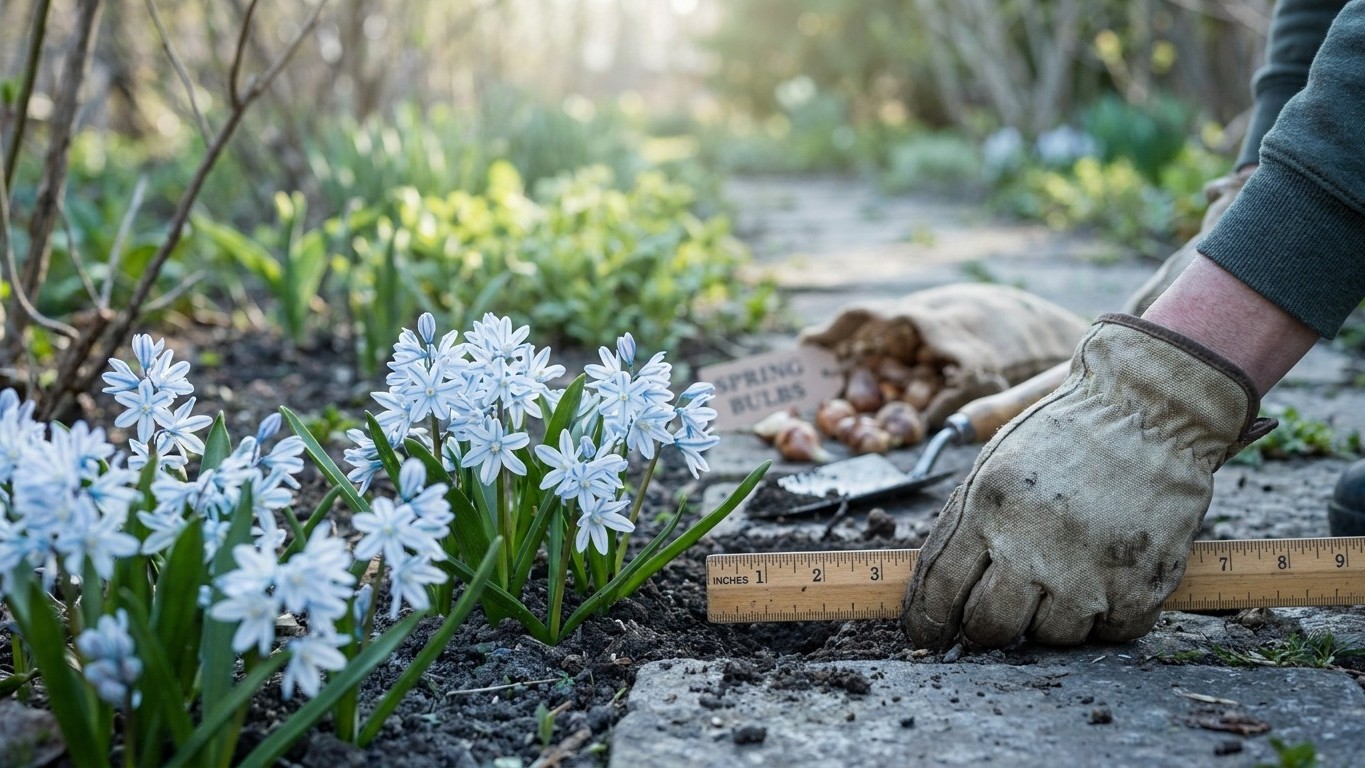

Puschkinia, better known as striped squill, needs 12 to 15 weeks of temperatures below 45°F before it flowers, and it grows reliably in USDA zones 3 through 8. Plant the bulbs 3 inches deep and 3 inches apart in early autumn, then leave them alone until the pale blue and white blooms show up in early spring.
What Striped Squill actually is

Two figures matter more than anything else on the label: USDA zones 3 through 8, and a cold requirement of 12 to 15 weeks below 45°F. That second number comes from Cornell University, Department of Horticulture, Flower Bulb Research Program, and it’s the one that decides whether you get flowers at all. Fall short of it and the bulb still produces leaves, but the flower stalk either never forms or comes up so short it hides in the foliage. A bulb that lands just under the requirement doesn’t always fail outright, it often flowers thin and sparse, so anyone gardening near the edge of a mild winter should treat the number as a caution rather than a guarantee.
Striped squill blooms in early spring, which puts it in the same window as crocus and the earliest daffodils rather than trailing behind them. The flowers themselves are pale, blue with a fine white stripe running down each petal, which is exactly why placement matters more with this bulb than with most. Colors this washed-out disappear when viewed from across a lawn or a driveway. The plant reads best up close, along a path or a stepping-stone border where someone actually walks past it in April, not as a splash of color seen from a porch thirty feet away.
Where it fits among spring bulbs
Botanically it belongs to the puschkinia group, a small genus that gets lumped in with the minor spring bulbs even though its cold requirement is stricter than several bulbs sold as tougher. Gardeners in zone 8, at the warm edge of its range, are the ones most likely to land in that uncertain band where the winter barely delivers enough chill hours. Everyone from zone 3 to the cooler side of zone 7 gets the cold in full and shouldn’t have to think about it again.
How deep and how far apart
The numbers are fixed, not a range to eyeball:
- Depth: 3 inches, measured from the top of the bulb to the soil surface
- Spacing: 3 inches apart, bulb to bulb
Depth does two jobs at once. It buffers the bulb from the freeze-thaw cycles that heave shallow-planted bulbs partway out of the ground over winter, and it keeps soil temperature swings from reaching the bulb directly. Plant shallower than 3 inches in a zone that swings hard between freezing nights and warm days, and don’t be surprised to find bulbs sitting half-exposed on the surface come February.
Spacing decides how the planting reads once it’s up. At 3 inches apart, a cluster of a dozen or more bulbs fills in as a continuous drift rather than a scattering of isolated dots, which matters given how pale and easy to lose these flowers are at any distance. Space them wider and the display thins out into something that looks accidental rather than planted.
Orientation and awkward bulbs
Like most spring bulbs, the pointed end goes up and the flatter, slightly rougher end (where roots will emerge) goes down. When a bulb is round enough that neither end gives a clear signal, plant it on its side rather than guessing wrong. Bulbs are resourceful enough to reorient a shoot toward the surface even sideways, so a sideways bulb still comes up fine, an upside-down one just wastes a season getting there.
Will it come back next year
Striped squill is a bulb worth planting for more than one season, and the reason has nothing to do with marketing copy. It comes down to physiology: after flowering, the leaves keep photosynthesizing and send the sugars they produce back down into the bulb, where next year’s flower bud is actually built. Cut the foliage back while it’s still green and you cut off that process mid-build, which is the single most common reason a planting of any spring bulb, this one included, stops flowering after its first year.
The fix is simple neglect. Once the flowers fade, leave the leaves standing until they yellow and go limp on their own, usually several weeks later. It looks untidy in a border for a stretch of late spring, but that untidiness is the plant doing the work that determines whether it flowers again. Bulbs planted where the foliage gets mowed down early, along a lawn edge that gets its first spring cut before the leaves have yellowed, are the ones that quietly vanish after two or three years.
Given a site within its hardy range, zones 3 through 8, and leaves left alone until they finish their job, striped squill behaves like a genuine perennial rather than a one-season bulb dressed up as one. Left undisturbed over several years it also tends to fill in on its own, which is one more reason the 3-inch spacing at planting doesn’t need to be generous, the gaps close in over time.
What eats it, and what leaves it alone
Striped squill goes untouched by rodents, which puts it in a different category from tulips and crocus, both of which squirrels and chipmunks treat as a stored food supply the moment the ground goes soft in autumn. That single detail changes the calculus on a lot of fall planting decisions. Anyone who’s planted a row of tulip bulbs only to find them dug up and scattered across the lawn within a week already knows the drill: wire mesh laid over the bed until the ground freezes solid is the measure that actually works, better than pepper flakes or predator urine sprays that wash out with the first rain.
With striped squill, that step simply isn’t necessary. The bulbs can go in the ground and stay there without a mesh cover, without a cage, without the fall ritual of protecting a planting from animals that dig on scent alone. That’s a meaningful difference for anyone planting a mixed bed of minor bulbs, it means the labor of rodent-proofing can be concentrated on the tulips and crocus in the same bed, while the puschkinia goes in and gets left alone.