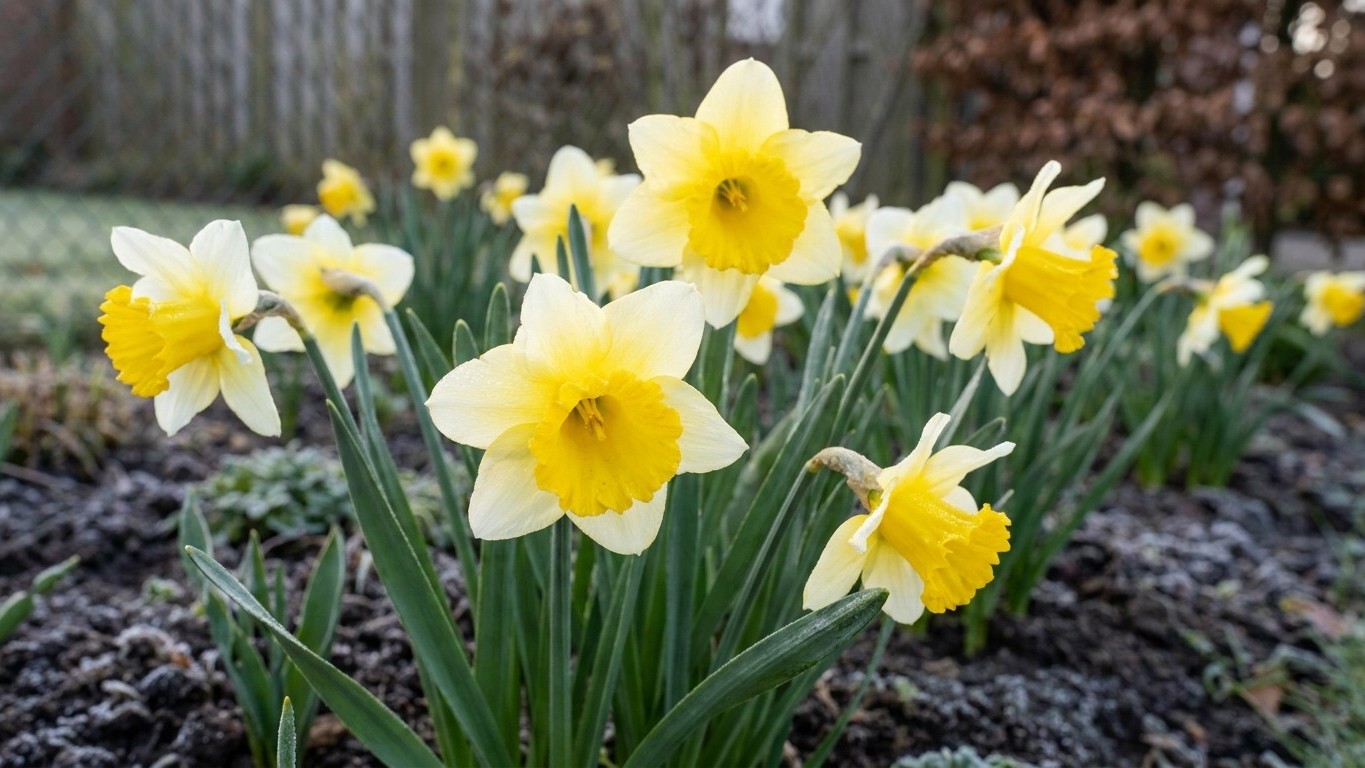

Daffodils need 12 to 16 weeks of temperatures below 45°F to bloom, they thrive in USDA zones 3 through 8, and the bulbs go in the ground 6 inches deep and 4 to 6 inches apart. Get those three numbers right and the rest of the planting mostly takes care of itself.
What Daffodil actually is

Two figures matter before you buy a single bulb: USDA hardiness zones 3 through 8, and a cold requirement of 12 to 16 weeks below 45°F. That second number, according to the Flower Bulb Research Program at Cornell University, Department of Horticulture, is the one that decides whether you get a flower at all. Fall short of it and the bulb still sends up leaves, but the bloom either never forms or shows up on a stem too short to notice. A bulb that gets close to the requirement but not quite there usually doesn’t fail outright, it just flowers thin and short. If your winter runs on the mild edge of zone 8, treat that as the uncertain band rather than a guarantee either way.
Daffodils belong to the narcissus group, and they bloom early to mid spring, generally ahead of the main tulip flush and often overlapping with the last of the crocuses. Colors run yellow and white, sometimes both on the same flower, which is part of why they read as the transitional bulb between the last cold snap and the start of real spring.
The habit worth knowing before you plant, not after: daffodil foliage keeps growing well past the bloom, and it has to be left alone to yellow and collapse on its own. That process, unglamorous as it looks in a front bed, is doing the actual work of building next year’s flower inside the bulb. Gardeners who tidy the leaves away too early are, without realizing it, cutting off the plant’s food supply mid-project. It’s a detail that matters enough to get its own section further down, because it’s the single most common reason a once-reliable patch of daffodils quietly stops blooming.
How deep and how far apart
The numbers aren’t a suggestion, they’re the difference between a bulb that survives winter heave and one that doesn’t:
- Depth: 6 inches, measured to the base of the bulb
- Spacing: 4 to 6 inches apart
Six inches gives the bulb enough soil mass above it to buffer against freeze-thaw cycles. Shallow planting is the main reason bulbs “walk” upward over a couple of seasons and eventually sit exposed at the surface, where they’re far more likely to rot or get frost-damaged. The spacing decides the look more than the survival: 4 inches apart reads as a dense, naturalized drift once the clumps fill in over a few years, while spacing closer to 6 inches keeps individual plants more distinct, closer to a row than a meadow effect.
Which end goes up
Daffodil bulbs aren’t subtle about orientation. The pointed end goes up, the flatter, slightly rougher end (where old roots were attached) goes down. On the rare bulb where the shape gives no clear signal, plant it on its side rather than guessing wrong. A sideways bulb will still find its way up through the soil; an upside-down one wastes a full season correcting itself underground.
If the bulbs feel unusually dry or lightweight when you buy them, soak them overnight before planting. That single step rehydrates tissue that’s begun to shrink in storage, and it’s often the difference between a bulb that establishes roots quickly in fall and one that sits stalled and vulnerable to rot for weeks. Skipping it on visibly shriveled bulbs is one of the more avoidable ways a planting fails before it ever gets a chance to flower.
Will it come back next year
Here’s the honest answer, and it’s a good one for daffodils: this bulb naturalizes freely and returns for decades, not just two or three seasons. That puts it in a different category than bulbs sold as “perennial” that really only perform reliably for a short stretch before petering out. Daffodils don’t just persist, under decent conditions they multiply, splitting into new bulbs underground until a single planting turns into a spreading colony over ten or fifteen years.
The physiology behind that longevity comes back to the same foliage question from earlier. After the flower fades, the leaves keep photosynthesizing for several more weeks, and that energy gets stored back into the bulb to fund next year’s bloom. Cut the leaves while they’re still green, braid them, mow over them, or fold them down to tidy the bed, and you interrupt that storage process before it’s finished. The plant survives, usually, but it flowers weaker the following spring, and a few years of that treatment is the most common reason an established daffodil patch goes leaves-only with no blooms at all.
The practical rule: let the foliage yellow and flop on its own, which typically takes four to six weeks after flowering. Only then is it safe to cut back or mow. It’s an unglamorous stretch of the season, but it’s the entire mechanism behind why this bulb keeps coming back when so many others don’t.
What eats it, and what leaves it alone
Daffodils are one of the few spring bulbs a gardener can plant without worrying about rodents. Every part of the plant, bulb, leaves, and flower, contains lycorine, a compound that’s toxic to squirrels, voles, chipmunks, and deer. That’s not a folk claim, it’s the reason daffodils show up so often planted in rings around tulip beds: the tulips are the vulnerable target, and the daffodils act as an unappetizing buffer that animals learn to route around.
This is worth knowing before you plant, because it changes how much effort protection is worth. If you’re mixing daffodils with other bulbs that are palatable, put the effort where it’s needed rather than everywhere. Wire mesh laid over the soil surface and left in place until the ground freezes hard is the measure that actually stops rodents from digging up vulnerable neighbors before winter sets in, and it’s worth reserving that step for the bulbs that need it rather than blanketing a bed that includes daffodils, which don’t.