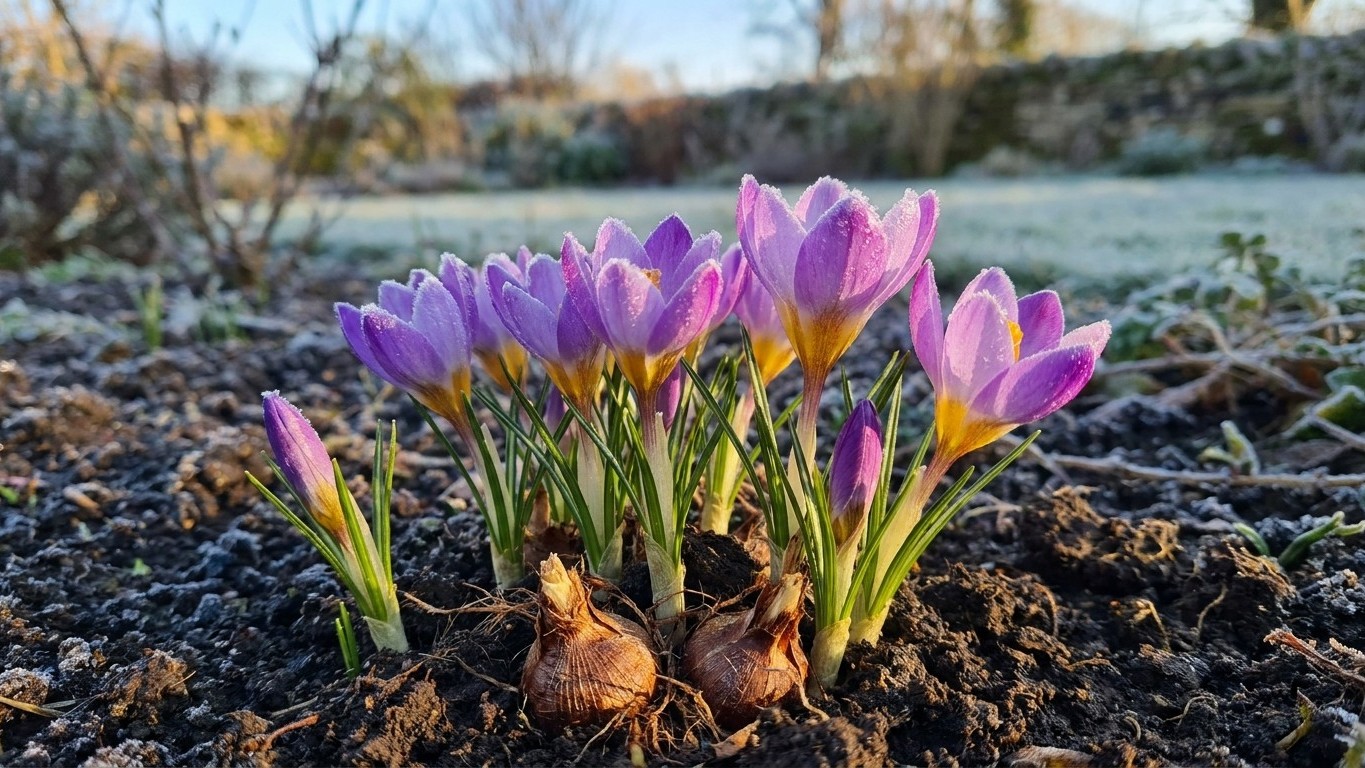

Crocus corms need 8 to 15 weeks below 45F before they’ll flower, and they’re hardy across USDA zones 3 to 8. Get the chilling window wrong and you’ll get leaves with no bloom. Get the planting depth right, and this is one of the few bulbs that actually multiplies on its own for years.
What Crocus actually is

Two figures matter more than any other detail on the label: the hardiness range and the cold requirement. Crocus is rated for USDA zones 3 through 8, which covers most of the continental United States except the hottest pockets of the Gulf Coast and southern Florida. If your garden sits in Canada, note that Canadian hardiness zones come from a different system, built on seven climate variables rather than average minimum winter temperature, so the number on a Canadian map does not translate directly to a USDA zone. Don’t put the two scales side by side and expect them to match.
The cold requirement is the figure that decides whether you get flowers at all. Crocus corms need 8 to 15 weeks of temperatures below 45F, according to Cornell University’s Department of Horticulture, Flower Bulb Research Program. Fall short of that window and the corm still produces leaves, but the flower either never forms or emerges on a stem too short to notice. A corm that lands just under the minimum doesn’t necessarily fail outright, it often flowers thin and uneven, so gardeners near the edge of the hardiness range should treat their results as unpredictable rather than assume total failure.
Crocus is one of the earliest bloomers in the spring bulb lineup, opening well before daffodils and most tulips, often while patches of snow are still on the ground. The flowers come in purple, yellow, and white. One habit catches new gardeners off guard: in many crocus varieties, foliage emerges in autumn and stays green through winter, then the flower appears in early spring while that older foliage is already present or starting to fade. It’s not a sign of disease or a bulb planted upside down, it’s just the plant’s normal rhythm, and understanding it early saves a lot of unnecessary worry come November.
How deep and how far apart
Plant crocus corms 3 to 4 inches deep and 3 inches apart. Depth isn’t a cosmetic choice, it’s a buffer. A corm sitting too shallow gets pushed around by freeze-thaw cycles over winter, and repeated heaving can shove it partway out of the soil, exposing it to drying air and hungry animals. The 3 to 4 inch range keeps the corm below that disturbed layer while still close enough to the surface for the shoot to reach daylight in early spring.
Spacing decides how the planting reads once it’s up. Set corms 3 inches apart and clustered in groups, and you get a solid drift of color that looks natural in a lawn or border. Space them out in a single line at that same distance and you get a row of separate dots, which reads more like a formal edging than a naturalized patch. If the goal is the drift look, plant in loose clusters of a dozen or more rather than a neat grid.
Orientation and pre-planting soaking
Crocus corms usually show a flatter side (the base, where roots emerge) and a slightly pointed or rounded top. Plant the flatter side down. When a corm is round enough that neither end is obvious, don’t agonize over it, plant it on its side. The shoot will find its way up regardless; it just takes a few extra days.
If the corms feel dry or shriveled when they arrive, soak them overnight in room-temperature water before planting. This single step is often the difference between a corm that establishes roots quickly in fall and one that sits dormant, dehydrated, and never gets going before the ground freezes. It costs nothing and takes five minutes, so there’s little reason to skip it.
- Depth: 3 to 4 inches
- Spacing: 3 inches apart
- Orientation: flatter side down; if unclear, plant on its side
- Pre-planting: soak dry or shriveled corms overnight before planting
Will it come back next year
Crocus is a genuine perennial, not a one-season bulb dressed up as one. Under the right conditions, and left undisturbed, it naturalizes into lawns and borders, multiplying year over year rather than fading out after a season or two. That’s a meaningfully different profile from bulbs that bloom big the first spring and quietly disappear by year three. The difference comes down to how the corm rebuilds itself underground each year, not marketing language on a bag.
Here’s the part that trips up most gardeners: after the flower fades, the leaves have to be left alone until they yellow and die back naturally on their own schedule. Those leaves are doing real work during that stretch, photosynthesizing and feeding energy back down into the corm, where next year’s flower bud is actually formed. Cut the foliage early, even if it looks messy or is flopping over the lawn, and you cut off that energy supply. The corm survives, usually, but it shows up the following spring with weak growth or no flower at all. This single mistake, mowing or trimming green crocus foliage too soon, is the most common reason an established planting stops blooming.
The practical takeaway is patience: resist tidying up the bed until the leaves have gone fully yellow and papery. In a lawn setting, that means holding off on the first couple of mowing passes in spring until the crocus foliage has finished its job. It’s a small inconvenience for a planting that, done right, keeps expanding and blooming for years without replanting.
What eats it, and what leaves it alone
Squirrels dig up crocus corms, and this is one of the more common frustrations reported with fall bulb plantings. Unlike daffodils, which contain compounds that make them unpalatable to most rodents, crocus corms don’t carry that same natural defense, which is part of why they’re a target while other bulbs planted nearby go untouched.
The measure that actually works is mechanical, not chemical: lay chicken wire or another wire mesh directly over the planting area right after you finish putting the corms in the ground. Leave it in place until the ground freezes solid for the season. Squirrels dig by feel and scent in the loosened soil right after planting, so the mesh barrier during that early window, when the ground is still soft and freshly disturbed, is what stops the digging before it starts. Once the ground freezes hard, the corms are largely out of reach anyway and the mesh can come off.
Sprays, pepper flakes, and other scent deterrents get sold as solutions but tend to wash away or lose potency within days, right when the corms are most vulnerable. The wire mesh, however unglamorous, is the one method with a track record of actually keeping a fresh planting intact through that first exposed fall.