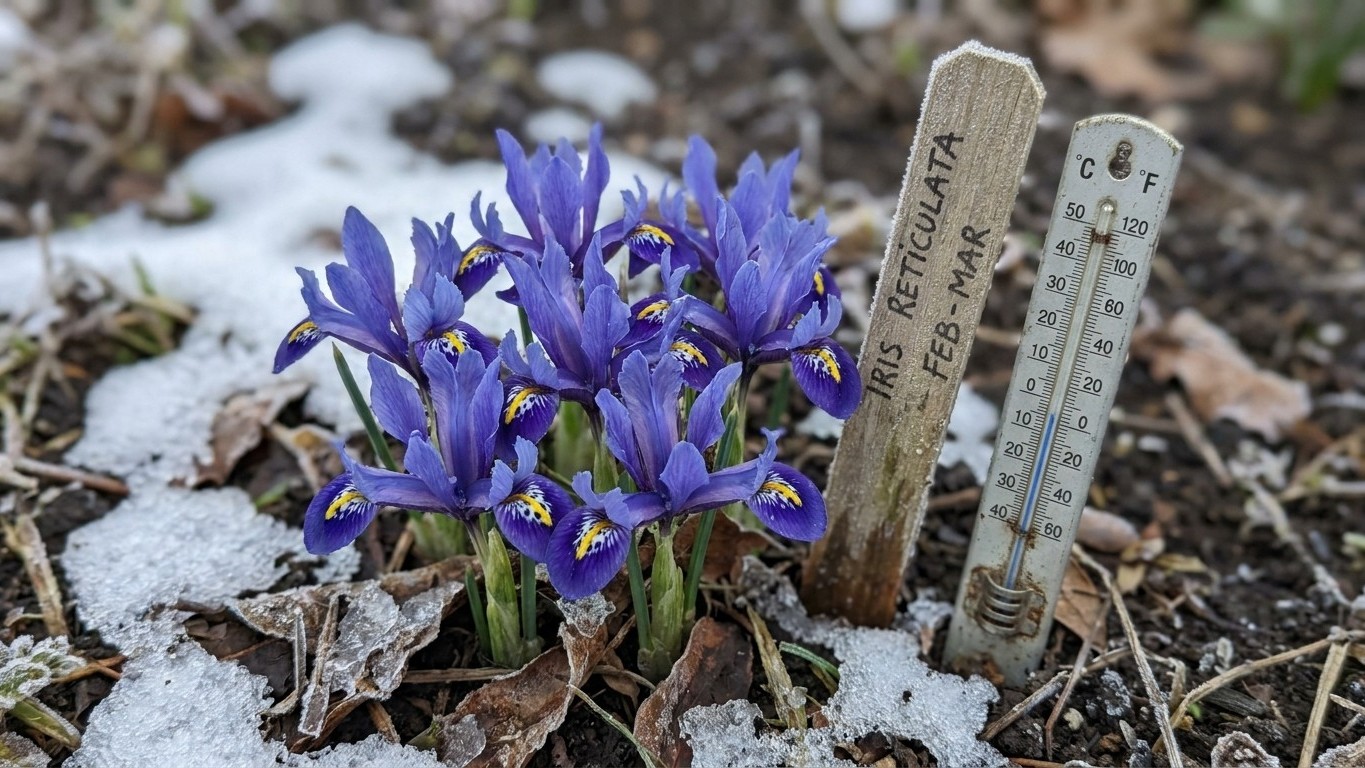

Reticulated iris needs 12 to 14 weeks below 45F to flower at all, and it survives outdoors in USDA zones 5 through 9. Get the planting depth and spacing right, respect that cold requirement, and this small bulb rewards you with blue and purple blooms before almost anything else stirs in the yard.
What Reticulated Iris actually is

Reticulated iris belongs to the iris family, but it has nothing to do with the tall bearded irises that dominate June borders. This is a bulb, not a rhizome, and it blooms in late winter, weeks ahead of daffodils and most tulips. The color range is narrow and reliable: blue and purple, usually with a splash of yellow or white marking on the falls, but no reds, no pinks, no oranges.
Hardiness runs USDA zones 5 to 9. Outside that band, either winter kills the bulb outright or summer never gives it the dry rest it wants. Inside the band, the second number that matters is the cold requirement: 12 to 14 weeks below 45F, according to the Flower Bulb Research Program at Cornell University’s Department of Horticulture. That figure is not a suggestion. A bulb that gets less cold than this often still pushes up leaves, but the flower stem stays too short to clear the foliage, or no bud forms at all. A bulb close to the threshold, a mild winter in zone 9 for instance, doesn’t necessarily fail completely, but it flowers weakly and unevenly. Treat anything near that 12-week mark as an uncertain bet rather than a guaranteed no.
A habit worth knowing before you plant
Two quirks catch new growers off guard. First, the foliage often dies back while the flower is still fully open, so the plant can look half-finished even at its best moment. Second, the leaves themselves appear in autumn and sit through the entire winter before the flower ever shows, which means a bed that looks bare in November may already have leaves poking through by December. Neither habit signals a problem. Both are just how this bulb runs its calendar, and knowing it in advance saves a panicked dig-up in January.
How deep and how far apart
The numbers are specific, and they matter more than they look. Plant 3 to 4 inches deep and space the bulbs 3 inches apart. Depth is not cosmetic here: it buffers the small corm against the freeze-thaw cycles that otherwise heave a shallow-planted bulb right out of the soil over winter, corm and all. Spacing decides the look of the bed just as much as the planting itself. At 3 inches apart, a cluster of a dozen or more bulbs reads as a drift of color at ankle height. Space them wider and the same dozen bulbs look like scattered dots, which undersells a bulb whose whole appeal is impact in late winter when little else competes for attention.
Orientation matters, and it’s usually obvious once you look closely: the pointed end goes up, with roots or a flatter basal plate facing down. When a bulb has no clear point, no clear flat side, the safe move is to plant it on its side. The shoot will find its way upward on its own; it costs nothing to hedge this way, and it avoids the guesswork that leads to a bulb planted upside down and struggling to emerge.
- Depth: 3 to 4 inches
- Spacing: 3 inches apart
- Orientation: pointed end up; plant on its side if unclear
Site selection reinforces all of this. Reticulated iris wants a dry summer baking after it finishes flowering, which is why it does so well in raised beds and gravel gardens where drainage is fast and reliable. A spot that stays damp through July and August is the single most common reason a planting rots below ground before the following winter’s cold requirement even comes into play.
Will it come back next year
This is the honest question, and the answer depends less on luck than on two things: whether the summer baking happens, and whether the leaves are left alone after flowering. Reticulated iris can return and multiply for years in a site that suits it, but it is not automatic, and it is not the same guarantee you get from a daffodil planted in decent soil and forgotten.
The leaves are the whole story here. After the flower fades, the foliage keeps working, feeding the bulb underground and building next year’s flower bud inside it before the leaves finally yellow and die back on their own. Cut that foliage while it’s still green, whether out of tidiness or because it looks messy next to fresher spring growth, and you’ve cut off the bulb’s only chance to recharge. That single mistake, foliage removed too early, is the most common reason a planting of reticulated iris flowers beautifully the first year and then produces nothing but leaves the next.
Left alone to finish its own cycle, and given the dry summer rest it needs, the bulb behaves like a genuine perennial rather than a one-season purchase dressed up as one. The failure mode isn’t the bulb’s biology letting you down; it’s usually a gardener’s pruning habits working against it.
What eats it, and what leaves it alone
Rodents target reticulated iris. Squirrels, mice, and voles will dig up freshly planted corms, sometimes within days of planting, and a bed that looked complete in October can turn up half-empty by spring. This is worth knowing before you plant a hundred bulbs and lose a third of them to a squirrel that treats your border as a pantry.
The fix that actually works is unglamorous but effective: lay wire mesh flat over the planting area, pinned down at the edges, and leave it in place until the ground freezes solid. Once the soil has frozen, digging becomes too much work for most rodents and they move on to easier targets. Repellent sprays and granules sold for this purpose tend to wash away with the first rain and need constant reapplication, which makes the mesh the more reliable option through the vulnerable weeks right after planting. Once the bulbs are established and the ground has frozen for the season, the mesh can come off, and it goes back on again only if the bed gets replanted with fresh corms the following autumn.