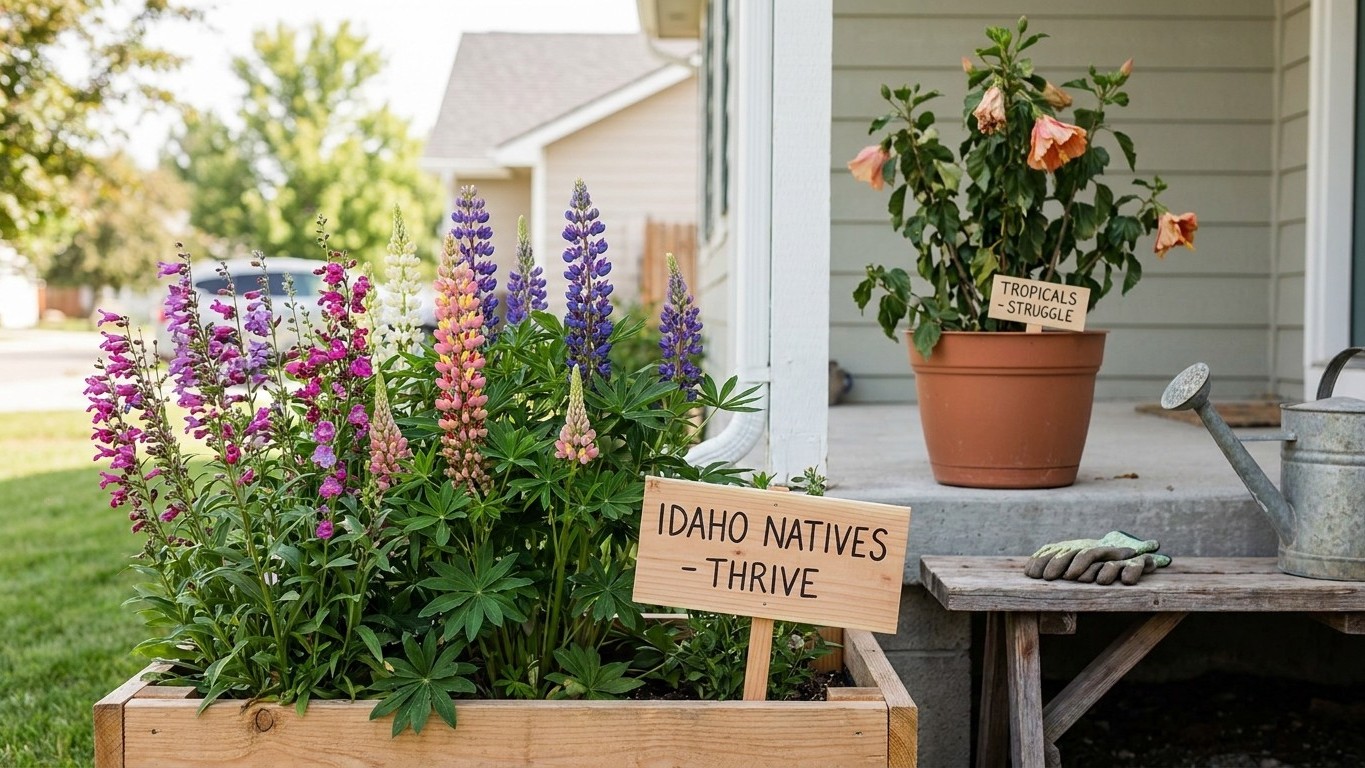

A 3b to 7b spread is what separates gardening in Boise from gardening an hour up the canyon, and that gap is what decides which flowers live. A perennial that sails through winter on the valley floor, where the coldest month averages a 25.4F low, can die outright at higher elevation, where the same statewide range pushes hard toward its cold end. Then summer flips the test entirely, with dry heat pushing past 90F on roughly 47 days a year, punishing anything bred for moisture and humidity instead of drought.
What thrives in Idaho

Cold hardiness comes first
A 3b to 7b range is one of the widest in the country, and it means a flower that winters over fine in the Boise foothills can die outright in the Sawtooth or Selkirk country a few hours away. NOAA’s NCEI normals for 1991-2020 put Boise’s coldest-month average low at 25.4F, which describes an ordinary winter night, not the record cold of a bad year. Buy for the zone where you actually garden, not the zone on a seed rack stocked for the whole region, and if you’re above the valley floor, assume conditions closer to the cold end of that statewide range. Gardeners in Idaho’s higher mountain valleys are effectively working the same zone 3 to 4 conditions and short season covered in our guide to flowers that actually thrive in Montana, where the same limits apply.
Heat and drought load
Summer is the second filter, and it works in the opposite direction. Boise averages 47.5 days a year at 90F or above, per NOAA’s NCEI normals, and humidity stays low through most of that stretch. Flowers that need steady moisture or thick, humid air tend to scorch, wilt, or mildew here even with regular watering. What holds up instead is anything with silver or fuzzy foliage that reflects heat, a taproot that reaches past dry topsoil, and a bloom habit that doesn’t quit the first week irrigation is missed. The daisy family, Asteraceae, supplies a disproportionate share of Idaho’s reliable performers, from blanket flower to coneflower to yarrow, because that family evolved across a lot of open, dry ground.
A planting scheme built for a wetter, more humid climate, the kind that suits New Brunswick with its steady summer rainfall, tends to fail here for the opposite reason it thrives there. Idaho’s border needs less moisture-loving foliage, more gray and silver, and irrigation scheduled around the dry stretch rather than assumed from rainfall.
Native plants worth the space
Plants that evolved across the Intermountain West and wider Pacific Northwest arrive already matched to Idaho’s swing between hard frost and dry heat. That’s the practical case for natives over imported bedding flowers: once established, most need no supplemental water beyond a normal season’s rain, and none of them need rescuing through a heat wave the way a petunia does.
Species worth planting
- Blanket flower (Gaillardia aristata): red-and-yellow daisy bloom, tolerant of poor soil and long dry spells.
- Rocky Mountain penstemon (Penstemon strictus): violet-blue flower spikes on stiff upright stems, a favorite of bumblebees.
- Showy milkweed (Asclepias speciosa): pink globe-shaped flower clusters, the main host plant for monarch caterpillars in the region.
- Western yarrow (Achillea millefolium): flat white flower clusters over ferny gray-green foliage, spreads by rhizome.
- Lewis’s mock orange (Philadelphus lewisii), Idaho’s state flower: a deciduous shrub with fragrant white bloom in early summer.
What natives do for pollinators
Most of Idaho’s native bees are solitary, ground-nesting species rather than honeybees, and many time their whole life cycle to the bloom of specific native plants. A border built entirely from imported cultivars, however showy, can leave a gap in that timing that a monarch or a native bumblebee has no substitute for. Mixing even a third of the bed with regional natives, rather than treating them as an afterthought at the border’s edge, closes most of that gap without giving up color or structure. Showy milkweed in particular is not optional if attracting monarchs matters to you, since their larvae eat almost nothing else.
Perennials that come back

“Perennial” only means something once it’s checked against a zone, and a plant tag that says perennial without a zone range attached is not giving you the information you need. A perennial rated to zone 5 will come back reliably in Boise, sitting at the warmer end of Idaho’s 3b to 7b range under the USDA’s 2023 map, but the same plant may need winter mulch or may simply not survive in a colder mountain valley a short drive away.
Comparing behavior across Idaho’s zone range
| Perennial | Typical zone rating | Behavior in Boise (near 7a-7b) | Behavior in colder Idaho valleys |
|---|---|---|---|
| Peony (Paeonia lactiflora) | Zone 3-8 | Reliable, dies back and returns each spring | Reliable, often blooms later in the season |
| Daylily (Hemerocallis hybrids) | Zone 3-9 | Reliable, foliage may stay evergreen through mild winters | Reliable, fully dormant in winter |
| Catmint (Nepeta faassenii) | Zone 4-8 | Reliable, reblooms after shearing | Reliable at zone 4 and warmer, risky below it |
| Lavender (Lavandula angustifolia ‘Munstead’) | Zone 4-9 | Usually reliable with good drainage | Often lost over winter, better grown as an annual or in a pot moved indoors |
That last row is the one gardeners moving from a milder state get wrong most often. Lavender, salvia species rated below zone 4, and many geraniums (Pelargonium, not the hardy cranesbill) are perennial in warmer parts of the country and are grown here as annuals, replaced each spring, because the plant simply won’t survive an Idaho winter outside the mildest valley floors. Read the zone number on the tag, then compare it honestly to your own site, not to Boise’s, unless you actually garden in the Boise valley.
Putting a border together
A border reads as designed rather than scattered when it’s layered by height and repeats its color instead of introducing something new every few feet. Put the tallest plants, delphinium, hollyhock, or Russian sage, at the back or center of an island bed, mid-height perennials like daylily and coneflower in the middle band, and low front-edge plants like yarrow or dwarf zinnia where they won’t get shaded out.
Sequencing bloom through the season
Boise’s frost-free window, based on NOAA’s NCEI 1991-2020 normals, runs from a last spring frost of April 23 to May 7 out to a first fall frost of October 7 to October 21, and other parts of the state have a noticeably shorter season on either end. Inside that window, stagger bloom time deliberately rather than letting everything peak in July and go bare for the rest of the season:
- Early: peony, iris, and columbine carry the border through late spring.
- Midsummer: coneflower, blanket flower, and daylily fill the peak heat months.
- Late season: Russian sage, aster, and rudbeckia extend color toward the first fall frost.
Repeat two or three colors through the length of the bed rather than planting one of everything, which is what makes a border look intentional from a distance instead of like a plant collection. Leave real gaps at planting time, roughly the mature spread listed on the tag, even though the bed looks sparse the first season. Perennials that are crowded from day one stay smaller and bloom less for years afterward.
Local help
The University of Idaho Extension runs the state’s extension service, including county Master Gardener programs that maintain plant lists suited to local conditions rather than the state as a whole. A county office can tell you which side of Idaho’s zone range you’re actually on, which matters more than any statewide guide. For planting calendars and other timing questions specific to the state, our Idaho guides cover the rest of the season.
Common questions
Can I just use the Boise frost dates for my whole garden?
No, only if you actually garden in the Boise valley. NOAA’s NCEI normals put Boise’s frost-free window between roughly late April and mid-October, but higher elevations across Idaho freeze earlier in fall and later in spring, sometimes by several weeks. Check locally rather than assuming the reference station applies.
Why did my lavender die over the winter when the tag said it was hardy?
Most likely a zone mismatch or poor drainage. Lavandula angustifolia cultivars are typically rated to zone 4, which survives in Boise but struggles in colder Idaho valleys, and wet winter soil kills lavender roots faster than cold air does.
Do I need to water native flowers once they’re planted?
Water them through their first one to two seasons while roots establish, then taper off. After that, most regional natives like blanket flower and yarrow get by on normal rainfall and only need supplemental water during an unusually long dry stretch.
What’s the easiest flower for a beginner to start with in Idaho?
Blanket flower and daylily are both forgiving of missed watering, poor soil, and beginner pruning mistakes, and both are widely available as starts rather than needing to be grown from seed. Start with those before moving on to anything that needs staking or winter protection.
Related guides
- Flowers That Actually Thrive in Washington, and the Ones That Struggle
- Flowers That Actually Thrive in Oregon, and the Ones That Struggle
- Flowers That Actually Thrive in Montana, and the Ones That Struggle