
Kentucky flowers succeed when they can shrug off both ends of the state’s climate: winter lows that average 27.8°F in the coldest month at Louisville, according to NOAA’s 1991-2020 climate normals, and summers that reach 90°F or hotter on 37.2 days a year on average, also per NOAA. The USDA Plant Hardiness Zone Map puts the state at zone 6a to 7a, with milder pockets in the west and colder ones toward the eastern highlands. Before you buy anything, check the hardiness range printed on the plant tag against your own county’s zone, not the state average.
What thrives in Kentucky

A flower bed here has to survive a real winter and then turn around and take a real summer, often within the same six months. That two-sided demand rules out a lot of catalog favorites that were bred for milder coasts or drier interiors. The plant needs to be rated hardy to at least zone 6, and ideally hold a margin below that for the colder counties where late cold snaps can dip past the state average.
Cold and heat, both
Winter hardiness only solves half the problem. NOAA’s Louisville normals put 37.2 days a year at 90°F or above, and that heat arrives with humidity that sits in the air overnight instead of breaking at dusk. Plants bred for cool, dry summers, delphinium and lupine among them, tend to rot at the crown or mildew badly here even when the zone rating on the tag looks fine. The heat load, not the cold, is what actually knocks out a surprising number of “hardy” perennials by August.
Families that carry these traits
Two plant families do most of the heavy lifting in Kentucky beds. The daisy family, Asteraceae, gives you coneflower, black-eyed Susan and aster, all of which combine deep taproots for drought with open, airy growth that dries out fast after a storm and resists fungal spotting. The mint family, Lamiaceae, gives you salvia, catmint and bee balm, most of them aromatic and slightly hairy-leaved, both traits that discourage the fungal diseases humid air encourages. Kentucky’s humidity is real but lighter than the coastal load described in our guide to flowers that thrive in Louisiana, so a plant that struggles in the Gulf South’s heat can still hold up fine here.
Native plants worth the space
A native plant has spent thousands of years adjusting its root system, bloom timing and drought response to this region’s rainfall pattern, and that shows up in the garden as less work. An established native rarely needs supplemental watering once it has a full season or two to root in, which is more than can be said for most nursery perennials bred for uniform bloom rather than survival.
Plants worth planting
These are native to the broader eastern and central United States and do well across Kentucky’s growing conditions:
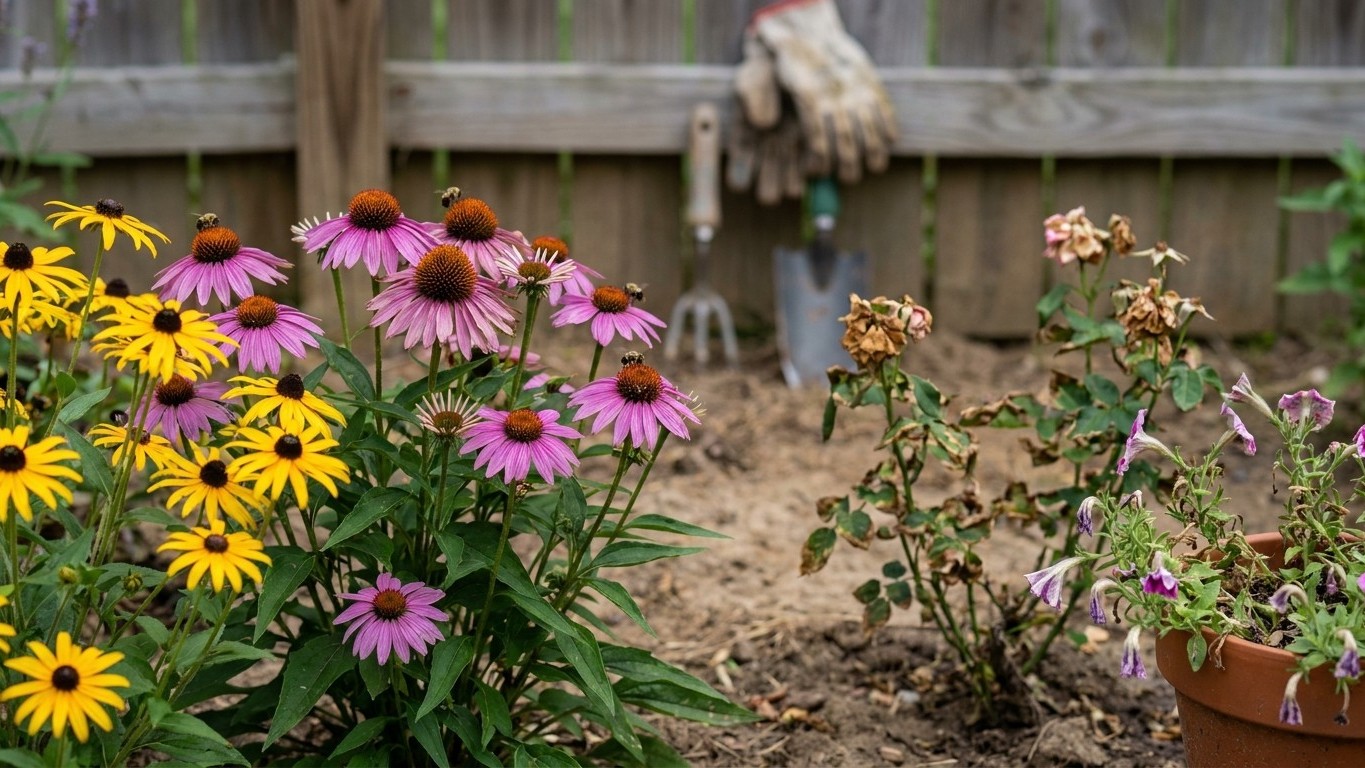
- Purple coneflower (Echinacea purpurea), lavender-pink daisy flower on a stiff stem
- Black-eyed Susan (Rudbeckia hirta), gold petals with a dark brown center cone
- Butterfly milkweed (Asclepias tuberosa), bright orange clustered flower heads
- Wild bergamot or bee balm (Monarda fistulosa), lavender shaggy blooms
- New England aster (Symphyotrichum novae-angliae), purple daisy flowers in fall
- Joe Pye weed (Eutrochium purpureum), dusty pink flower clusters on a tall stalk
Native plants also carry pollinators through the whole season rather than a single burst. Milkweed is the only host plant monarch caterpillars can eat, and bee balm draws hummingbirds as reliably as any feeder. Buy the straight species where you can rather than a heavily bred “nativar,” since some of those selections have been shown to produce less nectar than the wild form even though they look nearly identical on the shelf.
Perennials that come back

At zone 6a-7a, a solid list of perennials returns every spring without protection: peony (Paeonia), daylily (Hemerocallis), garden phlox (Phlox paniculata), catmint (Nepeta) and sedum, now often sold as Hylotelephium. Hosta holds up in shade with the same reliability. These are the plants to build the backbone of a bed around, since they don’t need replanting or a guessing game every spring.
Grown here as annuals
Plenty of plants sold at Kentucky garden centers every May are perennial only somewhere warmer, and treated here as one-season annuals. Lantana (Lantana camara) is hardy to roughly zone 9-11 depending on the selection. Tropical hibiscus (Hibiscus rosa-sinensis) needs about the same. Salvia guaranitica sits closer to zone 7b-10, which puts it right on the edge of survival in a mild Kentucky winter and dead in a hard one. Gardeners across the Ohio River, covered in our guide to flowers that thrive in Ohio, face an even tighter margin, since much of that state sits at zone 6a or colder with less room for error.
| Plant | Typical hardiness zone | Treatment in Kentucky (6a-7a) |
|---|---|---|
| Peony | 3-8 | Reliable perennial |
| Daylily | 3-9 | Reliable perennial |
| Lantana | 9-11 | Grown as annual |
| Tropical hibiscus | 9-11 | Grown as annual |
| Salvia guaranitica | 7b-10 | Annual in most winters |
Reading the tag against your zone
The zone range on a plant tag lists the coldest and warmest zones the plant survives outdoors year-round. If the lower number on the tag is higher than your zone, treat the plant as an annual unless you plan to dig it up, pot it, and overwinter it indoors. A tag reading “zone 8-10” in a Louisville garden sitting at 6a-7a is a clear signal, not a gray area.
Putting a border together
Layering by height
Put the tallest plants at the back of a bed viewed from one side, or the center of one viewed from all sides. Joe Pye weed and garden phlox anchor that back layer at several feet tall. Coneflower, black-eyed Susan and salvia fill the middle at knee to waist height. Catmint, sedum and dwarf selections of daylily edge the front. Skipping this order is the single most common reason a new bed looks messy rather than full.
Succession of bloom
Louisville’s growing season, bounded by NOAA’s 1991-2020 normals at a last spring frost of March 24 to April 4 and a first fall frost of November 2 to November 12, runs roughly seven months. Rural counties tend to see a tighter window on both ends, since NOAA notes the Louisville station itself runs later in spring and earlier in fall than the surrounding countryside. Plan for peonies and phlox in late spring, coneflower and bee balm through summer, and sedum and aster carrying the bed into fall, so nothing is bare for more than a few weeks at a stretch.
Repeating color and leaving room
Pick two or three colors and repeat them across the length of the bed rather than planting one of everything. A border of purple coneflower, purple salvia and purple aster reads as designed even with no other planning at all. At install, leave the full mature spread listed on the tag between plants. A bed that looks sparse in May at proper spacing will be full by July, and crowding it now only means digging plants out in two years when they collide.
Local help
The University of Kentucky’s Cooperative Extension Service runs the state’s Master Gardener program, and county offices keep plant lists tuned to local soil and rainfall that go well beyond anything a statewide guide can offer. Find your county office through the extension service directory, and browse more region-specific advice in our Kentucky guides.
Common questions
Why did my “hardy” perennial die over the winter?
Most often the plant’s zone rating was borderline for your county, not a mismatch with the state as a whole. Kentucky spans USDA zones 6a to 7a, and a plant rated to survive down to 7a will struggle in a colder pocket even a county or two away. Check the actual low the plant needs against your specific area rather than a statewide average.
Can I grow hydrangeas here?
Most hydrangea types handle Kentucky winters fine, but bigleaf hydrangea (Hydrangea macrophylla) sets next year’s flower buds in fall, and a late spring cold snap after growth starts can kill those buds even when the plant itself survives. Since NOAA’s 1991-2020 normals put the last spring freeze at Louisville anywhere from March 24 to April 4, a warm early spring followed by a return frost is exactly the pattern that costs a bloom season without killing the shrub.
Do I need to deadhead everything to keep flowers coming?
No, but it helps with some plants more than others. Coneflower, salvia and bee balm rebloom faster if spent flowers are cut back, while daylily and peony bloom once regardless of deadheading and only need the spent flower removed for tidiness or seed prevention.
What blooms through the worst of the summer heat?
Coneflower, black-eyed Susan, salvia and zinnia keep blooming through the stretch of 90°F-plus days NOAA’s Louisville normals put at 37.2 a year on average. Cool-season bloomers like foxglove or delphinium tend to fade or stop entirely once that heat sets in, even with regular watering.
Related guides
- Flowers That Actually Thrive in Indiana, and the Ones That Struggle
- Flowers That Actually Thrive in Ohio, and the Ones That Struggle
- Flowers That Actually Thrive in Louisiana, and the Ones That Struggle
- Kentucky Soil
- Growing Peppers in Kentucky
- Forcing Spring Bulbs Indoors in Kentucky