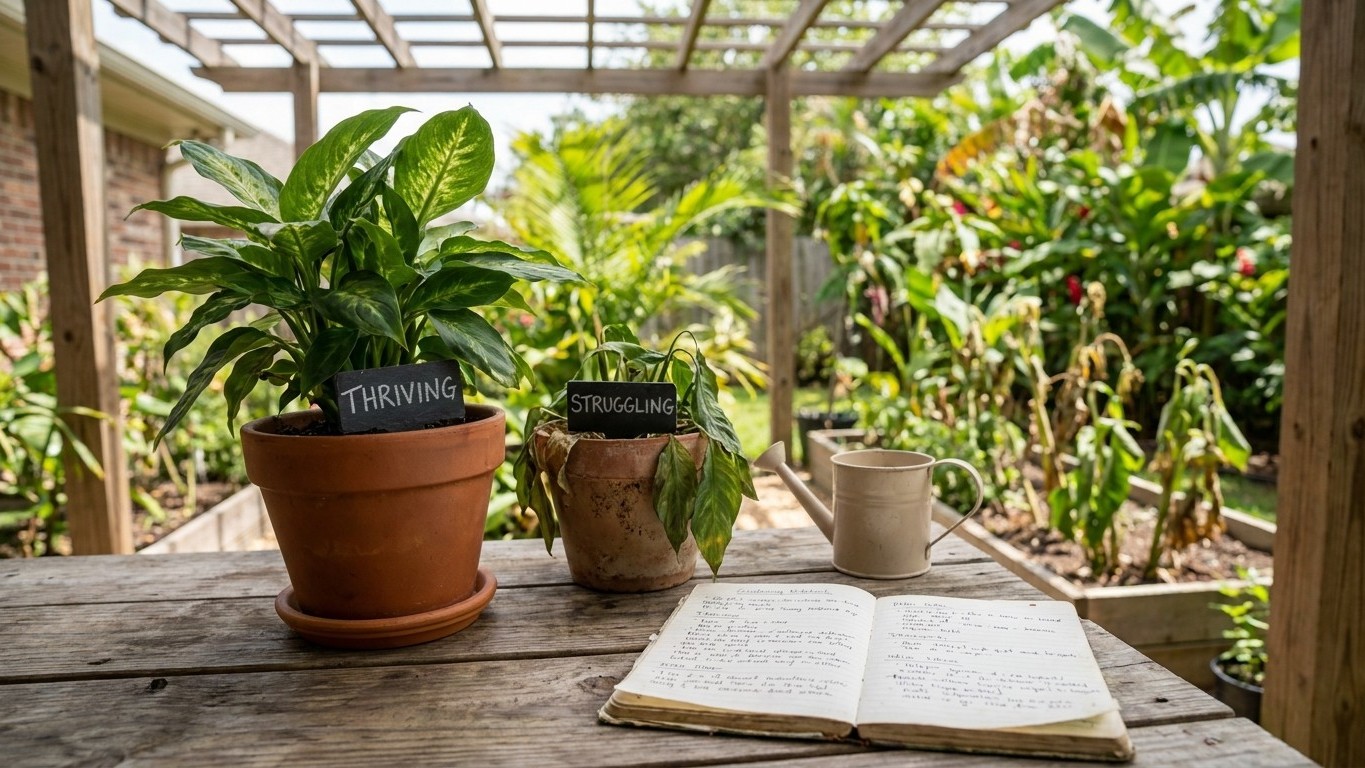

Your flowers are dying from heat and soggy soil, not cold, and that’s actually good news because it narrows down what to plant. Louisiana almost never gets a hard freeze that matters, so the whole game is picking flowers that shrug off wet feet, thick humidity, and stretches of 90-degree days without turning into a mildew mess. Before you buy anything else for that bed, check whether the spot drains after a heavy rain — that one detail decides more about what survives here than any tag on a nursery pot.
What thrives in Louisiana

The plants that hold up in a Louisiana bed share three traits: they take heat without wilting, they shrug off humidity that would otherwise open the door to fungal disease, and they tolerate soil that stays wet after a downpour. The USDA Plant Hardiness Zone Map puts the state at zones 8a to 10a, a wide range running from the cooler hill parishes in the north down to the nearly frost-free coast. Winter cold is rarely what kills a Louisiana flower bed. NOAA’s 1991-2020 climate normals put the average low of the coldest month at just 46.1F at the New Orleans reference station, mild enough that plenty of tender plants come through most winters untouched.
Heat is the real filter
Summer is where Louisiana gardens get tested. New Orleans averages 70.7 days a year at 90F or hotter, according to NOAA’s 1991-2020 normals, and that heat arrives with humidity that keeps foliage wet long after the sun is up. Powdery mildew, black spot and root rot take out more flowers here than any freeze does, so a plant’s resistance to fungal disease matters as much as its heat tolerance. Families that handle this combination well include the verbena family (lantana, verbena and porterweed), the mint family (salvias, especially the open, airy Salvia greggii and Salvia coccinea types that dry out fast after rain), and the daisy family, where narrow-leafed zinnias like Zinnia angustifolia resist the mildew that flattens wide-petaled bedding zinnias by August.
Tropical and subtropical genera also do well here because they evolved for exactly this climate: hibiscus, canna, crinum lily and esperanza (Tecoma stans) treat a Louisiana summer as home turf rather than an ordeal. Drainage matters more than drought tolerance for most of the state, since heavy clay and low-lying beds hold water after storms and rot the roots of plants bred for drier soil elsewhere. Raised beds or a simple berm solve this for species that need better drainage than the yard naturally offers. In colder states, the deciding factor runs the other direction entirely; our guide to Flowers That Actually Thrive in Maryland covers a climate where winter kill, not summer heat, sorts out what survives.
Native plants worth the space
A native plant that has spent thousands of years adapting to Gulf South heat, humidity and soil needs far less coddling once it settles in, because it isn’t fighting the climate the way an imported ornamental is. Once established, most regional natives need no supplemental water beyond a normal rain year and shrug off the fungal pressure that troubles plants bred for drier climates. They also do more for the wildlife that depends on them: native bees and butterflies evolved alongside these specific plants, and several can only complete their life cycle on a narrow set of host species.
Plants to look for
- Louisiana iris (Iris hybrids in the Louisianenses group) – spring bloom in reds, blues and yellows, happiest in a boggy or pond-edge spot
- Purple coneflower (Echinacea purpurea) – long summer bloom, drought-tolerant once rooted in
- Black-eyed Susan (Rudbeckia hirta) – reseeds freely and blooms through the worst of the summer heat
- Tropical sage (Salvia coccinea) – red or white spikes that hummingbirds visit all season
- Swamp milkweed (Asclepias incarnata) – the host plant monarch caterpillars need to complete their migration south
- Coral honeysuckle (Lonicera sempervirens) – a well-behaved vine, unlike invasive Japanese honeysuckle, that draws hummingbirds spring through fall
- Turk’s cap (Malvaviscus arboreus) – small red flowers built for hummingbird bills, blooms nonstop in part shade
- Blazing star (Liatris spicata) – narrow purple spikes that migrating monarchs use as a fall nectar stop
These species are native across the wider Gulf South and southeastern United States rather than to one narrow strip of Louisiana, so a plant tagged simply “native” at a big-box nursery may still have started from seed stock grown in a different state or region. Buying from a nursery that sources Louisiana or Gulf Coast seed stock gives you a plant already adapted to the local rainfall pattern, not just the same species grown from cooler or drier stock elsewhere. Pairing several of these in one bed, rather than planting a single specimen of each, gives pollinators a more reliable nectar source across the season and gives the bed a fuller look once the plants mature into their second year.
Perennials that come back

“Perennial” is relative to climate, and that catches a lot of gardeners moving to Louisiana from somewhere colder. A plant that dies to the ground and returns every spring in one climate might act as a true evergreen shrub here, or the reverse can happen: a plant hardy through brutal winters somewhere like South Dakota might rot in a Louisiana wet winter despite the mild temperatures, because it never evolved to handle standing water and humidity. Our guide to Flowers That Actually Thrive in South Dakota covers a nearly opposite problem, where winter cold is the deciding factor and summer heat is barely a concern.
Reading a plant tag against your zone
Most nursery tags list a hardiness range such as “zones 7-10.” Louisiana runs from USDA zone 8a in the northern hill parishes to 10a along the immediate coast, according to the USDA’s 2023 Plant Hardiness Zone Map, so a plant tagged hardy only to zone 9 will likely act as a true perennial in New Orleans and die back or fail outright in Shreveport. Check the tag’s low end against your own zone rather than the state average, since the ten-degree spread across Louisiana changes which plants survive winter without protection.
| Plant | Reliably perennial | Grown as an annual or dies back |
|---|---|---|
| Canna lily | 8a-10a, statewide | – |
| Esperanza (Tecoma stans) | 9a-10a, coastal parishes | 8a-8b, north Louisiana (roots often survive, top growth doesn’t) |
| Lantana camara | 9a-10a | 8a (dies to the ground most winters, returns from the root) |
| Pentas lanceolata | 10a, warmest coastal pockets only | 8a-9b, grown as a summer annual |
Cannas, daylilies (Hemerocallis hybrids) and Louisiana iris come back reliably across the whole state, since all three tolerate both the mild winters and the wet soil that trips up plants bred for drier climates. Lantana and esperanza are the ones to watch: both are true perennials in the coastal parishes but behave more like root-hardy die-backs in the northern part of the state, coming up late from the base after a hard winter instead of staying evergreen.
Putting a border together
A border reads well when the eye moves through height, color and bloom time instead of hitting the same plant at the same height in one flat band. Put the tallest flowers, cannas, esperanza, tall salvias, at the back or center of an island bed, then step down through mid-height perennials like lantana and pentas, and finish with a low edge of angustifolia zinnias or dwarf salvia in front. Leave real space between transplants even though a new bed looks sparse the first month. Louisiana’s heat and humidity push most of these plants to full size fast, and a border planted tight now is a tangled, disease-prone mess by August.
Spreading bloom across the season
Louisiana iris and other spring perennials open the season, native coneflower and black-eyed Susan carry the early summer, and lantana, pentas, zinnia and esperanza take over for the long, hot stretch from midsummer into fall. Because the frost window here is short and unreliable, with New Orleans’ first fall freeze arriving anywhere from December 17 to January 8 and the last spring freeze anywhere from January 18 to February 8 according to NOAA’s 1991-2020 normals, many of these “annuals” simply keep blooming through what would be a hard stop further north. In roughly one year out of seven, NOAA’s data shows no freeze at all reaches the reference station, and a warm winter can carry pentas or lantana blooms straight through to spring.
Repeating a color at intervals along the border, rather than grouping every red flower in one clump, pulls the eye down the whole bed instead of stopping it at a single spot. Three or five plants of the same color, repeated at two or three points, reads as intentional; one of everything reads as a plant collection, not a border. Keep a gap of a foot or more between distinct color blocks so the transition doesn’t muddy into a blur of mixed hues by midsummer.
Mulch between new transplants at planting time rather than waiting, since bare wet soil under Louisiana’s humidity encourages the same fungal problems that plague the plants themselves. A two-to-three-inch layer of pine straw or bark keeps roots cooler through the year’s 70.7 days a year above 90F, per NOAA’s normals, and cuts down on the fungal splash-back that comes from rain hitting bare dirt.
Local help
The LSU AgCenter runs the state’s Master Gardener program and publishes plant lists tuned to individual parishes, which matters given how much the coastal and northern zones differ. Check with the LSU AgCenter before committing to a large planting, especially for anything borderline for your zone. For more on gardening elsewhere in the state, our Louisiana guides cover vegetables, soil and other regional topics parish by parish, and the extension service itself is reachable at lsuagcenter.com.
Common questions
Can I grow tulips and daffodils in Louisiana?
Not as a plant that comes back on its own. Tulips need a sustained period of cold to form next year’s flower, and NOAA’s 1991-2020 normals put New Orleans’ coldest month average low at just 46.1F, well short of what most tulip bulbs need to rebloom. Gardeners here typically buy pre-chilled bulbs and treat tulips as a one-season annual, pulling and discarding the bulbs after bloom rather than expecting a second year.
Why does my zinnia patch get white powdery spots every summer?
That’s powdery mildew, and it’s close to unavoidable on the wide-petaled bedding zinnias (Zinnia elegans) once Louisiana’s humid nights set in. Switching to the narrow-leafed Zinnia angustifolia types, which grow more open and dry out faster after rain, cuts the problem dramatically without giving up the flower entirely.
Do I really need to track frost dates here?
Less than you would further north, but it still matters for a handful of tender plants. NOAA’s data puts New Orleans’ fall freeze window between December 17 and January 8 and the following spring’s last freeze between January 18 and February 8, and in roughly one year out of seven no freeze happens at all at the reference station. For most of what grows well in Louisiana, summer heat is the bigger threat than any of these dates, and areas away from New Orleans should expect somewhat different timing.
What can I plant in a spot that stays wet after every rain?
Louisiana iris, canna and swamp milkweed all tolerate soil that stays saturated for days, since all three occur naturally in wet ground. Avoid plants sold as drought-tolerant or Mediterranean, such as lavender or rosemary, in that same low spot. They need the fast drainage a wet corner of a Louisiana yard usually can’t give them, no matter how much sun the spot gets.
Related guides
- Flowers That Actually Thrive in Texas, and the Ones That Struggle
- Flowers That Actually Thrive in Arkansas, and the Ones That Struggle
- Flowers That Actually Thrive in Maryland, and the Ones That Struggle