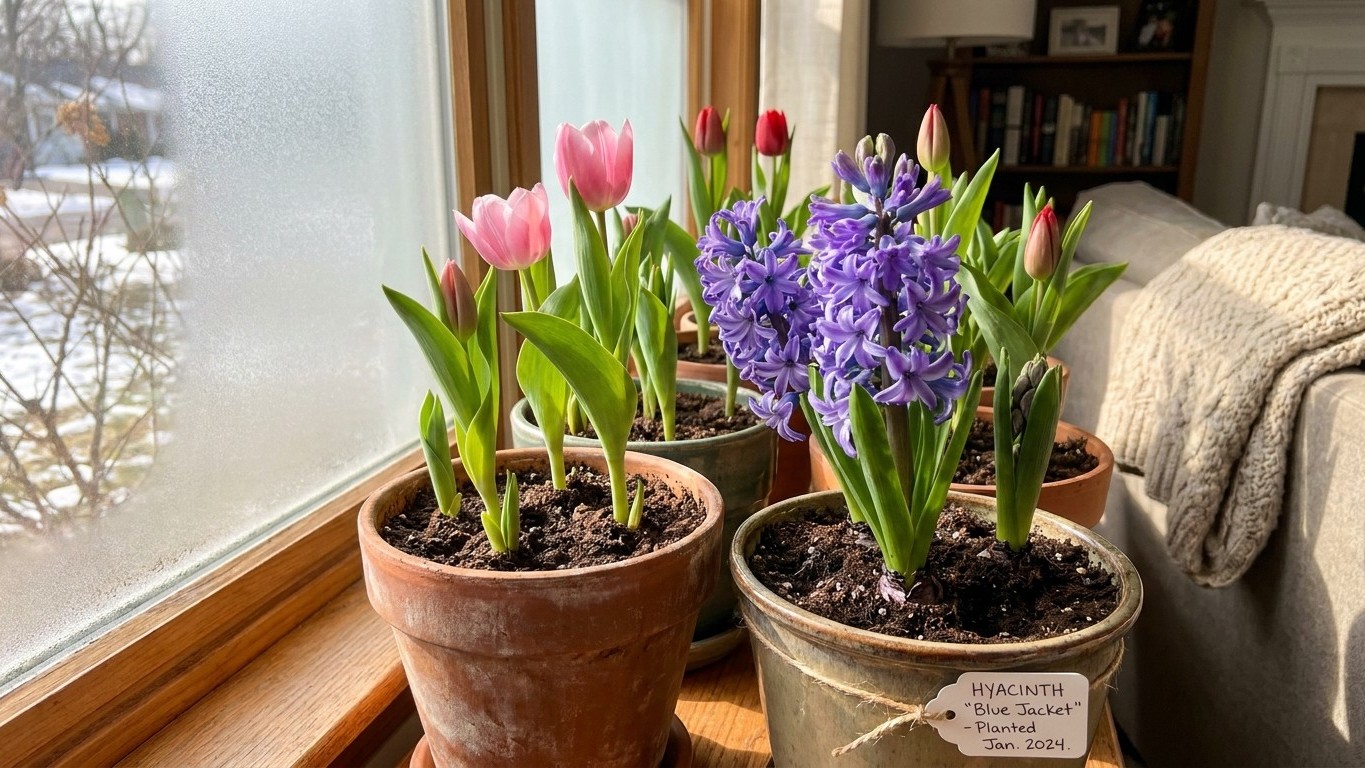

Forcing works in Kentucky because the challenge here isn’t a missing winter, it’s a pot that can’t survive one on its own. Give a bulb its cold period in a controlled spot, then bring it in to bloom weeks ahead of the garden, and it works reliably from Louisville to the far corners of the state.
Why this matters in Kentucky

The mean daily minimum for the coldest month at the Louisville reference station is 27.8°F, according to NOAA NCEI Climate Normals for 1991-2020. That’s a real winter. A gardener in a state where the coldest month barely dips below 50°F has to manufacture cold from scratch, usually in a refrigerator, because the bulb will never get its 12 to 14 weeks below 45°F any other way. Kentucky doesn’t have that problem. The ground here gets cold enough, for long enough, without any help.
So the reason to force bulbs indoors in this state isn’t a shortage of chill. It’s timing and it’s containers. A gardener who wants hyacinths blooming on a windowsill in February, well before anything shows outside, has to start the cold clock in September or October and manage the whole cycle by hand. That’s a scheduling choice, not a climate rescue.
Containers are the second, and more common, reason. The USDA Plant Hardiness Zone Map, built on the 1991-2020 normals, places the state in a range from 6a to 7a. That range matters because a hardiness zone describes ground temperatures, where surrounding soil mass buffers the bulb from the worst of the air temperature. A pot has no such buffer. Left on a porch or a patio through a Kentucky winter, a container’s soil tracks the air temperature almost exactly, and with a coldest-month mean minimum near 28°F, that soil can freeze solid, roots and all. A daffodil bulb rated hardy to zone 6a survives that same cold effortlessly in a garden bed. In an unprotected pot, it can die.
Louisville sits toward the warmer end of that 6a-7a range; other parts of the state, especially at higher elevation or farther from the Ohio River corridor, run colder. Anyone using the 27.8°F figure or the zone range to plan should treat Louisville as the reference point, not the whole territory, and adjust downward if they’re gardening somewhere colder within the state.
How to do it here
The mechanics are the same whether the goal is an early bloom on the windowsill or simply keeping a potted bulb alive through winter. What changes is where the cold comes from and how closely it needs to be watched.
- Plant in fall. Set bulbs in a well-draining pot, tips up, sometime in September or October, and water once so the soil settles around the roots.
- Find 12 to 14 weeks of cold between roughly freezing and 45°F. An unheated garage works if it reliably stays above freezing through the coldest stretch; given a coldest-month mean minimum of 27.8°F at the Louisville reference station, a garage attached to a heated house often runs a few degrees warmer than open air and can hold in that window, but check it with a thermometer rather than assuming.
- Use a refrigerator if the garage runs too cold or too warm. Keep the pot in a drawer or on a shelf away from ripening fruit, since the ethylene gas fruit gives off can damage the flower bud forming inside the bulb before it ever gets a chance to open.
- Track the weeks on a calendar. Guessing the chilling period is the single most common way to ruin a batch of bulbs; write the start date down.
- Look for a root system and a pale shoot an inch or two tall as the sign that the chilling period has done its job.
- Move the pot to a cool room, not a warm one, for the first week indoors, somewhere around 60°F with indirect light, so the shoot doesn’t scorch or stretch too fast.
- Shift to a sunny window once buds show color, keeping the room as cool as is comfortable to make the bloom last.
For anyone leaving a potted bulb outdoors instead of moving it to a garage or fridge, the container needs to behave like it’s two hardiness zones colder than the ground it’s sitting on, because it will lose heat two zones’ worth faster. In practice that means insulating the pot with mulch piled against its sides, grouping several pots together, or pushing them against a heated foundation wall, rather than trusting the zone rating printed on the bulb bag.
Which bulbs are worth it
Not every spring bulb rewards the effort of forcing. The ones that do tend to have a short cold requirement and a short, sturdy stem, both of which make them easier to manage in a pot on a windowsill rather than staked up in a garden bed. Height is the real enemy indoors, since a tall flower stalk grown under indoor light rather than full sun often stretches and flops before it ever opens.
| Bulb | Cold requirement | Stem behavior indoors |
|---|---|---|
| Crocus | Short | Low, sturdy |
| Hyacinth | Moderate | Low, sturdy |
| Muscari (grape hyacinth) | Short | Low, sturdy |
| Dwarf iris (Iris reticulata) | Short | Low, sturdy |
| Paperwhite narcissus | None required | Tall, can lean |
| Large trumpet daffodils | Long | Tall, prone to flopping |
| Tall tulip cultivars | Long | Tall, prone to toppling |
- Crocus
- Hyacinth
- Muscari
- Dwarf iris (Iris reticulata)
- Paperwhite narcissus
- Large trumpet daffodils
- Tall tulip cultivars
- Fritillaria
Paperwhites deserve a separate note. They need no cold period at all and bloom on their own timeline a few weeks after planting, which makes them the easiest bulb to force in the state. They also aren’t hardy outdoors in a 6a-7a winter, so a gardener who buys a bag of paperwhites was never going to plant them in the yard anyway. Forcing them costs nothing in the long run, because there was no outdoor future for that bulb to give up.
What goes wrong, and when you can still fix it
Leaves but no flower
The bulb put out green growth and stopped there, with no bud at all. That almost always means the cold period ran short, so the bulb never finished forming the flower inside itself before it started growing. There’s no fix for the plant that’s already growing this season. If it’s a bulb that’s hardy in Kentucky ground, such as a tulip or daffodil, it can be planted out in the garden once the leaves die back naturally, where it may re-establish and bloom outdoors in a future year, though it likely won’t force well a second time.
A flower on a stem too short to see over the pot rim
This happens when the pot was warmed up too fast, before the shoot had a chance to elongate in the cool transition period. The flower that opens is often fine, just low and hidden. Nothing rescues that stem this season. The fix is for next time: hold the pot in a cooler room longer after the chilling period ends, and warm it up in stages rather than moving it straight to a sunny, heated windowsill.
Rot at the base of the bulb
Soft, dark tissue at the base, sometimes with a sour smell, points to standing water around the roots, usually from a pot without real drainage holes or one sitting in a saucer that never got emptied. This bulb is not salvageable this season. For the next attempt, use a pot with open drainage and check the saucer after every watering rather than letting water collect.