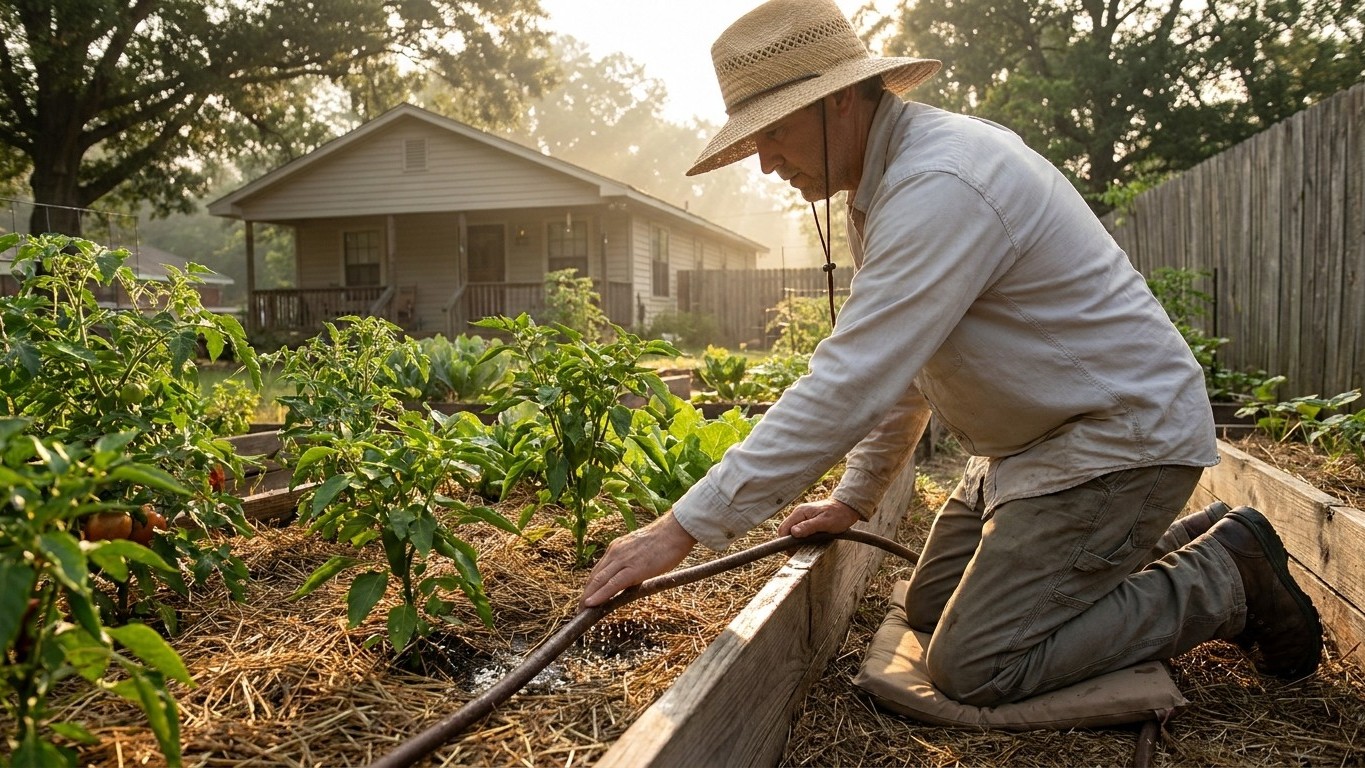

Mississippi doesn’t ask a gentle question about water. With 71.1 days a year reaching 90°F or hotter at the Jackson reference station, a garden here needs a plan, not a hope. The short version: water deeply, once or twice a week, at the soil line, and check your county’s restrictions before you set a schedule.
What the climate asks of you

Start with the number that actually rules a Mississippi garden: 71.1 days a year at 90°F or above, measured at the Jackson reference station over the 1991-2020 period. That’s not a heat wave. That’s more than two solid months of the year when a plant loses water through its leaves faster than most soil can resupply it through the roots. Every watering decision you make from June through August happens against that backdrop.
The state sits in USDA hardiness zones 7b through 9a, a range wide enough that a gardener near the coast and one in the hills are gardening in two different worlds. Jackson, the reference point most often used for the state, sees its last spring frost between March 6 and March 22, and its first fall frost between November 7 and November 22. That’s a long growing season, roughly eight months, and every one of those months after the frost date passes puts more demand on your hose.
What the numbers don’t hand you, at least not without checking your own county, is a clean monthly rainfall figure. Mississippi’s climate is humid subtropical, and summer rain here tends to arrive as afternoon thunderstorms rather than the slow, soaking rain that actually reaches root depth. A storm can drop half an inch in twenty minutes and run straight off a hard, sunbaked bed, leaving the top inch of soil damp and the root zone bone dry. That’s the trap: a rain gauge can say the week was “wet” while your tomatoes are wilting by 3 p.m.
Soil texture changes how far that rain gets. Sandy ground along the coastal plain drains fast and holds almost nothing in reserve, so a thunderstorm that would carry a clay-heavy Delta garden for four or five days might be gone from sandy soil in a day and a half. Because local rainfall and soil data vary block to block, the most useful move is a rain gauge in your own yard and a call to Mississippi State University Extension for county-level guidance before you build a watering schedule around an assumption. For a closer look at how to adjust that schedule when the rain stops altogether, see Watering Through a Dry Spell in Mississippi.
How much, how often
The old rule still holds: deep and infrequent beats shallow and daily, every time. A quick five-minute sprinkle each evening trains roots to stay near the surface, right where the top inch of soil bakes hardest during those 71-plus days of 90-degree heat. Roots that never have to reach down won’t, and a plant with shallow roots is the first one to collapse the day you forget to water or travel for a weekend.
Before you turn anything on, check the soil itself, whether you’re working a raised bed or Watering Pots and Containers in Mississippi. Push a finger two inches into the bed, or better, push a trowel in near the root zone. If it comes out dry and crumbly at that depth, water. If it’s still cool and damp, wait. This single habit does more to prevent both drought stress and root rot than any timer or app.
Sandy ground versus clay ground
Texture changes the math, not the principle. Sandy soil, common along the Gulf Coast and in scattered pockets statewide, holds little water in reserve and calls for shorter, more frequent soakings so the root zone doesn’t dry out between sessions. Heavy clay, more typical inland and through the Delta, can hold a week’s worth of water, but it drowns roots if you soak it again before it’s had the chance to dry, and it should never be worked or watered while it’s still wet and sticky underfoot.
| Soil type | Water retention | Watering pattern |
|---|---|---|
| Sandy | Low, drains fast | Shorter sessions, more often |
| Clay | High, drains slowly | Deep soak, then wait until dry |
Tie this back to the season itself: with 71.1 days above 90°F pushing evaporation hard and afternoon storms often too brief to reach root depth, most Mississippi gardens spend a large part of summer on irrigation rather than rainfall alone. Here’s a sequence that works across most of the state’s soils:
- Check the soil two inches down with a finger or trowel before watering at all.
- Water early morning, before 9 a.m., so leaves dry before the day’s heat sets in.
- Aim the hose or drip line at the base of the plant, never over the foliage.
- Give the bed roughly an inch of water, applied slowly enough to soak in rather than run off.
- On sandy soil, split that into two shorter sessions a few days apart; on clay, apply it in one session and let the bed dry before the next.
- Skip the next scheduled watering entirely if a storm has visibly soaked the bed, and re-check with your finger before resuming.
Restrictions and rules
Watering restrictions aren’t universal in Mississippi, but they aren’t rare either, and they tend to show up exactly when you need water most: during a hot, dry stretch in July or August. Municipal water systems and rural water associations set their own rules, often triggered by drought conditions, reservoir levels, or peak summer demand on the system rather than by a fixed calendar.
Because those rules change by city, county, and even by water provider within the same county, there’s no single statewide answer to quote here, and repeating one would do more harm than good. What can be said with confidence is that a state seeing more than 71 days a year above 90°F, with summer rain arriving in short bursts rather than steady soaks, is the kind of climate where local utilities are more likely to introduce watering-hour limits or odd-even day schedules during a dry summer.
The reliable move before you set an automatic timer or plant a water-hungry bed is a call or a visit to your local water utility’s website, and a check with Mississippi State University Extension, which tracks drought conditions and can point you to the right office for your county. Rules can shift mid-season, so what was fine in May might carry a fine in August.
Using less
Cutting water use in a Mississippi garden isn’t about watering less carefully. It’s about losing less of what you already put down. A few changes do most of the work, and they’re worth listing separately rather than blurring together, because each one solves a different problem.
- Mulch, two to three inches of it, shades the soil surface and slows evaporation, which matters most during those 71-plus days a year the thermometer clears 90°F.
- Drip irrigation or soaker hoses put water at the root zone instead of into the air, cutting the losses that come with overhead sprinklers on a hot afternoon.
- Grouping plants by water need means you’re not soaking a drought-tolerant shrub just to reach a thirsty tomato three feet away.
- Working organic matter into the soil helps sandy ground hold more water between sessions and helps clay drain a little better, softening the extremes of both.
- Rain barrels, where local codes allow them, catch water that would otherwise run off a roof and down the storm drain.
On that last point, the arithmetic is worth doing once. An inch of rain falling on a thousand square feet of roof works out to roughly 600 gallons of runoff. A single sharp summer thunderstorm, the kind that’s common but brief in Mississippi’s humid subtropical pattern, can fill a barrel fast, but the same storm pattern means dry stretches between rains can leave that barrel empty right when a bed needs it most. A barrel is a supplement to a watering plan, not a substitute for one, especially across a summer defined by more than seventy days of serious heat.
Common questions
How often should I water a vegetable garden in Mississippi during July and August?
Most beds need a deep soak roughly twice a week during the hottest stretch, adjusted by soil type and rainfall. Check two inches down with a finger before adding water rather than watering on a fixed calendar.
Does Mississippi have statewide watering restrictions?
No single statewide rule governs watering hours or days. Restrictions are set locally by municipal water systems and rural water associations, often tied to drought conditions, so check with your provider directly.
Is it better to water in the morning or evening?
Morning, generally before 9 a.m. Watering at the base of the plant early gives leaves time to dry before nightfall, which reduces the fungal problems that thrive in Mississippi’s summer humidity.
Can I rely on rain barrels alone during a Mississippi summer?
Rarely. Summer rain here tends to arrive in short, intense bursts rather than steady soaks, so a barrel can fill fast during a storm and sit empty during the dry stretch that follows. Treat it as backup, not a primary source.