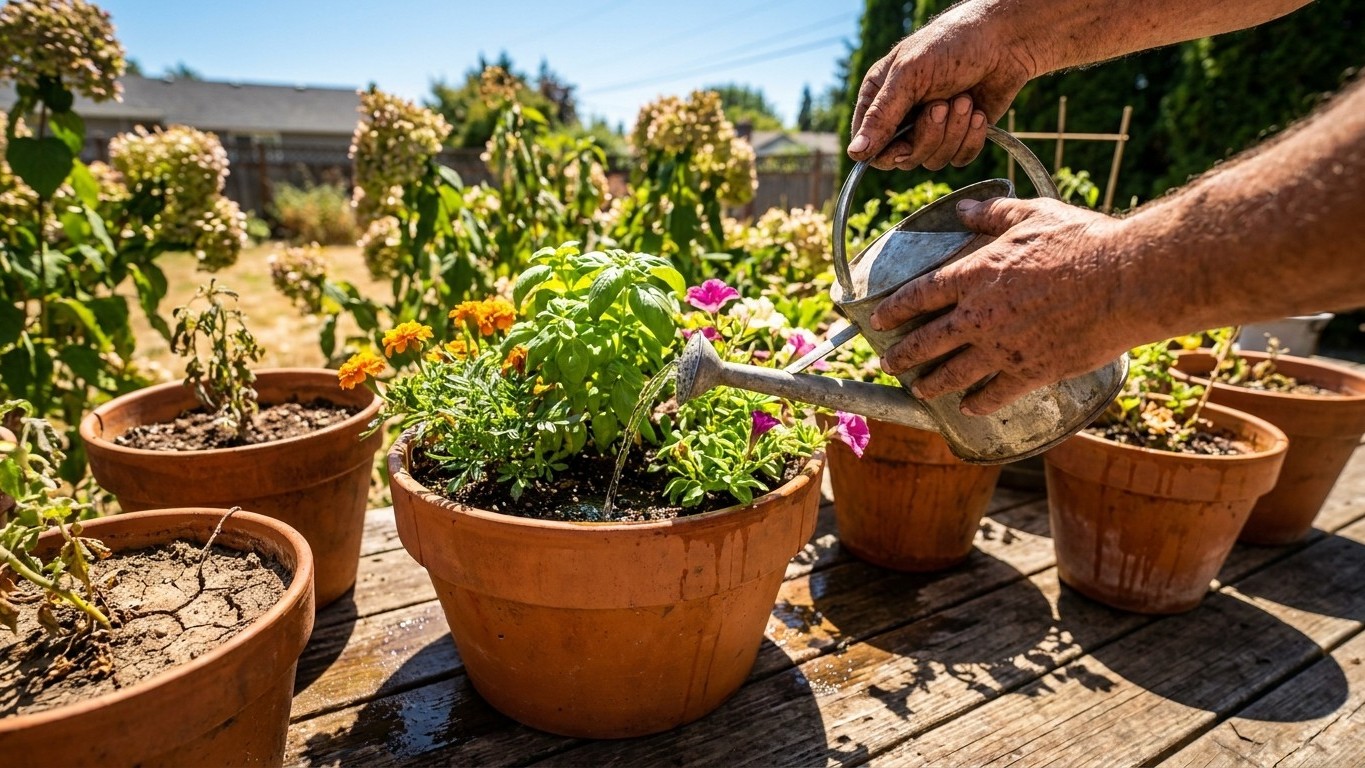

In Mississippi, a container garden needs watering roughly every one to three days through summer, because heat drives evaporation faster than rain can replace it, and a pot holds far less reserve than a garden bed does. The exact rhythm depends on pot size, material and where it sits, but the climate math behind that rhythm is worth walking through before you set a schedule.
What changes here

Two numbers set the terms for anyone watering pots in Mississippi. The driest summer month, June, brings about 4.43 inches of rain on average. And the state’s reference station logs 71.1 days a year at or above 90F. Put together, that’s a month with almost an inch of rain a week arriving from the sky, landing on ground that’s baking under three months of near-daily 90-degree heat. The rain sounds generous. The heat cancels a good chunk of it before it ever reaches a root.
Do the arithmetic on a standard garden bed first, since it’s the baseline every container gardener in Mississippi should understand before adjusting for pots. A bed wants roughly an inch of water a week. June’s 4.43 inches, spread over roughly 4.3 weeks in the month, works out to about 1.03 inches a week arriving naturally from rain alone. On paper, that’s almost exactly what a bed asks for. In practice, it rarely lands that way. Mississippi’s summer rain mostly comes as thunderstorms, not gentle steady soaks, and much of a heavy downpour runs off before it soaks in, especially on compacted or sloped ground. The 71.1 days above 90F push evaporation hard enough that even a well-timed inch can vanish from the top few inches of soil within a day or two.
Containers change this equation again. Potting mix drains faster than garden soil and holds a fraction of the water reserve, since there’s no surrounding earth to buffer temperature or hold moisture at depth. A pot that would need watering once a week if it were an in-ground bed in June often needs it two or three times over the same week, because there’s simply less material to hold onto that inch of rain, and a raised container heats up on all sides, not just the surface. The 4.43-inch figure is useful context for the whole property, but for a pot on a deck or patio, it’s the heat number that does most of the talking.
How to water when it matters
The method that works for pots in Mississippi summers comes down to three habits, each tied to what’s actually happening inside the plant and the soil. Water deeply rather than sipping, water at the base rather than overhead, and water in the morning rather than the evening. Each choice has a mechanical reason behind it, not just a tradition passed down.
Deep watering pushes moisture through the entire root zone instead of just wetting the surface, which trains roots to grow down and outward where conditions stay more stable. A quick daily splash never reaches that depth, so roots stay shallow, right where the day’s heat bakes them hardest. Watering at the base, rather than sprinkling the foliage, keeps leaves dry and cuts down on fungal problems that thrive when leaves stay wet overnight. Morning watering matters for a related reason: it gives the plant a full reserve before the day’s heat load hits, and any moisture left on foliage has hours of sun and airflow to dry before evening, when a damp leaf becomes an overnight invitation for disease.
Checking the soil, not the surface, is what actually tells you when to water. Push a finger about two inches into the pot’s soil, or use a small trowel for larger containers. If it’s dry at that depth, water. If it’s still damp, wait. Surface soil dries first and fastest, especially in Mississippi’s heat, so trusting what you see on top leads to overwatering nearly every time.
A simple sequence to start from, adjusted against your own container and how fast it dries out:
- Check soil moisture two inches down each morning before deciding whether to water.
- Water slowly and thoroughly until it runs from the drainage holes, rather than a quick surface splash.
- Water before 9 a.m. when possible, so foliage dries before the day’s heat and humidity peak.
- In peak summer, with 71.1 days a year reaching 90F, expect to repeat this daily or every other day for smaller pots; larger containers with more soil volume can often stretch to every two to three days.
- Recheck after each rain rather than skipping a scheduled watering, since a summer thunderstorm often wets only the surface of a container.
That daily-or-every-other-day figure is a starting point, not a rule. A six-inch terra cotta pot in full sun dries far faster than an eighteen-inch plastic container in partial shade, so treat the finger test as the final word, not the calendar.
What goes wrong
“I water a little every day, just to be safe”
This is the single most common way container plants suffer in Mississippi summers. Light daily watering wets only the top inch of soil, which trains roots to stay shallow instead of reaching down toward the more stable moisture deeper in the pot. Those shallow roots then sit directly under the surface, the hottest, driest layer of soil on a 90-degree day, and the plant ends up more heat-stressed than one watered deeply but less often.
“I water in the evening after work”
Evening watering feels convenient, but it leaves foliage damp overnight in warm, humid conditions, exactly the environment fungal diseases need to take hold. Mississippi’s summer humidity makes this worse than in drier climates, since the moisture on leaves has fewer hours to evaporate before nightfall.
“It rained yesterday, so I skipped watering”
A summer thunderstorm can look like a soaking rain and still leave a container’s soil dry an inch down. Heavy rain often runs off the surface of potting mix rather than absorbing evenly, particularly if the mix has dried and pulled away from the pot’s sides. Checking with a finger, rather than trusting the sky, catches this before a plant wilts.
“I didn’t bother with mulch, it’s just a pot”
Skipping a layer of mulch on top of container soil lets the sun pull moisture back out almost as fast as it goes in, especially across the many 90-plus-degree days Mississippi logs each summer. A simple layer of mulch or bark on top of the soil slows that evaporation and stretches the time between waterings.
Local help
The Mississippi State University Extension Service offers region-specific guidance on container gardening, soil mixes and seasonal care across the state. Watering restrictions vary by city and water provider and can change during drought conditions, so check with your local water utility for current rules before setting an automatic watering schedule.
Common questions
How often should I water containers in Mississippi during summer?
Most small to medium pots need water daily or every other day once temperatures reach the 90s, which happens on average 71.1 days a year in the state. Larger containers with more soil volume can often go two to three days between waterings.
Does Mississippi’s summer rain reduce how much I need to water pots?
Rain during June, the driest summer month, averages 4.43 inches, close to the inch-a-week a bed needs. But containers drain faster and hold less reserve than garden soil, so even a rainy week often doesn’t fully cover a potted plant’s needs.
What’s the best time of day to water container plants here?
Morning, before 9 a.m. if possible. It lets the plant take up water before peak heat and gives any moisture on foliage time to dry before evening, cutting down on fungal disease risk.
How do I know if a container is actually dry enough to need water?
Push a finger about two inches into the soil. If it feels dry at that depth, it’s time to water, regardless of how the surface looks or whether it rained recently.