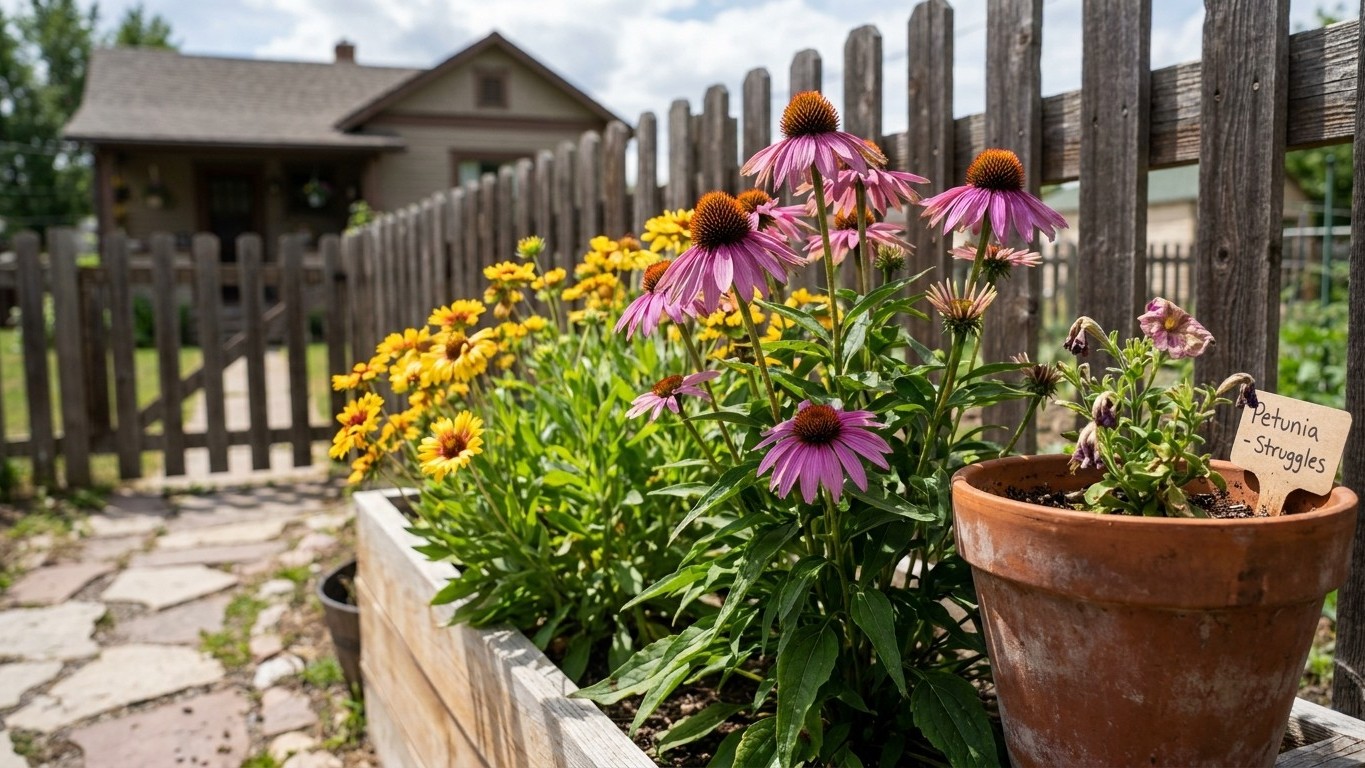

What actually grows here comes down to one thing: can it survive a winter low in the teens, live through a real run of 90-degree days, and keep blooming without rain in between. If it can’t do all three, it’s not going to make it in most Montana yards, no matter how good it looks on the tag in May. Before you plant anything, check the hardiness zone printed on that tag against your own county, not the state average, because a flower that’s fine in a warmer valley can still freeze out two counties over.
What thrives in Montana

Cold, heat, and drought in one season
Montana asks three separate things of a flower in a single year: survive a winter low that can sit in the teens or lower, tolerate a real stretch of summer heat, and keep flowering through weeks with no rain. NOAA’s NCEI 1991-2020 normals count 28.3 days a year at or above 90F at Billings, enough heat load to stress the cool-season annuals that look fine in May and collapse by midsummer. Add clay or sandy soils and a lot of rural acreage with no irrigation line running to the flower bed, and drought tolerance stops being optional.
The USDA Plant Hardiness Zone Map’s 2023 update puts the state at zone 3a to 6a, a wide enough spread that a flower rated hardy in a milder valley can still freeze out in a high mountain basin two counties over. Gardeners further south dealing with far hotter, longer summers, like those working from the flowers that actually thrive in Nevada, lean on different survival traits entirely, mostly heat-shedding foliage and deep taproots built for months without rain rather than for winter cold.
What struggles here is just as telling. Flowers bred for humid, mild climates, hydrangea mophead types and most tropical annuals like impatiens among them, need either more rainfall or a longer frost-free window than Montana’s growing season reliably provides. NOAA’s NCEI normals put the last spring freeze at Billings between April 29 and May 10, and the first fall freeze between October 1 and October 14, which leaves a working season of roughly five months in one of the state’s milder valleys and considerably less in the high country, not unlike the short summers that shape which flowers actually thrive in Newfoundland and Labrador. A flower that needs 90 frost-free days just to start budding is cutting it close before it even opens.
Families that carry the right traits
Plants that clear all three hurdles tend to come from a short list of families. The daisy family, Asteraceae, supplies purple coneflower (Echinacea purpurea), blanketflower (Gaillardia aristata), and Shasta daisy (Leucanthemum x superbum), all of which flower through heat rather than shutting down. The mint family, Lamiaceae, gives catmint (Nepeta) and most salvias, both of which handle poor soil and dry spells once established. Silver or fuzzy foliage, seen in artemisia and many salvias, reflects sunlight and slows moisture loss, a trait worth watching for on a plant tag when shopping for a bed in full sun. And taprooted plains natives, yarrow (Achillea millefolium) and blue flax (Linum lewisii) among them, reach moisture deep below a dry surface, which is why they keep blooming in a summer that’s already killed the lawn.
Native plants worth the space
A flower native to the Northern Great Plains or the Rocky Mountain foothills has already solved the local puzzle: it survived the region’s winters and dry summers for thousands of years before anyone irrigated a flower bed. Once established, usually after the first full year while the root system builds out, natives need far less supplemental water than most garden-center perennials, and many need none at all beyond normal rainfall.
Plants to look for
- Blanketflower (Gaillardia aristata), a Rocky Mountain and plains native with red-and-yellow daisy-like blooms through summer heat
- Blue flax (Linum lewisii), fine-textured with pale blue flowers that open in the morning and drop by afternoon
- Prairie coneflower (Ratibida columnifera), a plains native with drooping yellow petals around a tall brown cone
- Rocky Mountain penstemon (Penstemon strictus), spikes of deep blue-purple flowers on a plant built for rocky, fast-draining soil
- Showy milkweed (Asclepias speciosa), a plains and mountain native and one of the few larval host plants for monarch butterflies
These aren’t ornamental substitutes. They’re the plants that regional pollinators, native bees, monarchs and other butterflies, and hummingbirds, evolved alongside, and a garden-center cultivar bred purely for flower size often carries little of that value. Showy milkweed is worth naming on its own: monarchs need milkweed specifically to lay eggs, and a stand of it does more for the local pollinator population than a bed of hybrid petunias ever will.
Native plants also tend to shrug off the exact stresses that give imported ornamentals trouble here. They don’t need soil amended to a different pH, they don’t need shelter from wind coming off open plains, and their bloom times are already synced to the pollinators active in a Montana summer rather than to a nursery’s national shipping schedule. Most of these natives also prefer lean, unamended soil, and heavy compost or fertilizer meant for hybrid annuals can push them into lush foliage at the expense of flowers. The tradeoff is that most natives look less tidy than a bred cultivar, with a looser, more informal habit that some gardeners plant toward the back of a bed rather than the front border.
Straight species, rather than named cultivars bred from them, are usually the better bet for pollinator value, though a straight species can look weedier in a formal bed than a bred selection. Local native plant sales, often run through county extension offices or native plant societies, are a more reliable source than a big-box garden center, which stocks whatever ships well nationally rather than what’s suited to a Montana yard.
Perennials that come back

At zone 3a to 6a, per the USDA Plant Hardiness Zone Map, a genuinely reliable perennial needs a hardiness rating of at least zone 4, and zone 3 if the property sits in one of the colder mountain valleys rather than a milder river bottom like Billings. Peonies (Paeonia lactiflora), daylilies (Hemerocallis), Siberian iris (Iris sibirica), and yarrow all return for decades once planted, often outliving the gardener who put them in.
Reading a plant tag against your own zone
A plant tag lists a hardiness range, something like “zones 4-9,” and that number describes the coldest zone the plant survives in winter, not the hottest it tolerates. A Montana buyer needs to check the low end of that range against their own zone, not the high end, since the high end matters more to a gardener in a warm climate. A tag reading “zones 5-9” is a gamble in a zone 4 yard and an outright loss in zone 3, no matter how good the flower looks on the label.
Some plants sold everywhere in spring are perennial only where winters stay mild, and in Montana they’re grown as annuals, replaced every year, even though a nursery tag might call them “perennial” without a zone qualifier. Lavender (Lavandula angustifolia) survives in the milder zone 5-6 pockets of the state with sharp drainage and winter mulch but fails in most of the colder ground elsewhere. Dahlias are reliably perennial only from about zone 8 south, which means Montana gardeners either dig the tubers each fall and store them indoors or treat the plant as a one-season annual. Lantana, hardy only to roughly zone 8-9, never survives a Montana winter outdoors and is grown here strictly as a summer annual.
| Perennial | Hardy to zone | Bloom season | Height |
|---|---|---|---|
| Peony (Paeonia lactiflora) | zone 3 | late spring | 2-3 ft |
| Daylily (Hemerocallis) | zone 3 | summer | 1-3 ft |
| Siberian iris (Iris sibirica) | zone 3 | early summer | 2-4 ft |
| Yarrow (Achillea millefolium) | zone 3 | summer | 1-3 ft |
| Catmint (Nepeta) | zone 4 | late spring to fall | 1-2 ft |
Dividing an overcrowded clump of daylily or iris every few years also keeps bloom count high, since a crowded root mass tends to throw mostly foliage. The takeaway on any tag is the same: match the lowest number in the printed range to the coldest month’s average low in your own area, not to the state’s milder valleys, and when in doubt, buy the plant rated one zone colder than you think you need.
Putting a border together
A Montana border works the same way any border does, just compressed into a shorter window of bloom. Start with height: tall plants like delphinium or Siberian iris go at the back or center of an island bed, mid-height perennials such as coneflower and yarrow fill the middle, and low edging plants like catmint or blue flax run along the front where they won’t block the view of everything behind them.
Stacking bloom time so something is always flowering
Because the frost-free window here, roughly the five months between the spring and fall freeze dates NOAA’s NCEI normals give for Billings, is shorter than in milder states, succession planting matters more, not less. Pick at least one plant blooming in each stretch of the season:
- Early season: peony, Siberian iris, blue flax
- Midsummer: coneflower, blanketflower, daylily, catmint
- Late summer into fall: yarrow, Shasta daisy, sedum (Hylotelephium)
Without that spread, a border blooms hard for three weeks and sits green and empty the rest of the season, which is a common first-year mistake.
Repeating a color at intervals, rather than grouping every plant of one shade in a single clump, is what makes a border read as a whole rather than a set of separate patches. Three clumps of blue-purple penstemon spaced across a twenty-foot bed pull the eye down the length of it in a way that one large clump never does.
Leave room. A perennial bought in a one-gallon pot looks small the day it goes in the ground and within a few years needs the full spread listed on its tag, often two to three feet across for something like a mature peony or daylily clump. Planting at full mature spacing from day one leaves gaps that look bare for a season or two, but crowding plants to fill the bed immediately just means digging and dividing everything within a few years anyway. A layer of mulch applied after the ground freezes in fall also helps protect marginally hardy plants like lavender through the region’s cold, dry winters.
Local help
Montana State University Extension runs the state’s Master Gardener program, and county-level Extension offices publish plant lists suited to the local zone rather than the state average, since a list built for Billings won’t necessarily hold up in a colder valley two counties over. Start with Montana State University Extension for a county office contact, and check the broader Montana guides here for more on matching plants to the state’s range of growing conditions before buying anything for a border.
Common questions
Do peonies actually bloom every year in Montana or do I need to protect them?
Peonies are hardy to zone 3, so they return without winter protection in nearly all of Montana. The more common reason a peony fails to flower isn’t cold at all, it’s the crown planted too deep or moved too recently, since a disturbed peony can sulk for a season or two before it settles in.
Can I grow lavender in Montana or will it just die every winter?
Lavender can survive in the milder zone 5-6 pockets of the state with sharp drainage and a winter mulch layer, but in colder zone 3-4 ground it usually doesn’t make it through without extra protection. Many Montana gardeners just treat it as an annual and replace it each spring rather than fight the odds.
What flowers can I direct-seed instead of buying as transplants?
Fast-germinating annuals like zinnia, cosmos, and marigold, along with native plains species such as blanketflower and blue flax, establish fine from seed sown directly in the bed. Slower tropical annuals that need a long head start indoors are a poor fit for direct-seeding here, since Montana’s frost-free window, roughly five months at Billings and shorter in the high country, doesn’t leave enough time for them to mature after germination.
Why did the flowers on my plant tag say “perennial” but they didn’t come back?
Because the word “perennial” on a tag isn’t zone-specific. Plenty of nationally sold perennials are only reliably hardy in climates milder than Montana’s zone 3a-6a range, so the tag’s zone numbers, not the word “perennial” itself, are what actually tell you whether a plant will survive the winter where you garden.
Related guides
- Flowers That Actually Thrive in North Dakota, and the Ones That Struggle
- Flowers That Actually Thrive in South Dakota, and the Ones That Struggle
- Flowers That Actually Thrive in Nevada, and the Ones That Struggle