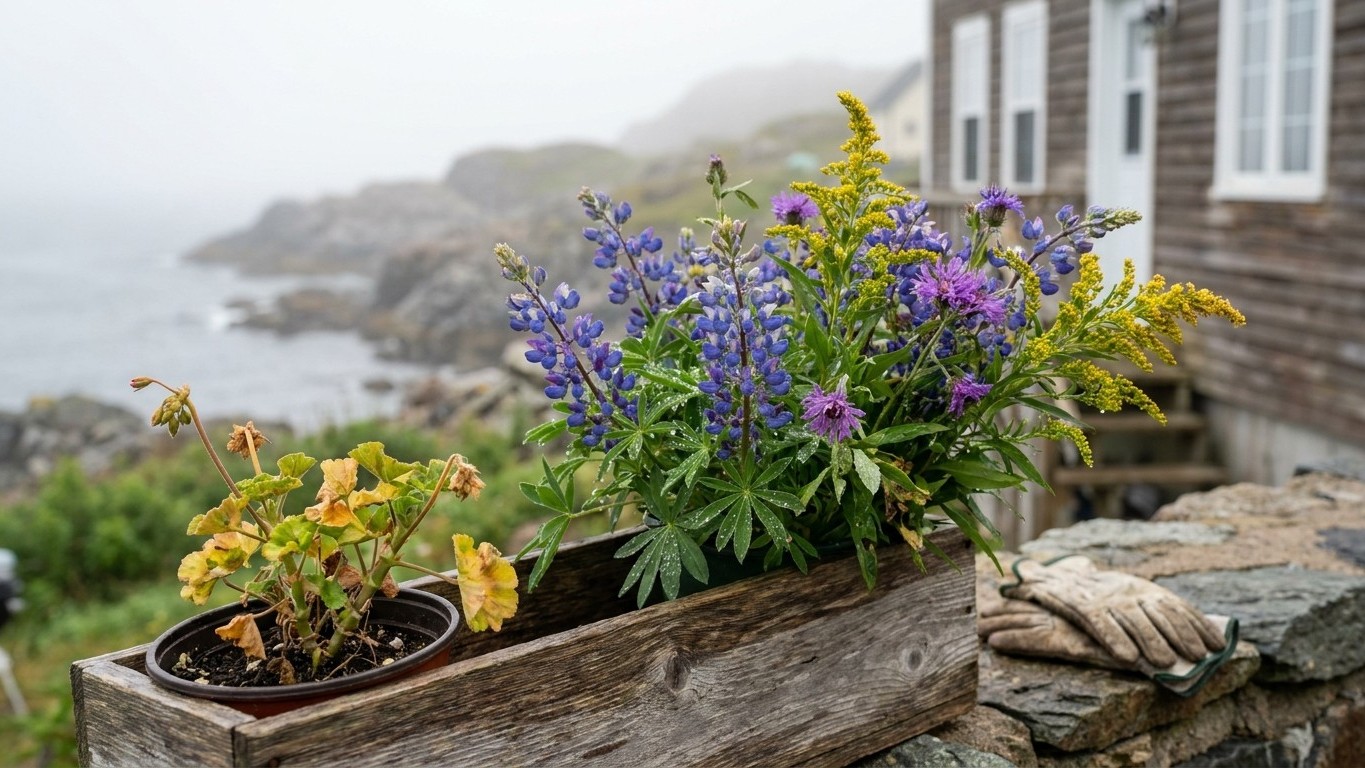

Newfoundland and Labrador’s flower gardens run on a short, cool season. Environment and Climate Change Canada’s 1981-2010 normals put the mean minimum of the coldest month at -8.7 °C at St. John’s, and the same station logs an average of zero days a year above 90°F. Cold-hardy perennials such as peonies, lupins, and astilbe thrive under those conditions, while heat-loving annuals like zinnias and cosmos usually struggle to open more than a handful of blooms before frost. Build the border around plants that finish their growth cycle in cool weather, and keep the long-season, heat-loving annuals for a sheltered, south-facing spot if you grow them at all.
Putting a border together

A Newfoundland border has to do its work between two averages. ECCC’s St. John’s normals put the last spring frost at May 30 and the first fall frost at October 17, a stated growing season of roughly four and a half months. Those are mean dates, not guarantees. Frost arrives later than May 30 in about half of all years on record, and earlier than October 17 in the other half. Treat the window as a target to plan around rather than a date to plant by, and lean toward plants that shrug off a late spring frost or an early fall one without losing the whole display.
Layering by height
Back row: delphinium (Delphinium elatum hybrids), foxglove (Digitalis purpurea), and lupins (Lupinus polyphyllus) all reach three to five feet and give a border its backbone. Lupins naturalize readily along Newfoundland roadsides and need almost no coddling once established, though a stand grown from seed can take two seasons to reach full height.
Middle row: peonies (Paeonia lactiflora cultivars such as ‘Sarah Bernhardt’ or ‘Festiva Maxima’) are among the longest-lived plants you can put in a Newfoundland border. They need a real winter chill to flower well, and the coldest month’s mean minimum of -8.7 °C at St. John’s, per ECCC, is nowhere near cold enough to trouble them. Astilbe, campanula, and hardy geranium such as ‘Rozanne’ fill the same tier and tolerate the damp summers that plague coastal gardens.
Front row: violas, pansies, and Iceland poppy (Papaver nudicaule) all bloom in cool weather rather than despite it, which suits a climate that rarely sees a hot day. Calendula self-seeds along the very front edge and usually comes back on its own the following spring.
Match plant height to exposure, not just to the plan on paper. A delphinium that looks perfect in a catalogue photo will snap in half on an exposed coastal lot the first windy week of July, so save the tallest plants for a wall or fence line and keep the front-of-border layer sturdier than you would further inland.
Succession of bloom across the season
Spring bulbs, planted the previous fall, open before or right around the average May 30 last frost and shrug off a late one, since daffodil and tulip foliage and buds tolerate temperatures well below freezing. Peonies and lupins follow in early summer. Sweet peas (Lathyrus odoratus), catalogued at 60 to 70 days from sowing to bloom, planted outdoors once the soil is workable around the average last-frost date, should flower by midsummer with plenty of the roughly twenty-week gap to spare before the average October 17 first fall frost. Astilbe, campanula, and the early asters carry the middle of the season. Sedum (Hylotelephium ‘Autumn Joy’) and the native New England aster (Symphyotrichum novae-angliae) close it out into September, often still blooming as the first fall frost arrives.
Compare that to a zinnia or a cosmos. Both are catalogued at 60 to 90 days from sowing to bloom, and on paper that fits inside a four-and-a-half month window with room to spare. In practice, neither germinates well in cool soil, and both need consistently warm nights to bulk up fast enough to flower on schedule. With an average of zero days a year above 90°F at St. John’s per ECCC, that heat rarely arrives, so the clock the seed packet promises rarely starts on time. The result is a plant still budding when frost finally ends the season, sometimes later than the October 17 average. Morning glory and lantana run into the same problem. Gardeners a long way south, in a state like Idaho, get the heat units these annuals were bred for, and Newfoundland mostly does not.
- Zinnias (Zinnia elegans): need warm nights to germinate, often still budding at frost.
- Cosmos (Cosmos bipinnatus): stays thin-stemmed and sparse without sustained warmth.
- Morning glory (Ipomoea purpurea): climbs slowly in cool soil, rarely fills a trellis before frost.
- Lantana: grown as a tender annual almost everywhere, and sulks without real heat.
- Moss rose / portulaca: flowers stay shut in the fog and cloud common along the coast.
Repeating color and leaving room at planting
Pick two or three colors and repeat them at intervals down the border rather than scattering one of everything. Blue works well here. Delphinium, campanula, and the late asters all come in true blue, and spaced through the length of a bed they tie an otherwise disconnected succession of bloom into one planting.
Leave room when you plant. A peony division looks like a handful of sticks its first spring and needs three to four years to reach the two- to three-foot spread it will eventually fill. Space it as though it were already mature, and fill the gap in the meantime with something you’re willing to pull out later, like calendula or an extra clump of Iceland poppy. Crowding a border in year one to make it look finished is the single most common mistake in a short-season climate. It costs the slower perennials the light and airflow they need just as they’re establishing roots for their first Newfoundland winter, and airflow matters more here than in a milder climate, since damp summers make foliage diseases like botrytis and powdery mildew a bigger risk to a young border than the cold ever is.
Gardeners working with an even shorter, colder season, such as in the Northwest Territories, plant more conservatively for the same reason. Fewer, tougher choices, set wider apart, survive a short summer better than an ambitious plan crammed into too little space.
Local help
The province’s Department of Fisheries, Forestry and Agriculture runs an extension service, the place to check for plant lists, pest advisories, and growing conditions specific to your own district rather than to St. John’s alone. Reach it directly through the provincial extension service before you commit a border plan to paper, especially if you garden in Labrador or on the west coast, where both frost dates and the coldest month’s minimum run colder than the St. John’s normals used above.
Many towns also have horticultural societies or Master Gardener volunteers who know which cultivars have actually survived a given neighborhood’s wind and salt exposure, information no climate normal can give you. For more on gardening across the rest of the province, see our Newfoundland and Labrador guides.
Common questions
Why won’t my zinnias or cosmos bloom before frost?
They’re catalogued at 60 to 90 days from sowing to bloom, which looks like it fits inside the roughly four-and-a-half month gap between ECCC’s average last frost of May 30 and average first frost of October 17 at St. John’s. The catalogue clock assumes warm nights the whole way, and St. John’s averages zero days a year above 90°F, so germination and early growth run slower than the packet promises, and bloom often arrives late or not at all.
Is Labrador the same growing conditions as St. John’s?
No. All of the figures above come from the ECCC station at St. John’s, and Labrador and the province’s interior run colder in winter and see a shorter frost-free window in summer. Treat the dates and temperatures here as a starting point, and check conditions for your own district with the provincial extension service before setting a planting date.
How do I know when it’s safe to plant out annuals?
ECCC’s May 30 last-frost figure for St. John’s is a mean date, not a guarantee, so frost falls after it in roughly half of all years on record. Wait until new growth on nearby perennials and the general run of local weather both suggest the risk has passed, and hold tender seedlings back a week or two later than the average if your garden sits somewhere colder or higher than St. John’s.
Will peonies and other border perennials actually survive the winter here?
Yes, easily. Peonies, delphiniums, astilbe, and hardy geraniums all tolerate winters far colder than St. John’s mean coldest-month minimum of -8.7 °C, and peonies specifically need a real winter chill to flower well the following spring. The plants far more likely to struggle in Newfoundland are heat-loving summer annuals, not cold-hardy perennials.
Related guides
- Flowers That Actually Thrive in Quebec, and the Ones That Struggle
- Flowers That Actually Thrive in Northwest Territories, and the Ones That Struggle
- Growing Melons in Newfoundland and Labrador
- Beet Soil in Newfoundland and Labrador
- Growing Pumpkins in Newfoundland and Labrador