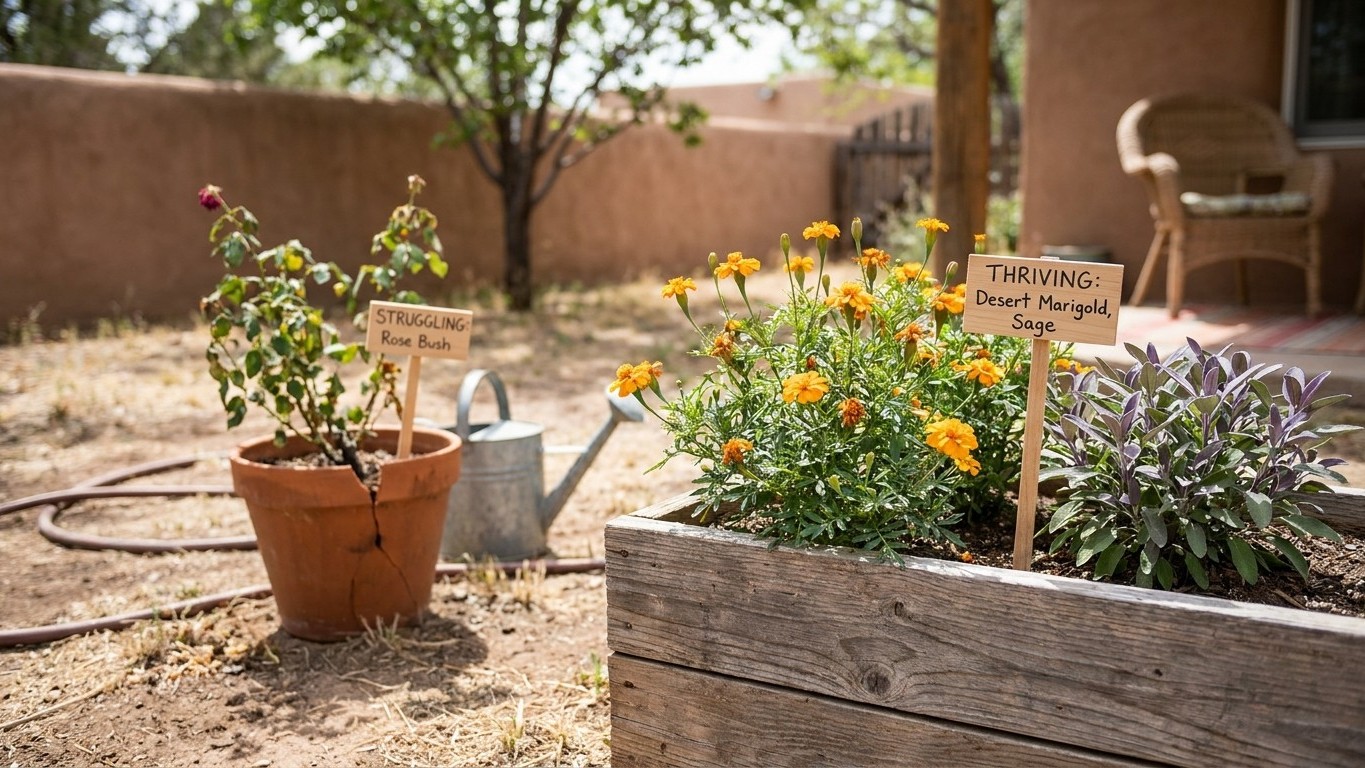

Flowers that thrive in New Mexico are built for wide temperature swings and long dry stretches: drought-tolerant perennials, regional natives and heat-hardy annuals that shrug off the 42.5 days a year Albuquerque spends above 90F, according to NOAA’s 1991-2020 climate normals. Cool-season bloomers that sail through a mild, humid summer elsewhere often scorch here by July. Check your zip code against the USDA Plant Hardiness Zone Map before ordering perennials, since the state spans zone 4b to 9a.
What thrives in New Mexico

Some flowers shrug off a New Mexico summer, and some just give up by July. The ones that make it here share three traits: they take real cold in winter, real heat in summer, and long stretches without rain in between. So before you fall for something pretty at the nursery, flip the tag over and check its hardiness zone against your own elevation, not against “New Mexico” as a whole, because a mountain valley and a low desert basin in this state might as well be different climates entirely.
Heat load is the other half of the equation. At the reference station in Albuquerque, NOAA’s NCEI climate normals record 42.5 days a year at or above 90F. That is enough sustained heat to finish off petunias, lobelia and most English cottage-garden standbys by midsummer unless they get afternoon shade and steady water. It is also why drought resistance matters as much as cold hardiness when you are picking flowers for this state. A plant can be perfectly winter-hardy on paper and still fail here because it was bred for a climate with regular summer rain.
Traits and families that hold up
Look for these traits on a plant tag or in a catalogue description before you buy:
- Silvery or fuzzy foliage, which reflects heat and slows water loss
- A taproot rather than a shallow fibrous root system, for reaching deep soil moisture
- Native range that includes the Southwest, high plains or Chihuahuan Desert
- Bloom that holds up in full sun rather than needing dappled shade
The families that consistently deliver on those traits are the sunflower family (Asteraceae), which covers blanketflower, coneflower and coreopsis, and the mint family (Lamiaceae), which covers salvia, agastache and Russian sage. Both families produce plants with the kind of root systems and foliage that handle a dry, high-desert summer without daily attention. The coldest-month low of 26.4F recorded at Albuquerque is mild enough that most zone 5 and warmer perennials from those families overwinter without protection in the valley, though anyone gardening at higher elevation should expect colder nights than that figure and plan accordingly.
Native plants worth the space
A plant native to the Southwest or the wider Chihuahuan and high-plains region has already solved the local problem: it evolved with exactly this pattern of hot days, cold nights and unreliable rain. Once its roots are established, usually after the first full year in the ground, it needs far less supplemental water than an imported ornamental of the same size. That single fact is why native plantings save the most on a water bill over time, not because the plants are cheap to buy.
Names to look for
Rocky Mountain penstemon (Penstemon strictus), with its spikes of blue-violet tubular flowers, is one of the most reliable native perennials across the region and a magnet for native bees. Chocolate flower (Berlandiera lyrata) produces yellow daisy-like blooms that genuinely smell of cocoa in the morning and reseeds itself readily once established. Blackfoot daisy (Melampodium leucanthum) forms a low, tidy mound of small white flowers and tolerates rocky, poor soil that would stunt most garden perennials. Desert marigold (Baileya multiradiata) throws up bright yellow flowers on wiry stems nearly all summer with almost no irrigation once its first season is behind it.
For structure rather than just flower color, Apache plume (Fallugia paradoxa) is a native shrub with white rose-like flowers followed by pink, feathery seed heads that catch the evening light, and red yucca (Hesperaloe parviflora) sends up tall coral-pink flower spikes that hummingbirds visit for weeks. Rocky Mountain bee plant (Cleome serrulata), with its clusters of pink-purple flowers on tall stems, draws in a wide range of native bees and was historically gathered by Indigenous communities in the region for food and dye.
These plants also carry pollinators through periods when nothing else is blooming. A garden built mostly on native perennials tends to have overlapping bloom from a wider range of native bee species than a garden of imported annuals, simply because the flower shapes and bloom timing match what local pollinators already look for. That matters more in a state with limited natural nectar sources than it might somewhere with a longer wet season.
Perennials that come back

Whether a perennial survives the winter here comes down to matching its published hardiness zone against your actual location, not against the state as a whole. New Mexico’s USDA range of 4b to 9a means a plant labeled “hardy to zone 6” will return reliably in Albuquerque’s milder pockets but may need winter mulch or a sheltered wall in a colder mountain county, and will fail outright somewhere colder still. NOAA’s 1991-2020 normals put Albuquerque’s coldest-month average low at 26.4F, which sits comfortably within zone 6 territory, but that figure is an average, not the coldest night the garden will ever see.
Reliable returners at this hardiness level
Yarrow (Achillea millefolium), catmint (Nepeta x faassenii) and Russian sage (Perovskia atriplicifolia) are all rated hardy to roughly zone 4 or 5, which puts them well within range for most of the state and explains why they show up in nearly every xeriscape planting list from Santa Fe to Las Cruces. Daylilies (Hemerocallis) and bearded iris are similarly dependable, tolerating both the winter lows and the summer heat load without special care. Salvia greggii, sometimes called autumn sage, is rated to about zone 6b to 7 and comes back reliably in Albuquerque’s warmer neighborhoods but can die back to the roots or fail entirely in a colder, higher county, which is a useful example of why the zone number on the tag matters more than the plant’s popularity.
Lavender is the plant gardeners most often get wrong here. English lavender (Lavandula angustifolia) cultivars like ‘Munstead’ and ‘Hidcote’ are rated hardy to roughly zone 5, so they can survive New Mexico’s winter cold, but they resent wet feet and heavy clay, which is a soil problem rather than a temperature problem. Read the tag for both the cold hardiness zone and the drainage note, because a plant can pass one test and fail the other. A gardener moving from a wetter climate, the kind where lavender and delphinium both perform well without much thought, such as the coastal conditions covered in our guide to flowers that actually thrive in Rhode Island, will need to unlearn some of those assumptions about soil moisture before anything in this state settles in.
Putting a border together
Start with height and work outward rather than starting with color. Tall plants like Russian sage, hollyhock and red yucca go at the back of a bed viewed from one side, or the center of a bed viewed from all sides. Mid-height plants such as blanketflower, salvia and coneflower fill the middle layer, and low mounding plants like blackfoot daisy or catmint edge the front. This layering keeps every plant visible and gives the bed a sense of depth instead of a flat wall of flowers at one height.
Sequencing bloom across the season
New Mexico’s growing season in Albuquerque runs from the last spring freeze, which NOAA’s 1991-2020 normals place between March 31 and April 12, to the first fall freeze, placed between October 29 and November 9. Gardens outside the city, especially at higher elevation or in outlying counties, typically see frost linger later in spring and arrive earlier in fall, so treat those dates as a starting estimate and confirm the window with your own local records before setting out tender annuals. Within that window, stagger bloom time deliberately: penstemon and iris carry the early season, blanketflower and salvia carry midsummer, and Russian sage, chocolate flower and fall-blooming asters carry the garden through September and into October.
Repeat two or three colors through the length of the border rather than scattering a different color every few feet. A bed that repeats the same blue-violet penstemon or salvia at intervals reads as designed even to someone who knows nothing about gardening, while one-of-everything planting reads as cluttered no matter how nice each individual plant is. Leave real space between plants at installation, at least the mature spread listed on the tag, even though the bed will look sparse for the first year. Crowding at planting time is the single most common mistake in a new xeric border, and it is much harder to fix later than an empty-looking gap is to tolerate now. The same heat-load math that shapes a New Mexico border also drives planting decisions in places with a similar number of 90-degree days, which is worth keeping in mind if you are comparing notes with a gardener working through our guide to flowers that actually thrive in Oklahoma.
Local help
New Mexico State University’s extension service, reachable at aces.nmsu.edu, runs county-based Master Gardener programs that maintain plant lists tailored to local elevation and soil, which is far more useful than any statewide list given how much the growing conditions shift across zones 4b to 9a. A county agent can also confirm your area’s actual frost window rather than the airport-based figures cited above. For planting timelines and other state-specific advice, the New Mexico guides hub collects that information in one place.
Common questions
Can I grow roses in New Mexico?
Yes, many rose classes handle the state’s winter lows and summer heat, particularly rugosa types and hardy shrub roses bred for drought tolerance. Hybrid teas tend to struggle without regular deep watering and afternoon shade during the hottest stretch of summer, so pick a rose bred for heat and dry air rather than one bred for a cool, humid climate.
Why do my perennials come back smaller every year?
This usually points to under-watering during the first two establishment years rather than the plant being wrong for the climate. A perennial needs consistent moisture while its root system is developing even if it will be fully drought-tolerant once mature, and skipping that establishment period is a common reason plants decline instead of filling out.
Is it too late to plant perennials if I missed spring?
Fall planting works well here and is often easier on the plant than spring planting, since the soil is still warm but the air is cooling, which reduces transplant stress. Aim to get perennials in the ground with enough time to root in before the first fall freeze, and check your county’s typical frost timing rather than relying on the Albuquerque airport dates alone.
Do I need to amend my soil before planting drought-tolerant flowers?
Most native and xeric perennials actually prefer lean, poorly amended soil over rich garden loam, since heavy organic matter and extra fertility can produce weak, floppy growth. The bigger issue is usually drainage. Heavy clay that holds water around the crown in winter kills more drought-adapted plants here than cold ever does, so improving drainage matters more than adding fertility.
Related guides
- Flowers That Actually Thrive in Arizona, and the Ones That Struggle
- Flowers That Actually Thrive in Utah, and the Ones That Struggle
- Flowers That Actually Thrive in Oklahoma, and the Ones That Struggle