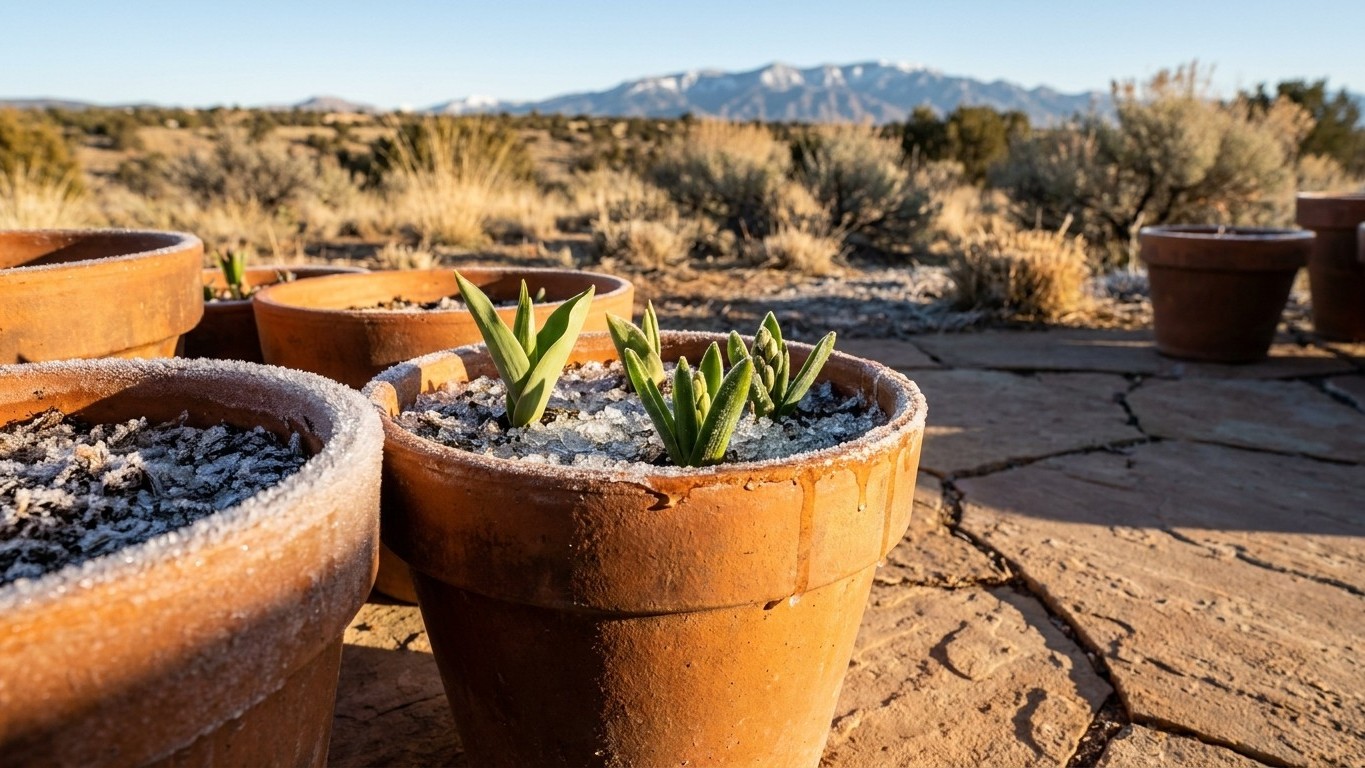

Spring bulbs grow well in New Mexico containers, but the state hands gardeners two separate problems disguised as one question. In Albuquerque, the coldest month averages a 26.4F daily minimum, cold enough that chilling is rarely the bottleneck. The real threat is different: a pot freezes solid, roots and all, while the same bulb in open ground stays insulated by soil mass.
Why this matters in New Mexico

Start with the number: 26.4F is the average daily minimum for the coldest month at the Albuquerque reference station (NOAA NCEI Climate Normals, 1991-2020). That figure sits well under the 45F threshold a tulip or hyacinth bulb needs to break dormancy properly. The state’s winter already supplies the cold that forcing exists to fake. Gardeners in Minneapolis or Chicago force bulbs indoors because their bulbs, left outside in pots, would never get reliably cold enough or would freeze past survival. New Mexico’s problem runs the other direction.
The USDA Plant Hardiness Zone Map (2023 edition, built on 1991-2020 normals) puts the state anywhere from zone 4b to zone 9a depending on elevation. That’s a spread wide enough to cover Duluth on one end and coastal Georgia on the other, inside a single state’s borders. A bulb rated hardy to zone 5 survives a New Mexico winter easily in the ground almost anywhere in the state. Put that same bulb in an unglazed terra cotta pot on a patio in the high country, and the calculation changes completely.
Here’s the mechanism: soil in the ground rarely drops below 32F more than a few inches down, because the earth beneath acts as thermal mass. A container has no such buffer. Once air temperature stays below freezing for more than a day or two, the entire root ball, in the pot’s full depth, drops with it. A bulb that would shrug off a hard freeze in a garden bed can turn to mush in a pot exposed to the same air.
So this territory’s real risk isn’t a chilling shortfall, it’s a container freeze-through. The reference city figure, 26.4F, confirms the ground here gets cold enough for spring bulbs without help. What it doesn’t confirm is that a pot sitting exposed on a deck or porch will survive that same cold without protection. That distinction drives everything that follows.
How to do it here
Two separate methods apply, and confusing them is the most common mistake. One is forcing bulbs for an early indoor bloom, useful anywhere regardless of climate. The other is protecting a potted bulb meant to bloom outdoors on its own schedule. Both start with the same understanding: a spring bulb needs roughly twelve to fourteen weeks below 45F before it can flower normally.
- Pick a container with drainage holes and fill it with a fast-draining potting mix; standing water around a bulb in cold weather is the single fastest way to lose it.
- Set the bulbs at the depth recommended for that species, pointed end up, then water once to settle the soil.
- For forcing an indoor bloom, move the pot somewhere that holds a steady temperature under 45F but doesn’t freeze solid: an unheated garage that stays above freezing works, and so does a spare refrigerator drawer, kept well away from apples, pears, or other ripening fruit, since the ethylene gas they give off can damage the flower bud forming inside the bulb.
- Leave it there the full twelve to fourteen weeks. Check the pot occasionally for roots showing through the drainage hole, a sign the chilling period is doing its job.
- Once the chilling period is complete, bring the pot into a bright, warm spot and let it green up and bloom over the following two to three weeks.
- For a pot meant to overwinter outdoors and bloom in its own season, check the bulb’s hardiness rating against your container’s exposure. As a rule of thumb, a potted bulb needs a hardiness rating at least two zones hardier than your ground zone to survive without help, since the pot loses the insulation the soil would otherwise provide.
- If the bulb doesn’t meet that two-zone cushion, move the pot into an unheated garage or against a heated house wall for winter, and pile mulch, straw, or bagged leaves around the sides of the container to slow the freeze.
None of this requires guessing. The pot itself tells you whether it worked: roots at the drainage hole mean the cold period is registering; a pot that never freezes solid at the exposed spot you chose means your protection is enough.
Which bulbs are worth it
Not every spring bulb rewards the extra work a container demands. Short, sturdy bulbs with a modest chilling requirement tend to force fast and stay upright in a pot. Tall bulbs with long chilling needs often produce a flower stalk that outgrows the container’s stability before it ever opens.
Paperwhite narcissus deserve a separate mention: they need no cold period at all, which makes them the easiest bulb to force in a container anywhere, New Mexico included. Since paperwhites are typically a one-season purchase anyway, forcing them costs nothing in the long run. They were never going to bloom a second year regardless of how they’re treated.
- Tulips (short-to-moderate chill requirement, compact form)
- Hyacinths (reliable, fast, strongly scented)
- Crocus (shortest chill requirement of the common forcing bulbs)
- Grape hyacinth, Muscari (small, sturdy, forgiving of pot conditions)
- Paperwhite narcissus (no chill required at all)
- Giant drumstick allium (tall stem, top-heavy, tips pots easily)
- Camassia (long chill requirement, floppy stem in containers)
- Crown imperial fritillaria (finicky about pot conditions, strong odor, poor forcer)
- Large trumpet daffodil cultivars (heavy bloom head, leans without staking)
What goes wrong, and when you can still fix it
Leaves but no flower
This means the cold period ran short. A bulb that gets pulled out early has enough stored energy to push leaves but hasn’t finished the internal process that builds the flower bud. There’s no fixing this season’s bulb. Plant it out in the ground once the ground thaws, let it go through a full winter there, and it will likely flower normally the following spring.
Flower on a stem too short to see
This happens when a chilled bulb gets warmed too fast. Stem elongation depends on a gradual shift from cold to warm temperatures; rush it, and the flower opens nearly at soil level instead of on a normal stalk. The bloom itself is still genuine, just stunted. Let it finish and fade naturally. That bulb, once forced this way, rarely performs well if forced again, so treat it as a one-time bloom.
Rot in the pot
Soft, mushy, or moldy bulb tissue means water sat around the roots too long, usually from a container without adequate drainage. Caught early, before the bulb itself turns soft, moving it into fresh, fast-draining mix can save it. Once the bulb tissue has gone soft or discolored, there’s nothing left to save this season, and that bulb won’t return next year either.