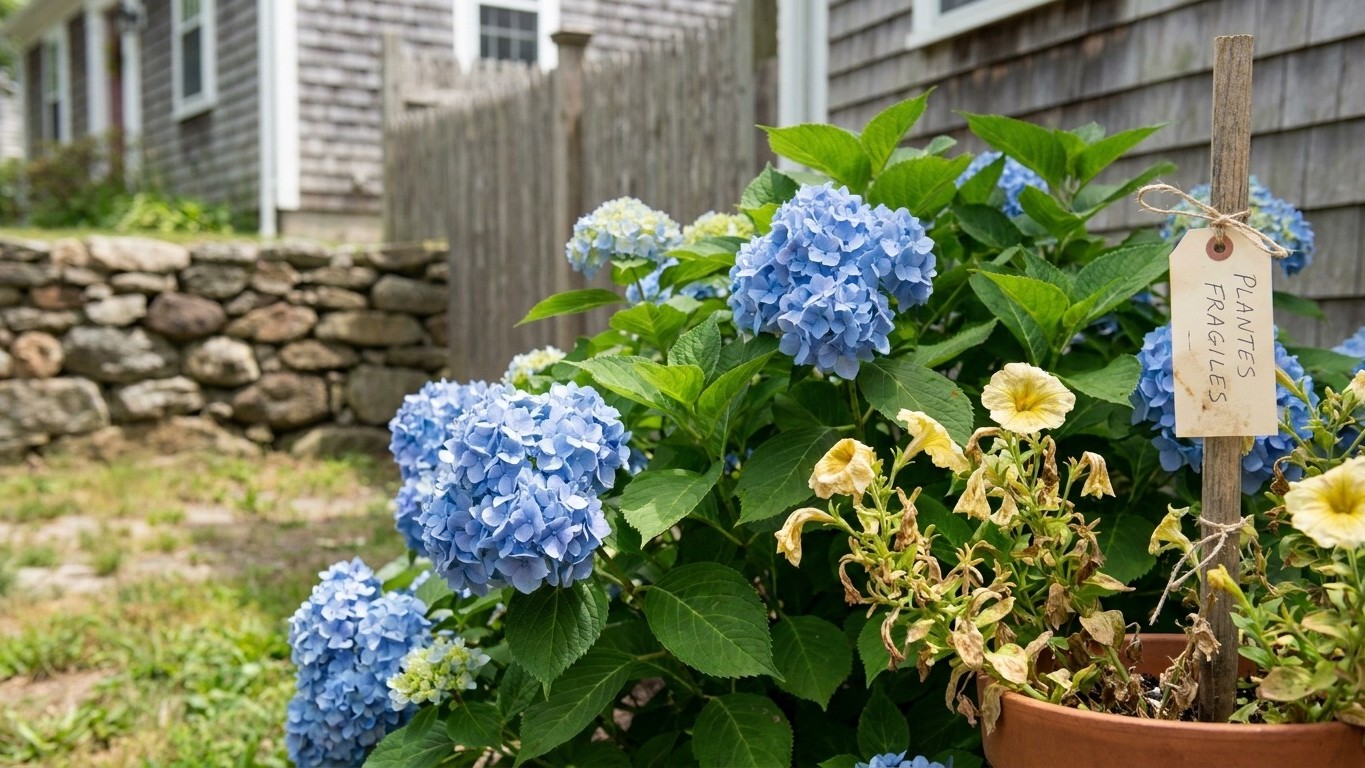

Flowers that thrive in Rhode Island are the ones built for a cold winter followed by a short, humid summer: coneflower, black-eyed Susan, aster, daylily and other hardy perennials rated for USDA zones 6a to 7b, the range the USDA’s 2023 Plant Hardiness Zone Map assigns to the state. Anything rated for warmer zones than that struggles or dies once winter lows settle in near Providence’s coldest-month average of 22.1°F, according to NOAA’s 1991-2020 climate normals. Check the hardiness zone printed on any plant tag against your own town before you buy, since coastal and inland Rhode Island run several degrees apart.
What thrives in Rhode Island

Zones 6a to 7b, wrapped in the damp, still air of a New England summer — that combination is the whole story here, and it’s a different story than the one told in most flower advice. General planting guides lean on cold hardiness alone, as if a zone number were the only hurdle. Rhode Island adds a second test, humidity that lingers on foliage for weeks, and that’s where plenty of celebrated garden flowers quietly fail while sturdier, less glamorous ones take over.
That combination rules a few things in and a few things out. A flower needs to be rated hardy to at least USDA zone 6 to survive an ordinary Rhode Island winter without protection, since the state sits within zones 6a to 7b. It also needs foliage that tolerates humid air without collapsing into powdery mildew or black spot, which is why so many modern rose and bee balm cultivars are bred specifically for disease resistance. Plants that need bone-dry summer air to perform, such as many silver-leaved Mediterranean natives, tend to sulk here even when the winter cold suits them fine. This is close to the opposite problem faced in a place like Arizona, where Flowers That Actually Thrive in Arizona, and the Ones That Struggle covers plants selected mainly for drought tolerance rather than winter cold or fungal disease.
Families that carry the right traits
The daisy family, Asteraceae, does an outsized share of the work in Rhode Island gardens: purple coneflower (Echinacea purpurea), black-eyed Susan (Rudbeckia fulgida) and New England aster (Symphyotrichum novae-angliae) all combine solid cold hardiness with tolerance for humid, still summer air. The mint family, Lamiaceae, contributes catmint (Nepeta) and bee balm (Monarda didyma), though bee balm needs a mildew-resistant selection such as ‘Jacob Cline’ to avoid the powdery gray coating that plagues older varieties by August. Daylilies (Hemerocallis) and peonies (Paeonia) are near-bulletproof across the whole zone range the state occupies, which is one reason they show up in so many older Rhode Island yards that have had no attention in decades.
Native plants worth the space
A native perennial that has spent generations adapting to Northeast winters and summers generally needs less from the gardener once it settles in: less supplemental water after the first year or two, less fertilizer, and less spraying against the fungal problems that hit stressed, out-of-place plants hardest. That is not a promise of zero maintenance, but it does mean a native planting typically asks for a fraction of the attention a fussier ornamental demands by its third summer.
The bigger argument for natives is what they bring in beyond the garden bed. Common milkweed and butterfly weed (Asclepias syriaca and Asclepias tuberosa) are the only host plants monarch caterpillars can eat, so a patch of either does more for that species than any amount of nectar-rich but unrelated planting. Wild bergamot and bee balm (Monarda species) draw hummingbirds and a wide range of native bees, and mountain mint (Pycnanthemum muticum) is consistently one of the most heavily visited plants by small native pollinators in Northeast garden trials, even though it is rarely sold at big-box nurseries. Cardinal flower (Lobelia cardinalis), with its tall spikes, is one of the few plants that reliably brings hummingbirds to a wet or partly shaded corner of the yard.
Structure as well as flowers
Native plantings do not have to mean an all-summer meadow look. Winterberry holly (Ilex verticillated), a deciduous shrub native to the wider Northeast, holds bright red berries through winter after its leaves drop, giving a border presence in the cold months when nothing is blooming. Switchgrass (Panicum virgatum) and little bluestem (Schizachyrium scoparium) add upright winter structure and seed heads that feed birds long after frost. Mixing in this kind of native structural planting is what keeps a border from going flat and brown the moment the first freeze hits, and it is a detail worth reading about further in our broader Rhode Island guides for garden planning across the state’s varied microclimates.
Perennials that come back

At Rhode Island’s zone range of 6a to 7b, a genuinely hardy perennial should return on its own for years without being dug up and stored over winter. Peony, daylily, Russian sage (Perovskia atriplicifolia), catmint ‘Walker’s Low’, and ‘Autumn Joy’ sedum (Hylotelephium ‘Herbstfreude’) all fall into that category almost everywhere in the state. Lavender is a partial case: ‘Munstead’ and ‘Hidcote’ are rated hardy to roughly zone 5, so they survive a typical Providence winter, but only where the soil drains sharply. Standing water around the crown in a wet Rhode Island winter kills lavender faster than the cold itself does.
Plenty of popular flowers sold in the same nursery aisle are perennial only in a much warmer climate and get grown here as annuals instead. Dahlias and cannas are reliably perennial down around USDA zones 8 to 10, well south of Rhode Island’s range, so local gardeners either treat them as one-season plants or dig the tubers each fall and store them indoors over winter. Tropical hibiscus, often sold alongside cold-hardy rose-of-Sharon at garden centers, is hardy only to about zone 9 and will not survive outdoors here at all.
Reading a plant tag against your own zone
Every perennial tag lists a hardiness range, usually as two zone numbers. Compare the lower number on that tag to Rhode Island’s zone range of 6a to 7b, remembering that coastal towns run toward the warmer end and inland towns toward the colder end. A tag reading “zones 4 to 8” is safe practically anywhere in the state. A tag reading “zones 7 to 10” is a gamble everywhere except the mildest coastal pockets, and a tag reading “zones 8 to 11” is not a perennial here at all, whatever the label implies.
| Plant | Typical hardiness range | Behavior in Rhode Island |
|---|---|---|
| Peony (Paeonia) | Zones 3-8 | Reliable perennial, often outliving the gardener |
| Russian sage (Perovskia) | Zones 4-9 | Reliable perennial in well-drained soil |
| Lavender ‘Munstead’ | Zones 5-8 | Perennial only with sharp drainage over winter |
| Dahlia | Zones 8-10 | Grown as annual, or tubers dug and stored |
| Canna | Zones 8-11 | Grown as annual, or rhizomes stored indoors |
| Tropical hibiscus | Zones 9-11 | Does not survive outdoor winter, grown as annual/houseplant |
Gardeners just across the state line face the same reading exercise with a colder answer. In Flowers That Actually Thrive in Vermont, and the Ones That Struggle, several perennials that overwinter fine in Providence are annuals-only, because Vermont’s colder zones push the safe cutoff on that tag several numbers lower.
Putting a border together
A border reads as designed rather than scattered when it is built in layers by height: tall plants like Joe-Pye weed or peony at the back or center, mid-height plants like coneflower and black-eyed Susan in the middle, and low edging plants like catmint or creeping sedum at the front. Skipping this step is the single most common reason a new border looks messy even when every individual plant is healthy.
Succession of bloom
No single plant blooms all season, so a border needs a sequence handed off across the year:
- Spring: peony, iris, columbine
- Early summer: daylily, catmint, bee balm
- Midsummer: coneflower, black-eyed Susan, phlox
- Fall: New England aster, sedum ‘Autumn Joy’, switchgrass seed heads
Planting only midsummer bloomers is the most common gap: the border looks full in July and bare in April and October. Repeating the same color or plant in at least three spots along the border, rather than using one of everything, is what makes a bed read as intentional from a distance instead of as a random collection.
Leave room at planting
Most perennial tags call for spacing of 18 to 24 inches between mature plants, and a bed planted at that final spacing on day one looks sparse and bare for its first year or two. It is a normal, temporary look, not a sign anything is wrong, and filling the gaps with annuals like zinnia or cosmos for that first season is a better fix than crowding perennials closer than their tag recommends, since crowded perennials stay smaller and are more prone to fungal problems in Rhode Island’s humid summers.
Local help
The University of Rhode Island’s Cooperative Extension runs a Master Gardener program and keeps plant lists tailored to the state’s growing conditions, including guidance broken out by coastal versus inland zones. It is the best source to check before spending money on anything unusual, and the extension service also fields questions directly from home gardeners through its office. Their staff can also confirm your specific town’s frost dates, which run later or earlier than the Providence airport figures depending on how far inland or elevated your garden sits.
Common questions
What zone is Rhode Island for planting flowers?
Rhode Island spans USDA hardiness zones 6a to 7b, according to the USDA’s 2023 Plant Hardiness Zone Map. Coastal areas near the bay generally sit at the warmer end of that range, while inland towns away from the water run colder, so check your specific town rather than assuming the state-wide range applies evenly.
When can I plant flowers outside in Rhode Island without frost risk?
At the Providence reference station, NOAA’s 1991-2020 climate normals put the last spring freeze between April 7 and April 17, and the first fall freeze between October 24 and November 3. Gardens away from Providence, especially inland and at higher elevation, typically see frost linger later in spring and arrive earlier in fall, often by a week or two, so treat these as a starting point and confirm locally.
Why do my dahlias or cannas die every winter even though the tag says perennial?
Because that tag’s hardiness rating is usually zone 8 or warmer, and Rhode Island sits in zones 6a to 7b. Dahlias and cannas are true perennials only where winters stay milder than the state ever gets, so here they either die back permanently if left in the ground or need their tubers or rhizomes dug up and stored indoors each fall.
Do I need to water native flowers in Rhode Island once they’re established?
Established native perennials generally need less supplemental water than non-native ornamentals, but “established” usually means through at least one full year, sometimes two, of regular watering while the root system develops. A newly planted native perennial in its first summer still needs consistent moisture just like any other transplant, especially during a stretch of the 90-degree days that hit Providence roughly 9.4 times a year on average.
Related guides
- Flowers That Actually Thrive in Connecticut, and the Ones That Struggle
- Flowers That Actually Thrive in Massachusetts, and the Ones That Struggle
- Flowers That Actually Thrive in Vermont, and the Ones That Struggle