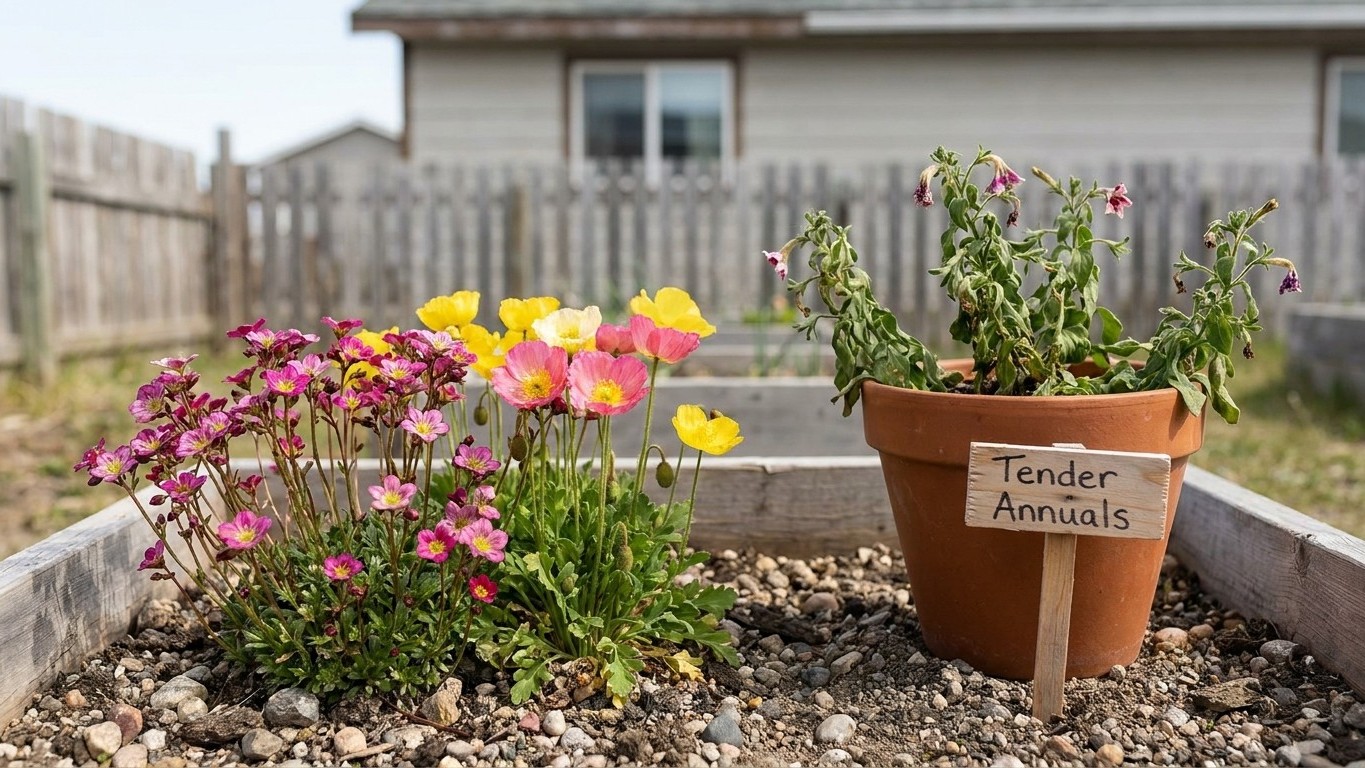

Flowers that thrive in Nunavut are fast, cold-hardy annuals started as transplants, not seeds sown outdoors and left to mature on their own. Environment and Climate Change Canada’s 1981-2010 normals for Rankin Inlet put the average winter low at -34.3 °C and count zero days a year reaching 90°F, which rules out anything that needs a long, hot stretch to flower. The frost-free window there runs on average from June 19 to September 13, roughly twelve weeks. Pick cultivars listed at 45 to 65 days to maturity on the seed packet, start them indoors or buy started plants, and set them out only after you’ve hardened them off to whatever the local frost pattern is doing that year.
Putting a border together

A twelve-week window, not a promise
Everything about a Nunavut border comes back to the length of the season, and the length of the season is shorter and less certain than most gardening advice assumes. ECCC’s Rankin Inlet normals give June 19 as the average date of the last spring frost and September 13 as the average date of the first fall frost. Counted out, that’s about 86 days, call it twelve weeks. But an average date is a midpoint, not a guarantee: in roughly half of all years the last frost falls later than June 19, and the first fall frost can arrive earlier than September 13 too. Treat the whole window as narrower than the calendar suggests, and build in a buffer at both ends rather than planting to the exact average date.
Rankin Inlet is also just one station on Hudson Bay, in the central part of a territory that spans two time zones and several climate zones of its own. Iqaluit, Cambridge Bay, and the High Arctic communities each run their own version of this window, and some are shorter still. If you garden outside the Kivalliq region, use the Rankin Inlet figures as a rough guide to what “short and cold” means here, not as your planting calendar.
Layering by height
A twelve-week season compresses everything, including the height differences you’d normally use to layer a border. Most flowers that actually finish here stay under two feet, so the “tall, medium, short” structure common in longer-season guides gets flattened into something closer to “medium, short, and very short.” Put the taller annuals, like dwarf cosmos, at the back or center of a bed facing the house, mid-height calendula and nasturtium through the middle, and low, mat-forming plants like sweet alyssum along the front edge or spilling over a raised bed wall.
| Flower | Approx. height | Days to maturity (from transplant) | Note |
|---|---|---|---|
| Iceland poppy (Papaver nudicaule) | 12-18 in | 90-100 from seed, faster from started plants | Genuinely arctic-adapted, tolerates hard frost |
| Pansy (Viola x wittrockiana) | 6-9 in | 60-70 | Keeps flowering through light frost |
| Calendula ‘Pacific Beauty’ | 18-24 in | 50-55 | Reseeds heavily if it gets the chance |
| Sweet alyssum ‘Snow Crystals’ | 4-6 in | 45-55 | Low, spreading, good edging plant |
| Nasturtium ‘Alaska Mix’ | 8-12 in | 50-60 | Tolerates poor soil, dislikes transplant shock |
| Dwarf cosmos ‘Sonata Mix’ | 18-24 in | 60-65 | Shorter-season cosmos than standard types |
Days to maturity on any seed packet is a catalogue figure, printed the same no matter where you garden, and it’s counted from the date of transplant or emergence, not from the date you sow indoors. Line that number up against the roughly twelve-week window between the Rankin Inlet averages, leave a couple of weeks of slack for a late spring or an early fall, and you’ll see quickly which cultivars have any real chance outdoors.
Succession of bloom across the season
There isn’t much room here for the kind of long succession of bloom you’d plan in a six-month growing region. Most Nunavut flower beds run one main flush, from mid-summer into early fall, rather than a spring-to-frost sequence. You can still stagger the start a little by choosing a mix of days-to-maturity figures within that window: something in the 45-55 day range, like sweet alyssum or calendula, will be flowering while a 60-65 day cosmos is still filling out, and both will likely still be going when the poppies, started earliest, are at their peak.
Repeating colour
Repetition does more work in a short bed than variety does. Pick one or two colours, orange calendula and blue pansies, or magenta nasturtium and white alyssum, and repeat them every few feet along the border instead of scattering a dozen different hues through it once. In a bed that’s only going to be in flower for a few weeks, a repeated colour reads as a design decision from across the yard. A one-of-everything planting just reads as busy, and it wastes the short window you have on plants competing for attention rather than filling it in.
Leaving room at planting
Wind, not frost, is often what actually knocks a Nunavut border around mid-season. Tundra and coastal sites get little in the way of windbreak, so leave more space between plants than a seed packet from a milder climate suggests, both for airflow and so a gust doesn’t take out three plants leaning on each other. Raised beds and large containers filled with brought-in soil are common here for a reason beyond convenience: the active soil layer above permafrost can be shallow and slow to warm, and a raised bed warms and drains faster than ground soil in spring, buying you a few extra usable days at the start of the window.
The flowers that struggle
Anything bred for a long, hot season fails here for one of two reasons: not enough time, or not enough heat, and Nunavut is short on both. ECCC’s Rankin Inlet figures show zero days a year reaching 90°F, so plants that need real heat units to set flower buds, not just frost-free days, stall out even in a long summer.
- Dahlias need a long, warm season to bulk up tubers and flower; most cultivars won’t finish in a twelve-week window even from a head start indoors.
- Gladiolus corms are bred around a season several weeks longer than Rankin Inlet’s average frost-free stretch.
- Standard zinnias and large marigolds often list days-to-maturity within the window on paper, but flower sparsely without real heat, even when the calendar allows it.
- Morning glory and other tropical vines rarely germinate reliably in cool soil, let alone flower before the first fall frost.
- Sunflowers other than the smallest dwarf cultivars need more warm days than the season reliably provides.
Gardeners in places with a longer, hotter summer have the opposite problem. In our guide to flowers that actually thrive in Utah, and the ones that struggle, the plants that fail there do so from too much heat and too little water, exactly the resource Nunavut has almost none of and doesn’t need to worry about.
Local help
Nunavut doesn’t run its own territorial Master Gardener certification program the way many southern provinces and states do, so start with the federal government’s own site, Agriculture and Agri-Food Canada, for general growing information and a starting point toward regional contacts. Community greenhouse groups in larger Nunavut communities are often the fastest way to find out what has actually flowered locally this year, since they’re working with the same wind and frost you are. For more on gardening elsewhere across the territory, our Nunavut guides cover related growing conditions in more depth.
Common questions
Can I grow perennials in Nunavut that come back every year?
Very few garden perennials survive a winter with an average low of -34.3 °C, the figure ECCC’s Rankin Inlet normals give for the coldest month. A handful of true arctic and subarctic natives persist in the wild at that temperature, but most flowers sold as garden perennials farther south are grown here as annuals, replaced each spring.
Do I need a greenhouse to grow flowers in Nunavut?
No, but it helps. A greenhouse or hoop house lets you start seedlings earlier than outdoor soil allows and protects young plants from the wind that does as much damage here as cold does. Given how narrow the roughly twelve-week window between the Rankin Inlet frost averages already is, a few extra weeks of protected growing time at either end can be the difference between a flower that blooms and one that doesn’t.
When is it actually safe to plant flowers outside in Nunavut?
There isn’t a single safe date, only an average one. ECCC’s Rankin Inlet normals put the last spring frost at June 19, but that’s a mean date, not a guarantee, and in about half of all years frost arrives later than that. Wait until plants are well hardened off, watch the local forecast rather than the calendar, and expect communities outside the Kivalliq region to run on a different schedule entirely.
Why didn’t my flower seeds mature before it turned cold?
Almost always it’s a mismatch between the cultivar’s days-to-maturity figure and the length of the season, or a variety that needed more heat than Nunavut’s summers provide. ECCC records zero days a year above 90°F at Rankin Inlet, so a flower bred for a hot, long summer elsewhere can run out of both time and warmth here even when it technically germinates. Compare the days-to-maturity number on the seed packet against the roughly twelve weeks between the average frost dates before you sow, and favour cultivars well under that figure rather than right at the edge of it.
Related guides
- Flowers That Actually Thrive in Northwest Territories, and the Ones That Struggle
- Flowers That Actually Thrive in Manitoba, and the Ones That Struggle
- Flowers That Actually Thrive in Ontario, and the Ones That Struggle