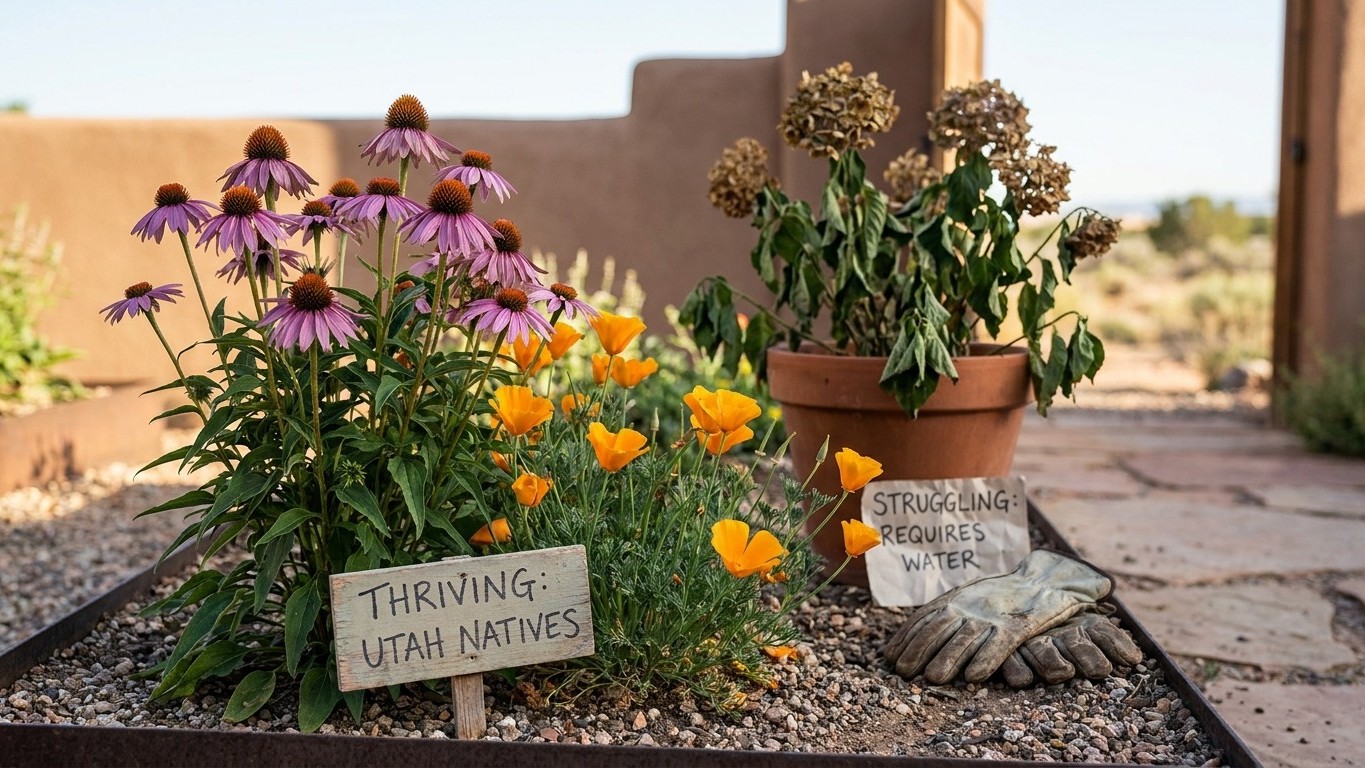

The flowers that make it here are the ones built for extremes, not for comfort — hardy enough to sit through a hard winter and tough enough to shrug off a bone-dry, blazing summer without babying. So the real question isn’t which flower is prettiest, it’s whether it can survive your particular patch of ground through both seasons. Before you plant anything, walk outside and check the hardiness zone printed on the tag against your own town’s elevation, since a number that works down in the valley can fail outright a few hundred feet higher up the bench.
What thrives in Utah

The flowers that hold up best here share three traits: they tolerate hard cold, they shrug off long stretches of dry heat, and they don’t sulk without regular rain. Utah’s growing conditions swing between two extremes inside the same calendar year, and a plant bred for a milder or wetter climate rarely survives both.
Cold hardiness first
NOAA’s 1991-2020 climate normals put the average low of the coldest month at 24.2°F at the Salt Lake City reference station, and the USDA Plant Hardiness Zone Map places Utah across zones 4a to 9a. That’s a wide spread for one state: high mountain valleys and northern benches sit at the cold end, while the St. George area in the southwest reaches the warm end. Check the zone for your own town, not the state average, before you trust a nursery tag. A perennial rated hardy to zone 6 might overwinter fine in a warm Salt Lake City yard and die outright in Logan or Park City. Gardeners just across the state line face a similar spread of elevation and cold, a challenge covered in Flowers That Actually Thrive in Wyoming, and the Ones That Struggle.
Heat and drought load
Summer is the other filter. Salt Lake City averages 52.1 days a year at or above 90°F, according to NOAA’s climate normals, and that heat arrives with low humidity and thin mountain sunlight that dries soil fast. Flowers bred for damp, cool summers tend to scorch or mildew here even when watered on schedule, which is nearly the opposite problem faced in Flowers That Actually Thrive in Nova Scotia, and the Ones That Struggle, where the challenge runs the other direction entirely. Drought tolerance matters more than bloom size when you’re picking a plant for a Utah border.
The families that carry both traits well include the mint family (Salvia, Nepeta, Agastache), the aster family (Rudbeckia, Echinacea, Achillea, Gaillardia), and the beardtongues (Penstemon). All three groups include species built for cold winters and dry, sun-baked summers, and most nurseries in the region stock several cultivars from each. Ornamental grasses such as blue grama and little bluestem round out a border with the same tolerance, giving it structure once the perennials go dormant for winter.
- Hard freeze tolerance well into the low 20s°F
- Low water needs once roots are established
- Tolerance for soils that trend alkaline in many valley locations
- Resistance to sunscald and mildew under intense, dry heat
Native plants worth the space
Native and regionally adapted flowers spend less time being babied because they evolved for exactly the cold winters, dry summers and often alkaline soils described above. Once established, most need only occasional deep watering instead of the twice-weekly soak a bedding annual demands.
Natives for pollinators
Rocky Mountain and Intermountain West species make up most of the reliable native list here. Rocky Mountain penstemon (Penstemon strictus) sends up spikes of blue-violet flowers in early summer and is one of the most drought-hardy perennials sold in western nurseries. Blanketflower (Gaillardia aristata) blooms red and yellow through the hottest part of summer and reseeds readily on its own. Showy milkweed (Asclepias speciosa) is a regional host plant for monarch butterflies, and orange or scarlet globemallow (Sphaeralcea) keeps flowering through drought that would flatten most garden perennials.
Utah’s state flower, the sego lily (Calochortus nuttallii), is native to the drier ground of the Intermountain West and produces a white, cup-shaped bloom with a purple-red blotch at the base of each petal in late spring. It’s a bulb, not a bedding plant, and it resents being watered on the same schedule as a lawn or annual bed, so give it its own dry corner rather than tucking it among thirstier perennials.
Native plantings support far more than good looks. Native bees, many of which nest in bare ground rather than hives, rely on native bloom shapes and timing that imported ornamentals don’t always match. A patch of rabbitbrush (Ericameria nauseosa) or Rocky Mountain bee plant (Cleome serrulata) blooming into fall gives late-season pollinators a food source after most garden annuals have quit for the year.
Give any native perennial a full growing season before judging it. Most spend their first year building root systems below ground rather than flowers above it, and a native planted in spring may look sparse until its second or even third summer. Skip the fertilizer at planting time. Most natives listed here evolved in lean, undisturbed soil, and heavy feeding produces soft growth that flops or draws aphids rather than better bloom.
Perennials that come back

At Salt Lake City’s hardiness range, most classic border perennials come back reliably year after year: peonies, bearded iris, daylilies (Hemerocallis), Shasta daisy, sedum (Hylotelephium), coneflower (Echinacea purpurea) and black-eyed Susan (Rudbeckia fulgida) all take the winter lows in stride and return thicker each spring. These are the workhorses that make a Utah perennial border look established within two or three years.
Grown here as an annual
Some familiar garden flowers are perennial only in warmer parts of the country and get planted here as annuals instead. Lantana and many of the tender salvias sold at nurseries are hardy only to about zone 8 or 9, and Utah’s coldest-month average low of 24.2°F, as measured by NOAA at the Salt Lake City station, kills them outright over winter across most of the state. Dahlias are perennial in mild climates but need their tubers dug and stored indoors here, since a hard freeze in the ground destroys them. Gardeners plant all three anyway, for their long summer bloom, and simply treat them as one-season plants or dig and store the roots each fall.
Reading the zone on a plant tag
Every perennial tag lists a hardiness range, something like “zones 5-9.” Compare that range to your own local zone, not to the state’s overall 4a-9a span printed on the national USDA map. A tag reading “zones 6-9” is a safe bet in a warm Salt Lake City neighborhood but a gamble in a colder mountain valley a few miles away, since USDA’s map shows Utah spanning six full zones across its elevation changes. When a tag’s low end sits right at or above your zone number, plant it in a sheltered spot near a south-facing wall, or treat it as an annual and enjoy one good season without expecting it back.
Don’t confuse a tag’s sun and water symbols with its hardiness rating. A perennial can be listed as “full sun, low water” and still be rated only to zone 7, which tells you nothing about whether it survives your winter. Read the actual zone numbers, not just the icons, before it goes in the cart.
Microclimates change the math further. A bed against a south-facing brick wall runs several degrees warmer through winter than an open, wind-exposed spot in the same yard, which is often enough to carry a borderline perennial through a cold snap it would not survive elsewhere on the same property.
Putting a border together
A border that looks good from spring through the first fall frost needs plants layered by height and staggered by bloom time, not one dramatic wave of color that fades by midsummer.
Layering by height
Put the tallest plants, like Rocky Mountain penstemon or ornamental grasses, at the back of a bed viewed from one side, or in the center of an island bed viewed from all sides. Mid-height perennials such as coneflower, black-eyed Susan and yarrow fill the middle layer, and low, spreading plants like sedum or creeping thyme edge the front and hide the bare soil around taller stems.
Succession and repetition
Utah’s frost-free window runs from the last spring freeze, which NOAA’s Salt Lake City normals place between April 12 and April 29, to the first fall freeze, dated between October 18 and October 29 at the same station. Both are ranges rather than fixed days, and both shift earlier at higher elevation and later in the warmer southern part of the state, so treat them as a planning window rather than a calendar appointment. Inside that window, stagger bloom times deliberately: peony and iris in late spring, penstemon and coreopsis into early summer, coneflower and Rudbeckia through the hottest weeks, and sedum and aster carrying color to the first frost.
Repeat two or three colors through the length of the bed rather than scattering one of everything. A border with single specimens of a dozen different flowers reads as clutter from a few feet away. The same yellow Rudbeckia or purple salvia planted in three or four clumps down the row ties the whole bed together.
Leave real space at planting. A one-gallon perennial looks lonely in a bed at installation but fills in within two seasons, and plants set too close compete for the same water and end up leggy and mildew-prone in Utah’s dry-then-humid summer swings. Follow the mature spread listed on the tag, not the size of the pot in your hand, when you’re spacing.
| Plant | Height | Bloom season | Water need |
|---|---|---|---|
| Rocky Mountain penstemon | 2-3 ft | Early summer | Low |
| Coneflower (Echinacea purpurea) | 2-4 ft | Midsummer | Low to moderate |
| Black-eyed Susan (Rudbeckia fulgida) | 1.5-3 ft | Mid to late summer | Low to moderate |
| Sedum (Hylotelephium) | 1-2 ft | Late summer to fall | Low |
Local help
Utah State University Extension runs the state’s Master Gardener program, with county offices that keep plant lists tuned to local elevation and soil rather than a statewide average. Call your county’s USU Extension office before you finalize a plant list, especially if you garden above 5,000 feet or in the warmer southwest corner, since both areas depart sharply from the Salt Lake City figures used throughout this guide. Find your county’s contact information through USU Extension, and browse more of our Utah guides for other planting timelines specific to the state.
Common questions
Can I grow hydrangeas in Utah?
Bigleaf hydrangeas are the tough case, since most set flower buds on the previous year’s wood, and a hard winter or a late spring freeze here can kill those buds before they open even when the plant itself survives. Panicle hydrangeas, which bloom on new wood each year, are a more reliable choice in most of the state, though alkaline valley soil can still shift bloom color away from what the tag promises.
Do native flowers need any water once they’re established?
Yes, occasionally. Established natives handle Utah’s dry summers without regular irrigation, but a deep soak every few weeks during the hottest stretch, when Salt Lake City averages over 50 days a year above 90°F according to NOAA, keeps them blooming instead of just surviving. Skip water entirely for more than a month in peak summer and even drought-adapted natives can drop buds.
What’s the real difference between a hardy perennial and one I’ll replant every year?
It comes down to whether the plant’s rated hardiness zone covers your local winter low, not just whether it’s labeled “perennial” on the tag. A plant rated to zone 8 is a genuine perennial in the American Southeast and a one-season annual across most of Utah, since the state’s coldest-month lows regularly drop below what that plant can survive.
When should I actually plant perennials, spring or fall?
Fall planting, done early enough that roots settle in before the ground freezes, often outperforms spring planting because the plant spends the following growing season on top growth instead of recovering from transplant shock. Either season works as long as you plant inside the frost-free window between the local last spring freeze and first fall freeze rather than right up against either edge of it.
Related guides
- Flowers That Actually Thrive in Idaho, and the Ones That Struggle
- Flowers That Actually Thrive in Wyoming, and the Ones That Struggle
- Flowers That Actually Thrive in Illinois, and the Ones That Struggle