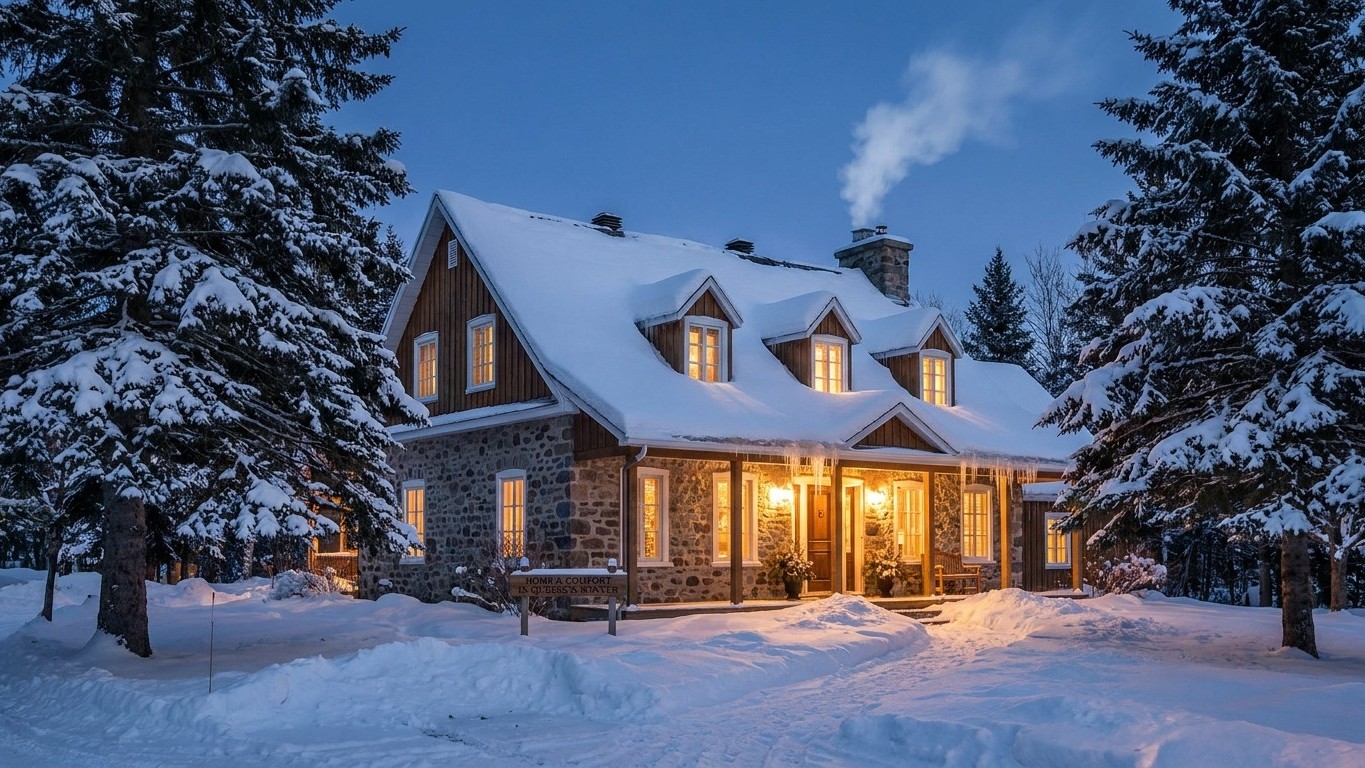

Winter in Quebec keeps a house working hard for months at a stretch, and the mean daily minimum in the coldest month, 6.7°F, is the number that explains why. That single figure drives furnace sizing, insulation choices, and how much firewood a household needs to make it to April. Here’s what it actually means once the thermometer settles in for the season.
How cold it gets, and for how long

The 6.7°F figure comes from Environment and Climate Change Canada’s 1981-2010 Climate Normals, using Montreal as the reference station. It’s not the record low, and it’s not a monthly average temperature. It’s the mean daily minimum, meaning that across the coldest month, the typical overnight low lands right around that mark. Half the nights dip below it.
That distinction matters more than it sounds like it should. A climate that hovers near freezing for four months puts steady, moderate demand on a heating system, day after day, without much drama. A climate that drops into single digits for two months asks for something different: a furnace that can push hard during short, brutal cold snaps, and a building envelope that doesn’t leak heat the moment the wind picks up. Quebec sits closer to the second pattern. When Does the Heating Season Start in Quebec? Often by late October, and it doesn’t fully let go until sometime in April.
What that means for equipment
A furnace or heat pump sized for a milder winter will run constantly and still fall short here, cycling nonstop through January without ever catching up to the thermostat setting. That’s the practical consequence of a 6.7°F coldest-month minimum: it’s not just “cold,” it’s cold for long enough that undersized equipment gets exposed fast. Pipes in unheated crawl spaces or exterior walls face real freeze risk once nighttime lows sit consistently near or below that figure, which is why insulation and pipe wrap tend to matter more here than in states with a shorter, gentler winter.
Wood-burning households feel the same math from a different angle. A stove that comfortably heats a home through a mild December can struggle once temperatures settle into the range this normal describes, which is part of why the volume of wood on hand, not just the species, becomes the thing that decides whether a supply lasts the whole season.
What a cord of wood is worth here
A cord is a volume, not a weight, and that single fact is where most firewood buyers get shorted. The standard measure is a stack 4 feet high, 4 feet deep, and 8 feet long, which works out to 128 cubic feet total (the actual solid wood inside is somewhat less, since bark and gaps take up space). Two loads can both be called “a cord” and deliver very different amounts of heat, because density is what actually carries the BTUs. A cord of a dense hardwood packs far more usable mass into that same 128-cubic-foot stack than a cord of a lighter species, even though both measure identically at the woodpile.
According to Michigan State University Extension, a cord of well-seasoned hardwood delivers about 20 million BTU. MSU frames that in terms a homeowner can actually use: one cord is roughly equivalent to the heat energy in 145 gallons of #2 fuel oil, or 215 gallons of LP gas. That comparison is worth sitting with, because it turns an abstract stack of logs into something you can weigh against a fuel bill.
| Measurement | Value |
|---|---|
| Standard cord dimensions | 4 ft × 4 ft × 8 ft |
| Total volume | 128 cubic feet |
| Heat value (seasoned hardwood) | about 20 million BTU |
| Fuel oil equivalent | roughly 145 gallons of #2 fuel oil |
| LP gas equivalent | roughly 215 gallons |
That 20-million-BTU figure is an average, and it only holds for wood that’s genuinely well seasoned. Species and moisture content move it considerably, which is exactly why the next section matters as much as the cord itself. A cord of wet, unseasoned wood measured with the same tape measure will not put out anywhere near the same heat, no matter what the seller calls it.
How long wood takes to dry in Quebec
Seasoning is a climate question, not a fixed number of months, because humidity and summer heat are what actually pull moisture out of a split log. MSU Extension puts the target at 20 percent moisture or less before wood goes in the stove, and notes that green, freshly cut wood can start out above 60 percent moisture. That difference is the whole story: water inside the wood has to boil off before the wood releases any usable heat, and that boiling consumes energy that should have gone into warming the house.
Split and stacked wood, with air moving freely through the pile, typically reaches that 20 percent mark after one full summer of drying. The key words are split and stacked. Wood left in rounds, or piled without airflow, dries far more slowly no matter how much time passes. MSU also flags red oak as a notable exception: its cell structure holds moisture more stubbornly than most hardwoods, so it needs longer than a single summer to season properly, sometimes closer to a full year or more depending on how it’s stacked.
Burning wood before it’s ready has consequences beyond a weaker fire. Unseasoned wood produces less usable heat for the same volume burned, since so much of the energy goes into evaporating water instead of radiating warmth. It also burns cooler and smokier, and that combination pushes more creosote into the flue. Over a winter, that means a chimney that needs sweeping sooner than it would with properly dried wood, and a higher risk of a chimney fire in the meantime. None of this is a reason to panic over a single damp log. It’s a reason to plan a summer ahead: split it, stack it where air can move through it, and let it sit.
Where to check before you buy
Quebec covers a wide range of elevation, exposure, and microclimate, and the figures above describe conditions at the reference station used for the province’s climate normals, Montreal. A property on higher ground, closer to the St. Lawrence, or further into a valley can run noticeably colder or milder than that reference point, and firewood species availability shifts with it too.
For local guidance on which species are commonly sold in your area, and on any seasonal restrictions that apply to outdoor burning or wood smoke, the Ministère de l’Agriculture, des Pêcheries et de l’Alimentation du Québec (MAPAQ) is the resource worth checking before buying a cord or firing up a stove for the season. Burn rules in particular are set at the local level and revised year to year, often in response to air quality concerns during stretches of still winter weather. What was allowed last season isn’t guaranteed to hold this one, so a quick check before the cold sets in beats finding out the hard way once the wood is already stacked in the yard.
What each heat source costs to run in Quebec
At Quebec’s average residential prices, this is what one million Btu of heat delivered into the house costs with each system (Canadian dollars). It compares fuels on the same unit: it is not a yearly bill, and it leaves out the price of the equipment.
| System | Cost per million Btu delivered |
|---|---|
| Electric resistance (baseboard, 100% efficient) | C$24.30 |
| Heat pump at 8.1 HSPF2 (seasonal COP about 2.4) | C$10.23 |
Cheapest to run in Quebec: heat pump, C$14.07 less per million Btu than the electric resistance.
Prices: Hydro-Québec, 2025 Comparison of Electricity Prices in Major North American Cities. Efficiencies: ENERGY STAR criteria. A heat pump’s figure is a seasonal average; in the coldest weather its efficiency drops.