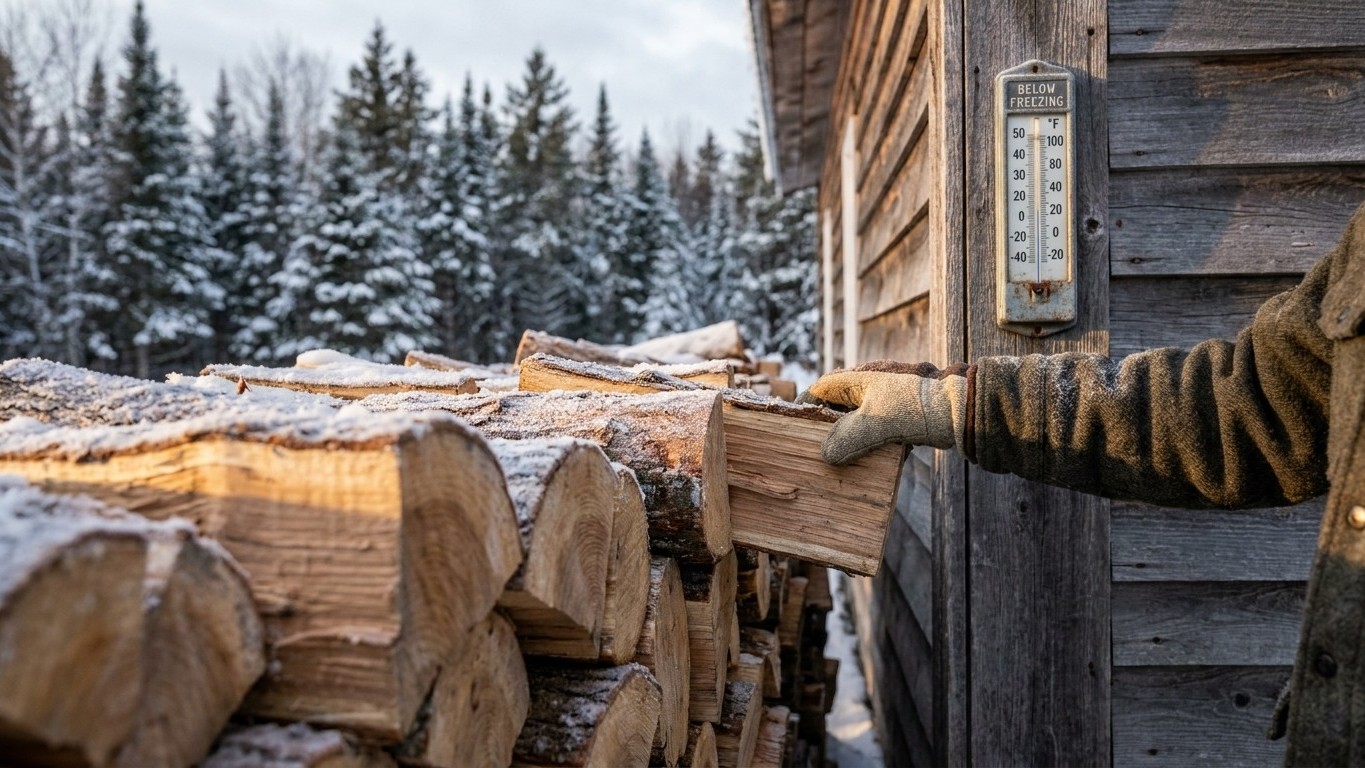

In Quebec, the wood that gets you through winter isn’t the one that smells nicest or splits easiest. It’s the one dense enough to hold a fire past midnight when the outdoor thermometer sits well below freezing for months. This guide breaks down how cold it really gets, which woods carry enough heat per cord to matter, how much you’ll actually burn, and why timing your seasoning wrong is the single most common mistake in this climate.
How cold it actually gets here

The average low during the coldest month at the Montreal reference station is 6.7°F, according to Environment and Climate Change Canada’s 1981-2010 Climate Normals. That’s not a record cold snap. That’s the typical overnight low, night after night, for weeks at a stretch during the deepest part of winter. It’s the number that should drive every decision about how much wood you stack and what kind.
A mean daily minimum below 7°F puts a home firmly in territory where wood heat, if it’s doing real work, is a survival tool as much as a comfort. This isn’t a climate where a couple of decorative logs in a fireplace on a chilly evening covers the need. If wood is heating a cabin, a rural house, or supplementing a furnace during cold snaps, the fire has to produce real, sustained heat output, night after night, without the operator babysitting it every two hours.
What that cold actually demands from a fire
At 6.7°F, heat loss from a house is constant and significant. Windows, doors, and even well-insulated walls are shedding warmth around the clock, and a stove or fireplace has to replace it just to hold steady, before it even gets ahead. That means the wood going into the firebox needs to release as much energy as possible per load, because you’re not just topping off comfort, you’re fighting a real and continuous draw.
This is also why an overnight burn matters so much here. A fire that dies out at 2 a.m. in a climate like this isn’t a minor inconvenience, it’s a house that’s noticeably colder by the time anyone wakes up, and pipes that are at some risk if the wood heat is the primary source. Density, and the sustained coal bed a dense wood leaves behind, is what buys those extra hours. For readers in a genuinely mild region, wood heat might be about atmosphere. In Quebec, at this cold figure, it’s functional infrastructure.
Which woods are worth the effort here
Because a cord is a fixed volume, always 4 feet by 4 feet by 8 feet, or 128 cubic feet, the wood that matters is the wood that packs the most mass into that space. Michigan State University Extension puts the heat content of a cord of well-seasoned hardwood at roughly 20 million BTU, which they equate to about 145 gallons of #2 fuel oil or 215 gallons of LP gas. That figure is an average, though, and it moves a lot depending on species and, more than anything, on how dry the wood actually is.
Denser hardwoods, the oaks, maples, birches, and ashes common across Quebec’s forests, pack more wood fiber into that same 128 cubic feet than lighter species do, which is why they’re the ones worth splitting, stacking, and babying through a full season of drying. Softer, lighter woods burn hot and fast but leave a smaller coal bed, making them a better fit for kindling, shoulder-season fires in October or April, or quick heat rather than an all-night burn through a January cold snap.
Where seasoning changes the math
Red oak deserves a specific mention here because MSU flags it as an exception: its cell structure makes it dry more slowly than most other hardwoods, so it needs extra time stacked and exposed to air before it reaches burnable moisture. Burn it too soon and you lose most of the advantage its density was supposed to give you.
| Wood condition | BTU per cord | Smoke | Sparks |
|---|---|---|---|
| Seasoned hardwood (20% moisture or less) | About 20 million BTU (MSU average) | Low, clean burn | Few |
| Green hardwood (over 60% moisture) | Well below the seasoned figure, energy goes to boiling off water first | Heavy, dark smoke | More frequent, from trapped moisture |
| Red oak, seasoned properly | Comparable to other seasoned hardwoods once fully dry | Low once seasoned | Few once seasoned |
None of this matters if you can’t actually buy or cut the species locally and get it seasoned in time. A modest hardwood you can source, split, and stack this season beats a theoretically superior species sitting green in a supplier’s yard, or worse, one you can’t find at all.
How much wood a winter takes
There’s no honest single number for “cords per winter” that applies across Quebec, and any published figure that hands you one without asking about your house is guessing. What determines the answer is a combination of three things: how cold your specific winter runs, how well your house holds the heat you generate, and whether wood is carrying the whole heating load or just supplementing a furnace on the coldest days.
The mechanism that makes this estimate swing so widely is insulation. A poorly insulated house, drafty windows, minimal attic insulation, uninsulated rim joists, can burn roughly double the wood of a tightly sealed home in the exact same winter, at the exact same outdoor temperature. The fire isn’t working harder because the wood is different. It’s working harder because the heat it makes is leaking out faster than it can replace it.
Run your own estimate against these variables rather than trusting a generic figure:
- How close your local winter runs to that 6.7°F coldest-month average, or how much colder or milder your specific area tends to be
- The age, insulation level, and air-sealing of your house, since two homes on the same street can have very different heat loss
- Whether wood is your primary heat source or a supplement to a furnace, boiler, or heat pump
- How efficient your stove or fireplace insert actually is at converting fuel to usable heat rather than sending it up the flue
- How consistently you’re burning fully seasoned wood versus wood that’s still holding excess moisture
Stack those factors against each other for your own house and you get something closer to a real estimate than any number pulled from a chart designed for an average home that doesn’t exist.
Drying wood in this climate
Species matters, but seasoning decides more of your heat output than any other single factor, and Quebec’s climate shapes how long that seasoning actually takes. MSU Extension sets the target plainly: firewood should burn at 20 percent moisture or less, while green, freshly cut wood can hold over 60 percent water inside its cell structure. That water has to be driven off before the wood gives up any real heat, and boiling it away is exactly what a fire does first, before it warms anything else.
What actually dries wood is air movement and time, not direct sun exposure. A pile that’s split, stacked loosely, and exposed to wind through a full summer will lose moisture far faster than a tighter, shaded stack, regardless of how much sunlight either one gets. Split wood ready in spring for the following winter typically reaches that 20 percent target after one full summer season stacked properly, with red oak needing longer given how slowly it releases moisture through its cell structure.
The most common mistake locally is timing: wood split in spring for that same winter almost never has enough time to season properly before the cold sets in. Cut and split now, and that wood is realistically headed toward next winter’s woodpile, not this one. Planning a full year ahead, cutting and splitting for the winter after next rather than the one bearing down, is what keeps a stack consistently at 20 percent or below instead of scrambling with half-dried wood every December.