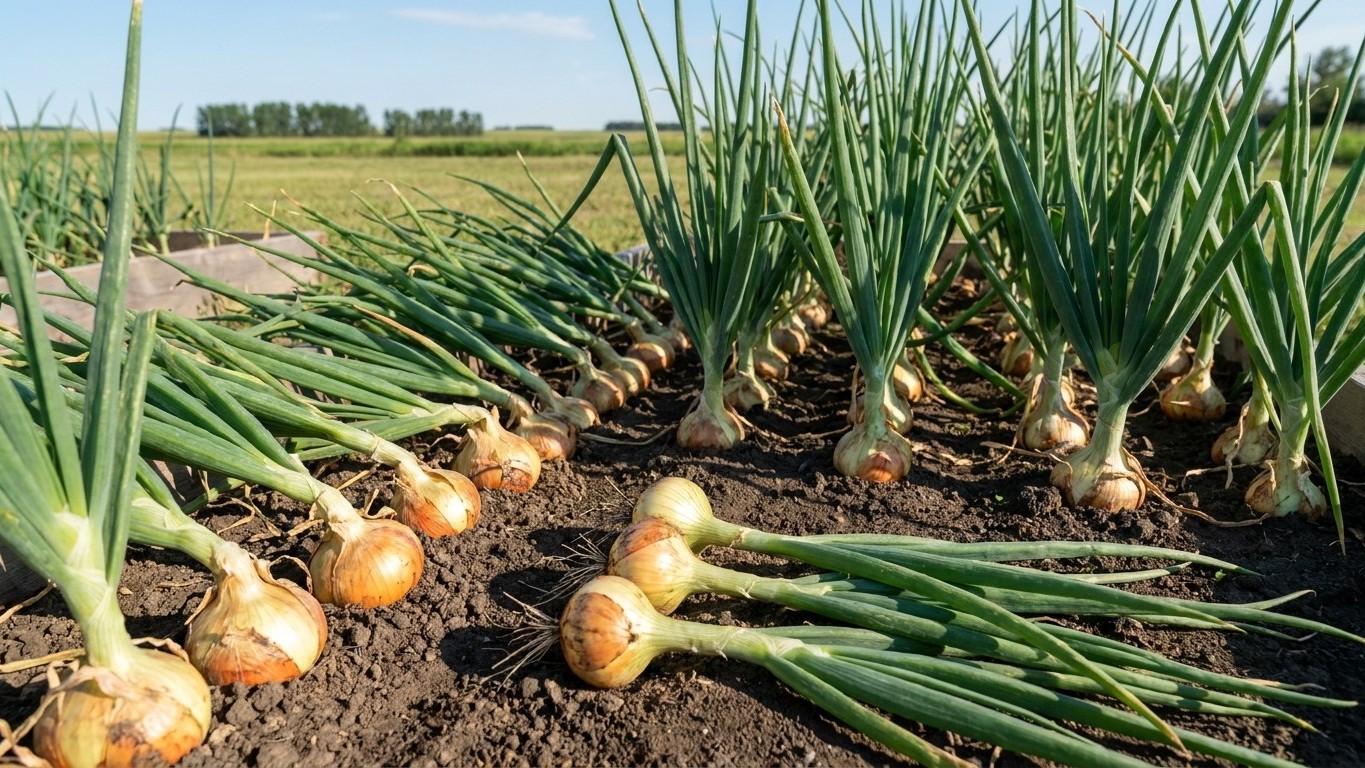

At 52.17 degrees north, Saskatoon gets 16 hours and 31 minutes of daylight on the longest day of the year. That single number decides which onions will ever form a bulb in a Saskatchewan garden and which ones will just sit there making leaves. It puts the whole province in long-day territory, full stop, and it rules out an entire shelf of onion varieties sold at big-box stores every spring.
How long your longest day is

Onions don’t respond to heat the way tomatoes or peppers do. They respond to day length. Once the hours of daylight cross a variety’s genetic threshold, the plant stops pushing out new leaves and starts diverting its energy into a bulb. Get that threshold wrong for your location and the plant never gets the signal, or gets it too early to matter.
Short-day onions start bulbing once daylight reaches roughly 12 hours, a threshold documented by Clemson Cooperative Extension’s Home & Garden Information Center. That’s a low bar, and it’s met almost everywhere on the planet by mid-spring. In the deep South, that low threshold works fine because the plant has had months of warm weather to build a decent root system before bulbing kicks in. In Saskatchewan, the same 12-hour trigger arrives while a young onion transplant is still tiny, so the bulb it forms is tiny too.
Long-day onions need something closer to 14 to 16 hours of daylight before they’ll bulb at all. Saskatoon’s 16 hours 31 minutes on the summer solstice clears that bar with room to spare, which is exactly why long-day varieties are the only sensible choice this far north. Anything requiring less daylight than that either bulbs too early and stays small, or in the case of some intermediate types, simply misses the window because the season ends before the trigger arrives.
One caution worth repeating: 52.17 degrees north is Saskatoon’s latitude, not the whole province’s. Saskatchewan stretches from the U.S. border up past the 60th parallel, several degrees of latitude that translate into real differences in summer daylight. A gardener near La Ronge or further north will see even more daylight hours on the longest day than Saskatoon does, while someone near the southern border gets slightly less. If you garden well north or south of Saskatoon, it’s worth checking your own city’s daylight hours before assuming this figure applies to you exactly. Everything that follows on this page builds on that one number.
Which varieties bulb in Saskatchewan
Of the 28 onion varieties documented on this site, six list a published latitude range that actually covers 52.17 degrees north. These are long-day types bred to wait for the long summer daylight that Saskatchewan provides in abundance. For a closer look at each option, see The Best Onion Varieties for Saskatchewan, and for timing your planting, see When to Plant Onions in Saskatchewan.
- Ailsa Craig — long-day, 38-60N
- Barolo — long-day, 38-55N
- Blush — long-day, 38-55N
- Patterson — long-day, 38-55N
- Redwing — long-day, 43-65N
- Walla Walla Sweet — long-day, 35-55N
Redwing stands out for stretching all the way to 65N, which makes it a solid pick even for gardeners well north of Saskatoon. The other five cover the mid-latitude band comfortably, meaning Saskatoon sits nowhere near the edge of their range.
The varieties that won’t work here
This is the part that matters more than the list above, because it explains a failure a lot of Saskatchewan gardeners have already lived through without knowing why. Twenty-two varieties documented on this site carry a published latitude range that tops out below 52.17 degrees north, meaning their catalogue range simply doesn’t reach this far north at all.
- Bridger (long-day, 35-50N)
- Cabernet (intermediate-day, 35-45N)
- Calibra (intermediate-day, 35-45N)
- Candy (intermediate-day, 33-40N)
- Elsye (intermediate-day, 32-45N)
- Expression (intermediate-day, 32-45N)
- Frontier (long-day, 40-50N)
- Gabriella (short-day, 20-35N)
- Madalyn (short-day, 20-35N)
- Monastrell (intermediate-day, 35-46N)
- New York Early (long-day, 38-50N)
- Powell (long-day, 43-47N)
- Red Carpet (long-day, 40-45N)
- Red Long of Florence (intermediate-day, 38-50N)
- Red Long of Tropea (intermediate-day, 35-48N)
- Red Rock (short-day, 30-36N)
- Rossa di Milano (long-day, 38-50N)
- Safrane (long-day, 42-50N)
- Scout (intermediate-day, 32-46N)
- Sierra Blanca (intermediate-day, 32-45N)
- Talon (long-day, 42-50N)
- White Castle (short-day, 30-38N)
Plant one of these in a Saskatchewan garden and here’s roughly what happens. The onion grows a healthy-looking top of green leaves all summer, because warmth and moisture are there and the plant has no reason to stop. Then fall arrives, the plant hasn’t bulbed, or has only barely swollen at the base, and cold weather or wet soil finishes the job by rotting the roots before anything can be harvested. If that story sounds familiar, if you’ve ever pulled a supermarket onion set from a garden center and ended up with skinny scallion-like stalks and no real bulb, you were probably growing a short-day or intermediate-day variety several degrees south of where its catalogue range says it belongs. It’s a variety mismatch, not something a gardener did wrong with fertilizer or watering.
When to plant onions in Saskatchewan
Planting timing for onions tracks day length too, which is why the calendar looks completely different depending on where you garden. In mild-winter states, growers plant long-day onions in fall and let them overwinter as small plants. In a Saskatchewan winter, that approach doesn’t survive, so the planting window shifts to late winter and early spring instead, timed around the region’s frost dates.
Environment and Climate Change Canada’s climate normals for the Saskatoon SRC station put the average last spring frost at May 18 and the average first fall frost at September 18. That’s a growing season of roughly four months bracketed by frost on both ends, which is tight for a long-day onion that won’t even start bulbing until daylight peaks in late June.
Those two dates are averages pulled from the 1981-2010 Canadian Climate Normals, not guarantees. By definition, a mean date means frost arrives later than May 18 in about half of all years, and earlier than September 18 in roughly half the falls too. Treat May 18 as the midpoint of a risk window, not a green light, and keep row cover or cloches handy for a cold snap that shows up after you’ve already set out transplants. The SRC station reading also applies specifically to the Saskatoon area; gardeners farther north in the province, or at higher elevation, should expect both frost dates to run later in spring and earlier in fall than what’s listed here.
Given that squeeze, most Saskatchewan gardeners start long-day onion seed indoors in late winter, roughly 8 to 10 weeks before the last expected frost, then move hardened-off transplants into the garden once the worst frost risk has passed in May. Onion sets are a faster shortcut but offer far less control over which variety you actually get, and since variety is the single biggest factor in whether an onion bulbs here at all, seed-grown transplants of a known long-day variety are the safer bet for a province where the daylight math leaves very little room for error.