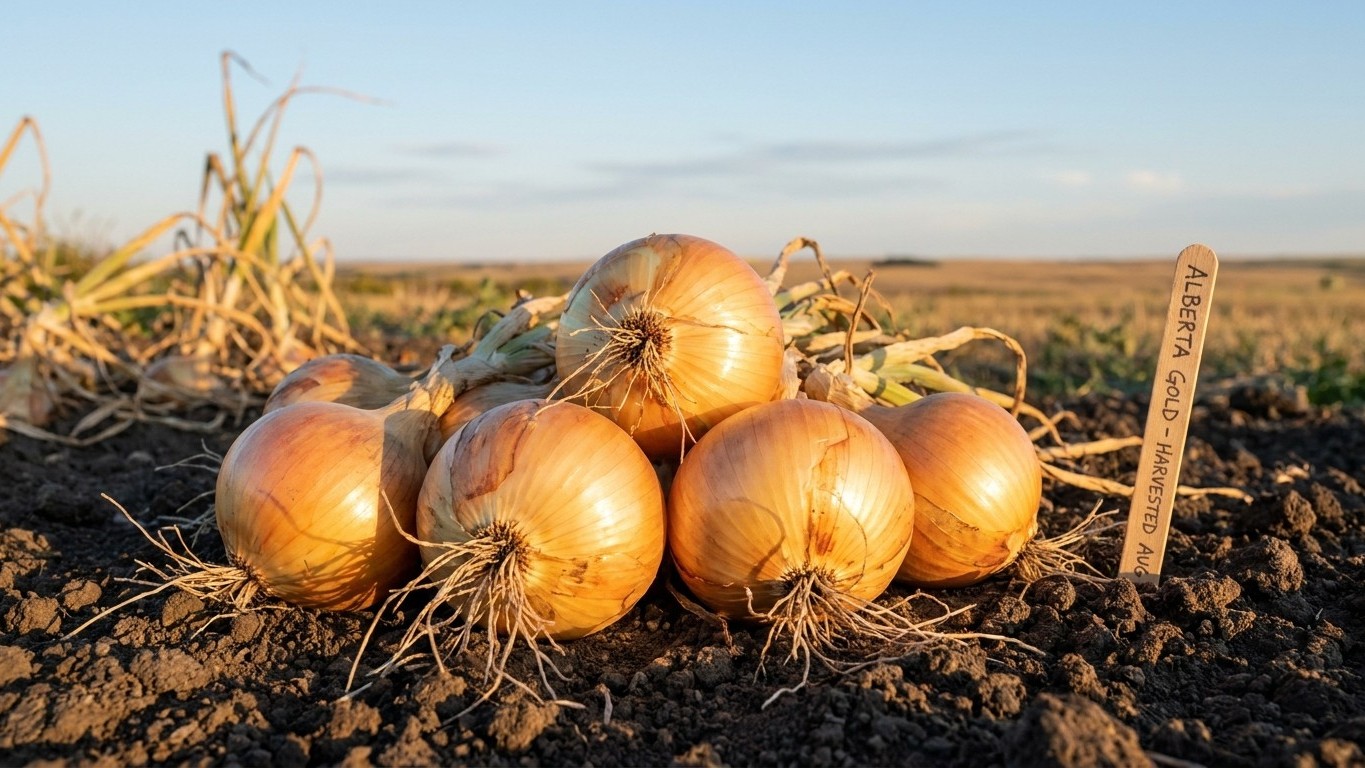

At 51.11 degrees north, Alberta’s growing season gets 16 hours and 20 minutes of daylight on the longest day of the year. That single fact decides which onion varieties will actually form a bulb here, and it rules out most of what you’ll find on a garden-center seed rack. This guide names the varieties built for this latitude and the ones that will waste a full season of your garden bed.
How long your longest day is

Calgary sits at 51.11 degrees north, and on the summer solstice the sun stays up for 16 hours and 20 minutes there. That number matters more than any frost date or soil temperature, because onions don’t bulb because it’s warm enough. They bulb because the days get long enough. An onion plant is reading the clock, not the thermometer, and once daylight crosses its genetic threshold, it stops making leaves and starts pushing all that energy into the bulb.
Onion varieties are bred around three day-length thresholds. Short-day types start bulbing at around 12 hours of daylight, a figure published by Clemson Cooperative Extension’s Home & Garden Information Center. Intermediate-day types need something in the 12-to-14-hour range. Long-day types hold off until they see 14 to 16 hours, sometimes more, before they’ll bulb at all.
At 16 hours and 20 minutes of summer daylight, Alberta clears the long-day threshold with room to spare. That’s the good news: this is long-day country, full stop. It also means short-day and most intermediate-day varieties are off the table here, not because they’d struggle, but because they’d trigger bulbing far too early, while the plant is still a few thin leaves tall, and give you an onion the size of a marble.
One caution worth repeating: 51.11 degrees north is Calgary’s latitude, not Alberta’s. The province stretches from around the 49th parallel at the Montana border up past the 60th near the Northwest Territories. A gardener near Lethbridge is working with slightly less summer daylight than one near Fort McMurray. If you’re near either edge of the province, it’s worth checking your own latitude rather than assuming Calgary’s number applies exactly to your yard. Everything that follows in this guide is built on that 16-hour-20-minute figure, and it’s the filter every variety decision should pass through first.
Which varieties bulb in Alberta
Six varieties documented on this site have a published latitude range that fully covers 51.11 degrees north, meaning their breeding is built for day lengths at or beyond what Alberta delivers. All six are long-day types, which lines up exactly with what the daylight math predicted above. You can see the full breakdown of these varieties in this Planting calendar onions Alberta Best varieties onions Alberta below.
| Variety | Day-length type | Published range |
|---|---|---|
| Ailsa Craig | Long-day | 38-60N |
| Barolo | Long-day | 38-55N |
| Blush | Long-day | 38-55N |
| Patterson | Long-day | 38-55N |
| Redwing | Long-day | 43-65N |
| Walla Walla Sweet | Long-day | 35-55N |
Seven more sit close enough to a published boundary, within 1.5 degrees, that they land in what’s best called the blurred zone. Their ranges are a continuum, not a hard cutoff, so these are worth a trial rather than a firm yes or no:
- Bridger (long-day, 35-50N)
- Frontier (long-day, 40-50N)
- New York Early (long-day, 38-50N)
- Red Long of Florence (intermediate-day, 38-50N)
- Rossa di Milano (long-day, 38-50N)
- Safrane (long-day, 42-50N)
- Talon (long-day, 42-50N)
What won’t bulb here
This is the part that matters most if you’ve already tried growing onions from a supermarket set and ended up with something disappointing. Fifteen varieties documented on this site have published ranges that sit below 51.11 degrees north, meaning they’re bred for shorter summer days than Alberta produces:
- Cabernet (intermediate-day, 35-45N)
- Calibra (intermediate-day, 35-45N)
- Candy (intermediate-day, 33-40N)
- Elsye (intermediate-day, 32-45N)
- Expression (intermediate-day, 32-45N)
- Gabriella (short-day, 20-35N)
- Madalyn (short-day, 20-35N)
- Monastrell (intermediate-day, 35-46N)
- Powell (long-day, 43-47N)
- Red Carpet (long-day, 40-45N)
- Red Long of Tropea (intermediate-day, 35-48N)
- Red Rock (short-day, 30-36N)
- Scout (intermediate-day, 32-46N)
- Sierra Blanca (intermediate-day, 32-45N)
- White Castle (short-day, 30-38N)
Plant any of these in Alberta and here’s what actually happens: the daylight trigger arrives before the plant has built enough leaf mass, so it bulbs anyway, small and underdeveloped. Some of the intermediate-day types closer to the edge, like Monastrell or Red Long of Tropea, may limp along and form a modest bulb, but the shorter-day varieties on this list simply run out of runway. The plant keeps sending up leaves that never thicken into a real onion, the season ends, and what’s left in the ground either stays green and small or starts to rot as fall moisture sets in. That’s a variety mismatch, not a feeding or watering mistake, and no amount of fertilizer fixes it.
When to plant onions in Alberta
Planting timing in onion growing is really about working backward from your last spring frost, and in Alberta that date sits later than it does almost anywhere south of the border. At the Calgary station, the average last spring frost falls on May 21, with the average first fall frost on September 16, according to Environment and Climate Change Canada’s Canadian Climate Normals for 1981-2010. That’s a growing window of roughly four months between frosts, on average.
Both of those dates are means, not guarantees. In one year out of two, frost arrives later than May 21 in spring or earlier than September 16 in fall, which means treating either date as a safe planting or harvest deadline is a mistake. Think of them as the midpoint of a window that shifts year to year, and build in a margin on both ends.
Given how late that spring frost lands, the practical approach in Alberta is to start onion seed indoors in late winter, roughly eight to ten weeks before your expected last frost, then harden off and transplant seedlings outside once the risk of hard frost has genuinely passed. Direct-sowing seed outdoors is possible but leaves little margin given how short the frost-free window already is compared to milder regions. Onion sets, the small bulbs sold for direct planting, are the faster option if you’re starting later in spring and want to skip the indoor-seedling stage.
Fall planting, the approach common in mild-winter states, doesn’t apply here. Alberta’s winters are too severe for overwintering onion sets or seedlings in open ground, so everything points to a spring start, timed around that mean May 21 frost date, with harvest wrapped up well before the average September 16 fall frost turns the tops soft.