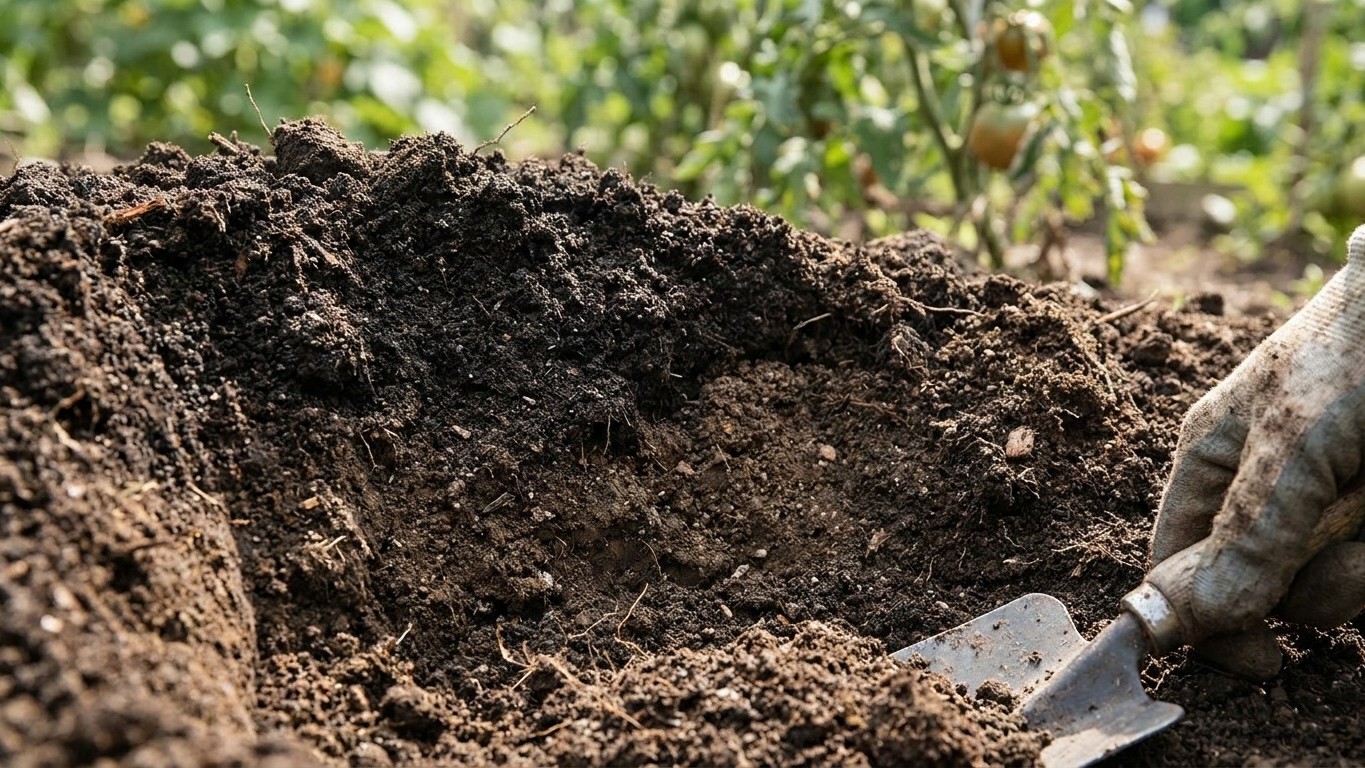

South Dakota’s official state soil is the Houdek series, a deep, dark prairie soil that helped build the Corn Belt. It runs close to neutral, drains well, and carries a decent load of organic matter. But that’s the soil the state chose to represent it, not necessarily what’s under your tomato bed. Here’s what the numbers say, and how to find your own.
What is under your garden

The Houdek series became South Dakota’s legal state soil in 1990, part of a national program through USDA NRCS that gives each state a soil to call its own, the way Colorado has a state bird or Georgia has a state flower. It’s a Mollisol, the soil order that covers most of the Great Plains and is defined by a thick, dark surface layer built up over thousands of years of prairie grass roots dying back and feeding the ground. That dark layer is why Mollisols grow some of the best wheat and corn on the planet.
The measured values come from USDA NRCS Soil Data Access, averaged across 90 mapped components of the series. Surface pH runs about 6.7, which sits right at neutral. Texture works out to a loam: 38 percent sand, 22 percent clay, 40 percent silt, a mix that neither crusts hard like pure clay nor drains straight through like pure sand. Organic matter lands around 3.0 percent, and the series is classified well drained.
| Property | Reading |
|---|---|
| Surface pH | about 6.7 (near neutral) |
| Sand | 38 percent |
| Silt | 40 percent |
| Clay | 22 percent |
| Organic matter | about 3.0 percent |
| Drainage class | well drained |
Now the honest part. A state soil is a representative average, not a guarantee. South Dakota holds hundreds of distinct soil series, and river bottoms, hill country, and any lot a builder scraped or filled with subsoil will read completely differently from the Houdek numbers above. The only way to know what you’re actually working with is to check it yourself.
Reading your own soil in five minutes
Grab a handful of moist soil from a few inches down and squeeze it into a ribbon between your thumb and forefinger. Sand won’t hold together at all. Loam forms a short ribbon, maybe an inch, then breaks. Heavy clay stretches into a long, greasy ribbon two inches or more before it snaps, and it’ll feel sticky doing it.
For a second read, fill a clear quart jar about a third full of soil, top it off with water, shake it hard, and let it sit overnight. Sand drops out within a minute and settles as the bottom layer. Silt follows over the next hour or two. Clay stays suspended longest and forms the top layer, sometimes taking a full day to clear. Whatever’s floating on the surface once it settles is your organic matter. Measure the layers with a ruler and you’ve got a rough percentage breakdown, done at your kitchen table for the cost of a mason jar.
Testing before you amend
Guessing at soil amendments is one of the more expensive habits a gardener can pick up. Lime, sulfur, and fertilizer aren’t cheap, and applying the wrong one, or the right one in the wrong amount, can set a bed back a full season. A lab test costs a fraction of what a bag of amendment does, and it tells you things your eyes simply can’t: exact pH, phosphorus and potassium levels, and often organic matter percentage.
Given the regional pattern, a South Dakota gardener can reasonably expect a pH somewhere near neutral going in. That’s a starting expectation, not a result. Expecting isn’t knowing, and the only way to close that gap is a sample from your own ground.
Taking a sample that means something
- Pick 8 to 10 spots scattered across the bed or lawn area, avoiding spots right next to a foundation, driveway, or old ash pile.
- Dig a small core at each spot, going down to the depth where most roots actually live, usually 6 to 8 inches for vegetable beds.
- Drop all the cores into a clean bucket and mix them together thoroughly.
- Pull about two cups of the mixed soil, let it air dry on a tray for a day, and bag it.
- Label the bag with the location and drop it off or mail it to your county extension office.
What the numbers mean
The report will list pH on a scale where 7.0 is neutral, along with parts-per-million readings for phosphorus and potassium, and usually an organic matter percentage. Most reports come back with a plain-language recommendation attached, telling you how much lime or sulfur to apply per hundred square feet if your number falls outside the range your crops want.
Amending it
The Houdek numbers point toward ground that mostly doesn’t need a pH correction. At 6.7, that surface reading sits comfortably between the thresholds where lime or sulfur become necessary, which means a lot of South Dakota ground can skip pH amendment entirely and put that effort into organic matter instead. But your test result is what matters, not the state average, so here’s what to do if yours lands outside that neutral zone.
If your test comes back below about 5.5
That’s acid ground, and lime is the fix, not sulfur. Acid soil locks up phosphorus so roots can’t reach it, and it makes life miserable for brassicas like cabbage and broccoli, which prefer a sweeter soil. Lime works slowly, moving through the soil profile over one to two full seasons rather than weeks, so apply it in fall for a spring bed.
If your test comes back above about 7.3
Lime should never touch this ground under any circumstance. The fix is elemental sulfur worked in gradually, paired with regular additions of organic matter, both of which nudge pH down over time rather than overnight. High pH also locks iron out of reach for plant roots, and that’s exactly what’s behind yellow leaves with dark green veins on plants like blueberries or azaleas, a classic sign of iron chlorosis.
Heavy clay ground
If your texture skews well past that 22 percent clay figure, organic matter is the long-term answer, compost, aged manure, shredded leaves, worked in every season. Never dump sand into clay hoping to lighten it; the two combine into something closer to concrete than loam. And never work clay soil while it’s wet, since compressing wet clay destroys its structure for a full year or more.
Sandy ground
Soil running heavier on the 38 percent sand side needs the same organic matter treatment, plus a change in habit: shorter, more frequent watering, since sandy ground won’t hold moisture or nutrients in place for long. Clay fixes can take two to three seasons to show real change. Organic matter added to sandy soil often shows a difference within a single growing season.
Drainage and compaction
The Houdek series carries a well-drained rating, meaning water moves through it at a reasonable pace without pooling for hours after a storm. That’s a favorable trait for most vegetables and ornamentals, which hate sitting in standing water at the root zone. Whether your own yard behaves the same way is worth checking directly rather than assuming.
The percolation test
Dig a hole about a foot deep and a foot across, fill it with water, and let it drain completely once to saturate the surrounding soil. Fill it a second time and time how long it takes to drop, then convert that to inches per hour. Anything around 1 inch per hour is solid loam-like drainage. Under half an inch per hour signals a real drainage problem, often compacted subsoil or heavy clay sitting close to the surface.
When to stop fighting the soil
Compaction from foot traffic, riding mowers, or construction equipment can undo good drainage even in naturally decent soil, since compressed particles leave no room for water or air to move through. Double digging used to be the standard fix, but it’s fallen out of favor because it disturbs soil biology and often compacts the layer just below where the shovel stops. On ground that percolates slowly and shows heavy clay in a ribbon test, a raised bed filled with purchased topsoil is often the better bet, saving three seasons of amendment for a result you get on day one.
- Well-drained, moderate percolation: proceed with in-ground beds and standard watering.
- Slow drainage, standing water after rain: raised beds or French drains before planting.
- Heavily compacted, high-traffic areas: core aerate lawns yearly; avoid vegetable beds there entirely.
Local help
South Dakota State University Extension runs soil testing for residents through extension.sdstate.edu. Bring or mail a sample to your county extension office, and staff there will walk through the results with you, translating the lab numbers into an actual amendment plan for your specific bed.
Common questions
What is South Dakota’s state soil and why does it matter?
The Houdek series, a dark, well-drained Mollisol named the official state soil in 1990. It matters because it represents the kind of deep prairie soil that made the region’s farmland productive, though it’s an average, not a guarantee for any single yard.
Is South Dakota soil good for gardening?
The representative Houdek numbers, near-neutral pH, balanced loam texture, decent organic matter, describe favorable garden ground. Actual conditions vary widely by location, especially near new construction or river bottoms.
Do I really need a lab test if my soil looks fine?
Yes. pH and nutrient levels aren’t visible to the eye, and applying lime or sulfur based on a guess can push a bed further from what your plants need.
Should I add sand to loosen up clay soil?
No. Sand mixed into clay tends to bind into a dense, brick-like material. Organic matter added consistently over a few seasons is the proven route to looser, more workable clay.
Related guides
- North Dakota Soil: What You Are Digging Into, and How to Improve It
- Minnesota Soil: What You Are Digging Into, and How to Improve It
- Tennessee Soil: What You Are Digging Into, and How to Improve It
- Idaho Soil: What You Are Digging Into, and How to Improve It
- Iowa Soil: What You Are Digging Into, and How to Improve It