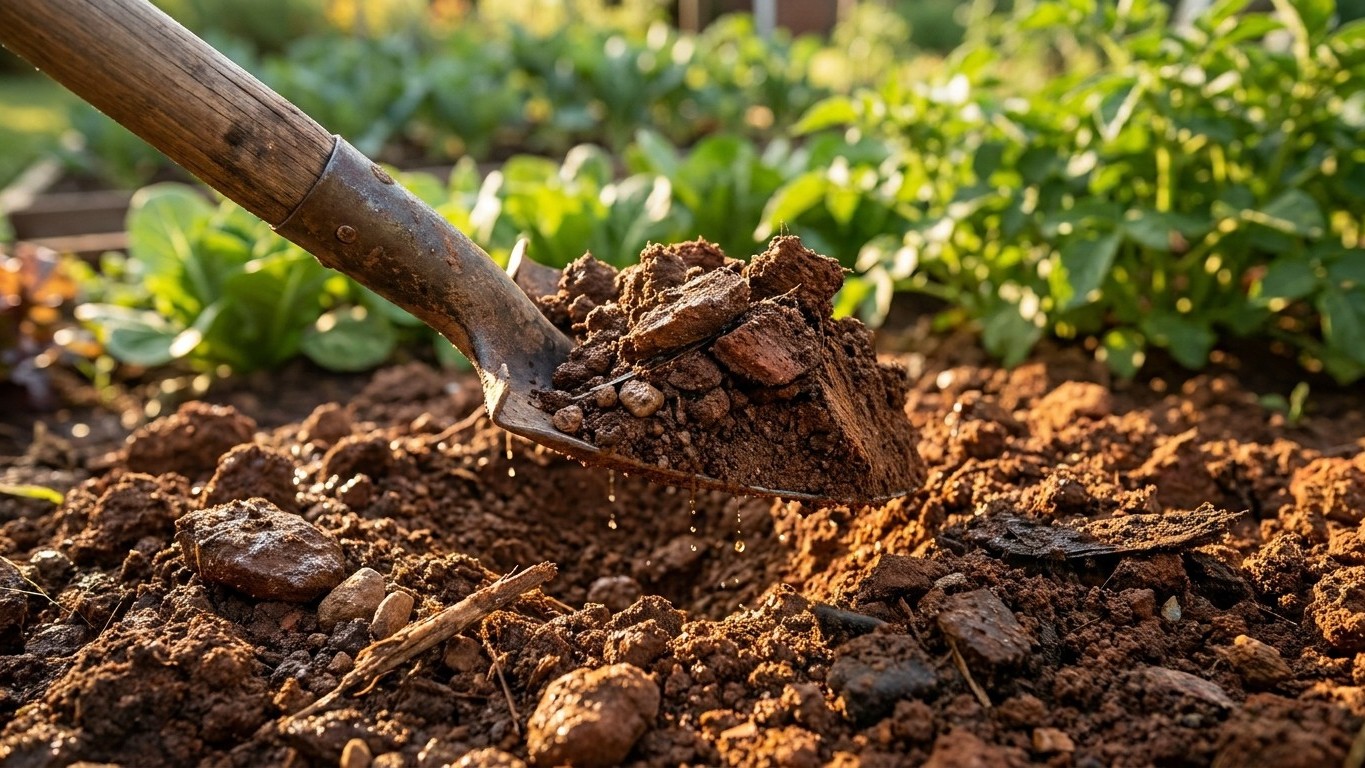

Dig a spade into ground almost anywhere in the state and there’s a good chance you’re standing on some version of the Dickson series, the soil USDA has singled out as representative of Tennessee. It’s old, it’s acid, and it’s not particularly rich. Knowing that changes how you plant, how you water, and what you add to the bed before anything goes in the ground.
What is under your garden

The Dickson series is an Ultisol, a soil order defined by centuries of weathering and leaching in a warm, wet climate. Rain has moved through this ground for so long that it’s stripped out much of the natural fertility, leaving behind a soil that’s naturally acid and short on nutrients before a gardener ever touches it. That’s not a flaw in the dirt so much as its history: Ultisols form under forest cover over long stretches of time, and Tennessee has plenty of both.
Here are the numbers USDA records for the surface horizon of the Dickson series, based on 115 sampled components:
| Reading | Value |
|---|---|
| Surface pH | about 5.0 (strongly acid) |
| Sand | 11 percent |
| Silt | 68 percent |
| Clay | 20 percent |
| Organic matter | about 1.5 percent |
| Drainage | moderately well drained |
That texture works out to a loam to silt loam, which is actually a decent starting point. Silt-heavy soils hold moisture and nutrients better than sandy ground, without the sticky, airless density of heavy clay.
Now the honest part. This is the soil USDA lists as representative of the state, not a measurement of your particular yard. A state this size holds hundreds of mapped soil series, and river bottoms, ridge tops, and hill country all behave differently from one another. If a builder scraped topsoil off your lot before pouring a foundation, or trucked in fill to level a low spot, you’re gardening in something that has nothing to do with Dickson series data. The number above tells you what the region’s ground tends to do; it doesn’t tell you what’s under your tomatoes.
Read your own dirt in five minutes
Grab a handful of moist soil and squeeze it between your thumb and forefinger, pushing it upward into a ribbon. If it barely holds together before crumbling, you’re closer to sand or loam. If it ribbons out an inch or two and feels slick, you’ve got real clay content. Then fill a clear jar about a third full of soil, top it off with water, shake it hard, and let it sit overnight. Sand drops to the bottom within minutes, silt settles in a middle layer over an hour or so, and clay stays suspended before forming a thin top layer by morning. The proportions you see are a rough, free version of a lab texture analysis, and they’ll tell you whether your garden leans toward the Dickson profile or somewhere else entirely.
Testing before you amend
A soil test tells you things your eyes simply can’t: exact pH, phosphorus and potassium levels, sometimes micronutrients like zinc or manganese. Guessing based on how the dirt looks or how plants performed last year is how gardeners end up dumping lime on ground that didn’t need it, or fertilizer that just runs off. Given the strongly acid surface pH the Dickson series carries, it’s reasonable to expect many Tennessee gardens run acid too. But expecting isn’t knowing, and a ten-dollar test settles the question instead of leaving it to a hunch.
Pulling a sample correctly matters as much as sending it in. Follow these steps standing in the garden, trowel in hand:
- Pick 8 to 10 spots scattered across the bed or lawn area, avoiding edges, low spots, and anywhere fertilizer was recently spilled.
- At each spot, dig a small core 4 to 6 inches deep, the zone where most vegetable and lawn roots actually live.
- Drop all the cores into a clean plastic bucket, never a metal one, which can skew micronutrient readings.
- Break up clumps and mix the cores thoroughly by hand.
- Pull about two cups of the mixed soil, let it air dry on newspaper if it’s wet, and bag it for the lab.
- Label the bag with the area it came from if you’re testing more than one bed separately.
When results come back, the pH reading is the number to look at first, since it governs how available every other nutrient is to plant roots. Phosphorus and potassium levels usually come back rated low, medium, or high, with a specific fertilizer recommendation attached. Take that recommendation over any generic bag instructions at the garden store.
Amending it
The Dickson series numbers point in a clear direction: acid ground, moderate clay, low organic matter. Each of those calls for a different fix, and mixing them up wastes both time and money.
Lime for acid soil
With a surface pH around 5.0, lime is the tool that matters most here, not sulphur, which would push already-acid ground further in the wrong direction. Acid soil locks up phosphorus, tying it to iron and aluminum in forms roots can’t reach, which is part of why low-organic, acid ground often shows weak, purplish, phosphorus-starved seedlings even when the nutrient is technically present. Brassicas like cabbage and broccoli suffer particularly badly in strongly acid ground, both in growth and in disease resistance. Agricultural lime, spread according to a soil test recommendation, raises pH slowly. This isn’t a fast fix: lime needs to react with soil moisture over a full season or more, so fall application ahead of spring planting works far better than a rushed spring dose right before seeds go in the ground.
Sulphur, only if pH runs the other way
Not every Tennessee garden matches the Dickson series. Some ground, especially over limestone parent material, tests alkaline instead, with pH above about 7.3. On that ground, lime should never go down, full stop. Elemental sulphur, worked in gradually along with compost and other organic matter, is the slow, honest route back toward neutral. High pH locks iron out of reach the same way low pH locks up phosphorus, and that’s exactly what yellow leaves with green veins on plants like blueberries or azaleas are signaling: the iron is there, but the chemistry won’t release it.
Organic matter for the clay and the low fertility
At 20 percent clay and only about 1.5 percent organic matter, this soil compacts more than sand but drains better than heavy clay. Working in compost, aged leaf litter, or well-rotted manure loosens the clay fraction, feeds the biology that’s currently thin, and buffers pH swings in both directions. One rule holds regardless of what the test says: never work clay-heavy soil when it’s wet, since that just presses out the pore space and creates compaction that takes years to reverse. Never add sand to clay soil either, hoping to lighten it. That combination tends to set up almost like concrete.
Organic matter additions show results within a single growing season. pH correction with lime or sulphur takes three seasons or more to fully shift, which is worth remembering before assuming last year’s amendment failed.
Drainage and compaction
The Dickson series is rated moderately well drained, meaning water moves through it, just not quickly. After a hard rain, expect the surface to stay damp for a day or so rather than puddling for a week, but also not vanishing within the hour the way it would on straight sand.
A percolation test settles the question for a specific bed. Dig a hole about a foot deep and a foot across, fill it with water, let it drain once to saturate the surrounding soil, then fill it again and time how fast the water level drops. An inch or more per hour is solid drainage for most vegetables and ornamentals. Half an inch or less signals a slow-draining spot where root rot becomes a real risk for anything planted directly in the ground.
Compaction compounds the drainage issue fast. Foot traffic across a bed, or a mower and tiller running the same path season after season, presses soil particles together and squeezes out the pore space water and roots both need. Double digging, the old practice of turning soil two spade-depths down, has fallen out of favor because it disrupts soil structure and biology more than it helps, and the compaction often returns within a season anyway.
- On slow-draining spots, skip in-ground beds for anything that hates wet feet and build raised beds instead, filled with a mix that drains on its own terms.
- Avoid walking or driving equipment across garden beds; stick to defined paths.
- Save moisture-loving plants for the naturally low or slow-draining areas rather than fighting the grade.
If a percolation test comes back slow and the bed sits in a low corner of the yard, a raised bed is genuinely the better bet over three years of amending clay that will still be clay underneath. That’s not a failure of gardening, just a read of what the ground is actually doing.
Local help
The University of Tennessee Institute of Agriculture runs soil testing through its Extension service, with county offices across the state. Drop off or mail in a sample, and staff there will walk through the results with you in plain terms, matching the pH and nutrient numbers to whatever you’re planning to grow.
Common questions
Is all Tennessee soil acid?
Much of it trends acid, matching the Dickson series pH of about 5.0, but ground over limestone or altered by construction can test neutral or even alkaline. A test is the only way to know for a specific spot.
How often should I retest my soil?
Every two to three years for an established garden, or yearly while you’re actively correcting pH with lime or sulphur, since those changes happen gradually and are worth tracking.
Can I skip testing and just add compost every year?
Compost helps almost any soil and rarely causes harm, but it won’t correct a strongly acid or alkaline pH on its own. Skipping the test means guessing at lime or sulphur needs, which can waste money or overshoot the target.
Why does my soil test differently from my neighbor’s a block away?
Soil series can change over surprisingly short distances, and fill dirt, old construction sites, or even a previous owner’s amendments can leave one yard behaving nothing like the one next door.