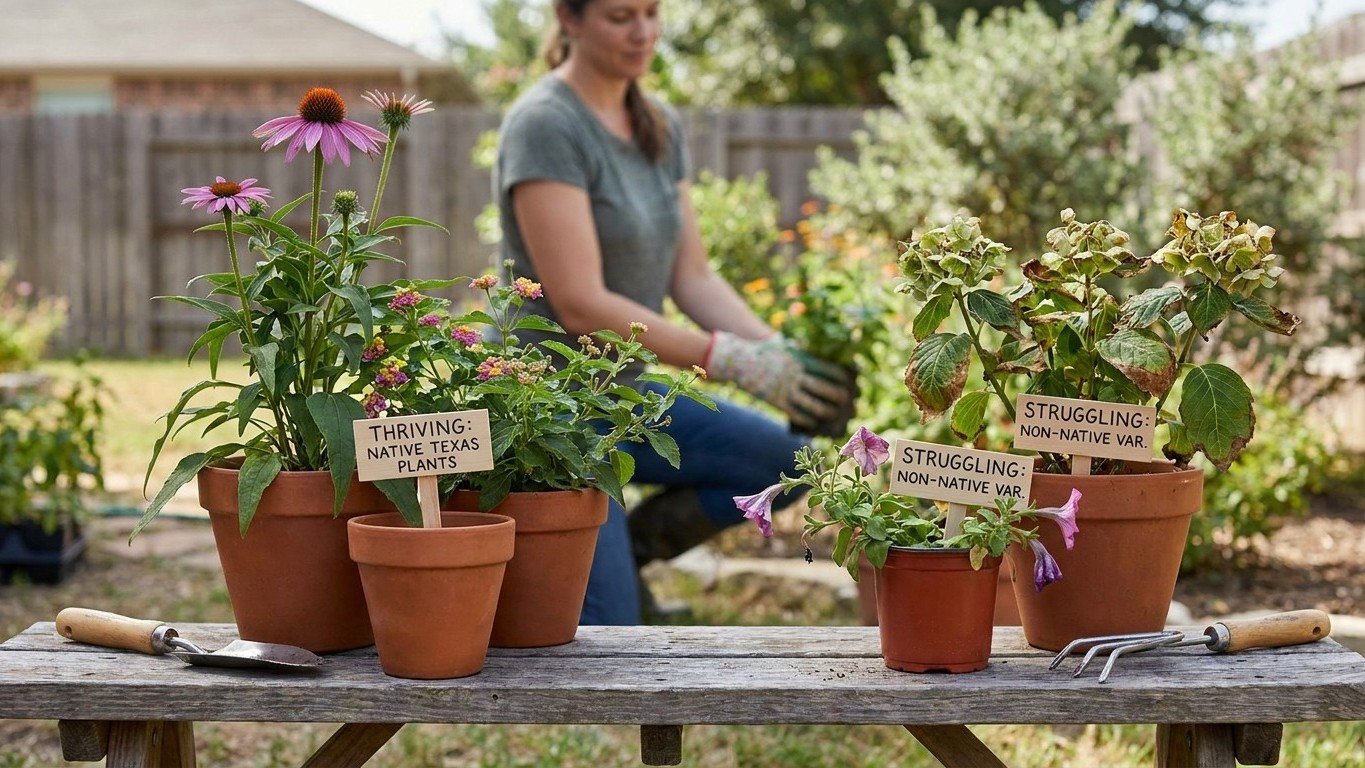

Texas flowers that thrive share two traits: tolerance for punishing summer heat and enough cold hardiness to survive whatever winter your part of the state delivers. The USDA Plant Hardiness Zone Map, using 1991-2020 climate normals, places Texas across zones 6a to 10a, a spread wide enough that a plant thriving in the Rio Grande Valley can die outright in the Panhandle. Before buying anything, find your county’s zone on the USDA map and check it against the plant tag, not against what a Houston nursery has on the shelf.
What thrives in Texas

Some flowers just won’t make it through a Texas summer, and some barely notice it. The ones that survive share a few habits: deep roots that can hunt down water, tough little leaves that shed heat, and a tolerance for soil that turns from mud to brick in the same year. Start by finding your zone on the map and matching it against the tag before you buy anything — that one check saves you from planting something bred for a mild spring that has no idea what’s coming in July.
The plants that hold up combine a few traits: deep or fibrous root systems that reach moisture during dry spells, leaf surfaces that shed heat (small, silvery, or leathery leaves rather than broad soft ones), and tolerance for both wet clay in spring and baked soil in August. Families that consistently deliver this combination in Texas include the aster family (zinnia, coneflower, lantana), the mallow family (hibiscus, hollyhock), and the mint family (salvia, and other tough perennial herbs grown ornamentally).
Plants that reliably struggle
Cool-season flowers bred for mild, even summers are the main casualties. Delphinium, lupine, and most pansies fade fast once the 90-degree days stack up. Anything described on a tag as needing “full sun, cool nights” is describing a climate Texas does not have from roughly May through September.
- Delphinium: collapses in humid heat, better treated as a one-season spring flower here
- Lupine: short-lived once soil temperatures climb, needs excellent drainage it rarely gets in clay
- Sweet pea: finishes blooming before the real heat starts, then dies back completely
- Astilbe: wants consistent moisture and part shade cooler than most Texas summers offer
Gardeners working with a growing season measured in weeks rather than months, the kind covered in our guide to flowers that thrive in Alaska, are solving the opposite problem: not enough heat to finish a bloom cycle at all. Texas gardeners rarely think about season length. They think about survival past the fourth 100-degree day in a row.
Native plants worth the space
A plant native to the region has already solved the local problems: it knows how to ride out a Gulf Coast humid spell and a Hill Country drought in the same year, because its ancestors did it for thousands of years without irrigation. Once established, usually after their first full year in the ground, natives need far less supplemental water than imported ornamentals, which matters given how many days a year push past 90°F.
Indian blanket (Gaillardia pulchella), a red-and-yellow daisy-flowered annual that reseeds itself freely, is native to much of the southern and central United States including Texas prairies and roadsides. Texas lantana (Lantana urticoides), with its clustered orange-and-yellow flower heads that shift color as they age, is native to the state and tolerates both drought and heat without complaint. Turk’s cap (Malvaviscus arboreus), a shade-tolerant shrub with small red spiraled flowers, is native to Texas and much of the Gulf region and keeps blooming into fall when little else does.
What natives bring for pollinators
Purple coneflower (Echinacea purpurea), native across much of the central and eastern United States, draws native bees and butterflies with its raised orange-brown cone and drooping pink-purple petals. Black-eyed Susan (Rudbeckia hirta) does the same with its bright yellow petals and dark central disc. Milkweed species native to Texas prairies are the only host plant monarch caterpillars can eat, so a Texas border without at least one milkweed is a border monarchs pass over entirely.
The tradeoff with natives is polish. They tend toward looser, wilder growth habits than hybridized bedding plants, and a few, like Indian blanket, reseed aggressively enough to need thinning. That is a small price for a plant that does not need daily watering once it has a season of root growth behind it.
Perennials that come back

Whether a perennial returns next spring in Texas depends less on the plant’s overall reputation and more on where your specific property sits inside the state’s 6a-10a range. A tag that says “hardy to zone 7” is a promise at the Gulf Coast end of that range and a gamble in the Panhandle. Read the tag’s low-end zone number, then compare it to your county’s zone on the USDA map, not to the zone printed on a bag of soil amendment from a big-box store two states away.
| Plant | Catalogue hardiness | Behavior across Texas |
|---|---|---|
| Autumn sage (Salvia greggii) | Zones 6-9 | Reliable perennial through most of the state, evergreen in milder winters near the coast |
| Esperanza (Tecoma stans) | Zones 9-11 | Perennial only at the Gulf Coast end of the range, grown as an annual or cut back hard further inland |
| Hardy hibiscus (Hibiscus moscheutos) | Zones 4-9 | Dies to the ground each winter and returns from the roots almost statewide |
| Lantana (Lantana camara cultivars) | Zones 8-11 | Root-hardy near the coast, killed to the ground or outright in colder inland winters |
This is the same logic gardeners in cooler, wetter climates use with their own zone maps. Someone reading our guide to flowers that thrive in Oregon is matching plants to a narrower, milder range. In Texas the range is so wide that “perennial” can mean two completely different planting decisions depending on which end of the state you garden in.
NOAA’s 1991-2020 climate normals put the mean low of the coldest month at Houston at 43.7°F, which is why many plants marginal elsewhere behave as true perennials near the Gulf Coast. Inland and northward, that same plant tag becomes a warning label rather than a guarantee.
Putting a border together
Height layering keeps a Texas border from turning into a flat mat of color by July. Put the tallest plants, hardy hibiscus or esperanza where it survives, at the back or center of an island bed. Mid-height fillers like autumn sage and lantana come next, and low front-edge plants like Indian blanket or trailing verbena finish the view. This is standard border design anywhere, but in Texas it does double duty: the taller plants shade the soil around the shorter ones, cutting moisture loss during those 90-plus-degree stretches.
Succession and repetition
Texas has a long enough season that a border can carry three distinct bloom waves: spring natives and reseeding annuals, a punishing midsummer stretch carried almost entirely by heat-tolerant perennials like lantana and salvia, and a fall rebound as coneflower, Turk’s cap and asters pick back up once the daily high count starts dropping. Plan for the July gap first, since that is the stretch that kills borders designed only around spring nursery inventory.
Repeat colors in groups of three to five plants rather than scattering one of everything. A single Turk’s cap here and one salvia there reads as clutter. Three salvias in a drift, repeated again twenty feet down the border, reads as a design. Leave real space between young plants based on their mature width printed on the tag, not the small pot size they arrive in. A hardy hibiscus that looks lonely at three feet apart in April will meet its neighbor by August.
Local help
Texas A&M AgriLife Extension keeps county-level plant lists and hosts the state’s Master Gardener program, and either is a better source for what actually performs in your specific county than a general list like this one. Find your county office and current plant recommendations through the extension service before committing a border to anything marginal for your zone. Our broader collection of Texas guides covers related seasonal planting questions for the same climate.
Common questions
What flowers bloom all summer in Texas heat?
Lantana, Salvia greggii, and Texas lantana are the three most dependable season-long bloomers through the hottest stretch, since all three tolerate the extended run of 90-plus-degree days that NOAA’s Houston normals put at over 100 annually. Deadheading extends the bloom on all three but is not strictly required to keep them flowering.
Why did my hibiscus not come back this year?
Hardy hibiscus (Hibiscus moscheutos) is reliably perennial across most of Texas, but tropical hibiscus (Hibiscus rosa-sinensis), often sold at the same nurseries, is not hardy outside the mildest parts of the state and dies outright in a hard freeze. Check which species you actually bought before assuming the plant failed.
Can I plant the same flowers in Houston and in the Panhandle?
Some, but not all. Texas spans USDA zones 6a to 10a, and a plant rated hardy only to zone 8 or 9 will survive winters at the Gulf Coast end and die in a Panhandle winter that runs colder and longer. Always check the plant tag’s hardiness zone against your own county, not against a Houston-based list.
Do I need to water native Texas flowers once they’re established?
Rarely, and only during extended drought stretches beyond what the plant’s root system was built for. Most Texas natives need regular water only through their first year while roots establish, after which they draw on moisture reserves deep enough that supplemental watering becomes optional rather than routine.
Related guides
- Flowers That Actually Thrive in New Mexico, and the Ones That Struggle
- Flowers That Actually Thrive in Oklahoma, and the Ones That Struggle
- Flowers That Actually Thrive in Alaska, and the Ones That Struggle